
Following Jesus’ crucifixion, John 19:38–42 describes the burial of His body, a moment of devotion amidst fear and uncertainty. This passage introduces Joseph of Arimathea and Nicodemus, two figures who step forward to honour Jesus in death. This study explores the significance of Jesus’ burial, Jewish customs, the garden tomb’s possible locations, and the disciples’ limbo, encouraging Christians to proclaim their faith boldly. The burial of Jesus reveals both human fear and profound devotion, pointing to the hope of resurrection.
Here’s the passage in full : John 19:38–42 (ESV)
“After these things Joseph of Arimathea, who was a disciple of Jesus, but secretly for fear of the Jews, asked Pilate that he might take away the body of Jesus, and Pilate gave him permission. So he came and took away his body. Nicodemus also, who earlier had come to Jesus by night, came bringing a mixture of myrrh and aloes, about seventy-five pounds in weight. So they took the body of Jesus and bound it in linen cloths with the spices, as is the burial custom of the Jews. Now in the place where he was crucified there was a garden, and in the garden a new tomb in which no one had yet been laid. So because of the Jewish day of Preparation, since the tomb was close at hand, they laid Jesus there.”
Secret Disciples: Joseph and Nicodemus
Joseph of Arimathea, a wealthy member of the Sanhedrin, is described as a “secret disciple” of Jesus, concealing his faith due to fear of the Jews. His position in Jewish society made public allegiance to Jesus risky, potentially threatening his status and safety. Yet, in a bold act, Joseph approaches Pilate to request Jesus’ body, an action that could have exposed him to scrutiny. Similarly, Nicodemus, who previously visited Jesus at night (John 3:1–2), likely out of fear, joins Joseph in this act of devotion. He brings approximately seventy-five pounds of myrrh and aloes, an extravagant amount of spices, signaling his commitment. Their actions challenge modern Christians to examine their own faith. Many face pressure to hide their beliefs in hostile or secular environments. Rather than concealing faith, believers are called to proclaim it sensitively but unashamedly, as Jesus instructs in Matthew 5:16: “Let your light shine before others.” How can we move from secrecy to courageous witness in our daily lives?
Jewish Burial Customs in the Passage
In the first century, Jewish burial practices were rooted in respect for the deceased and adherence to purity laws. Deuteronomy 21:23 required prompt burial to avoid defilement, especially before the Sabbath. The body was typically washed, wrapped in linen cloths, and anointed with spices like myrrh and aloes to honor the deceased and mask the odour of decay. In John 19:38–42, Joseph and Nicodemus meticulously follow these customs. They wrap Jesus’ body in linen with the spices Nicodemus provides, a quantity far exceeding typical burials, reflecting deep reverence. Their care fulfills Isaiah 53:9, which prophesies the Messiah’s burial with the rich. This deliberate act underscores Jesus’ dignity, even in death.
The Garden Tomb: Location and Significance
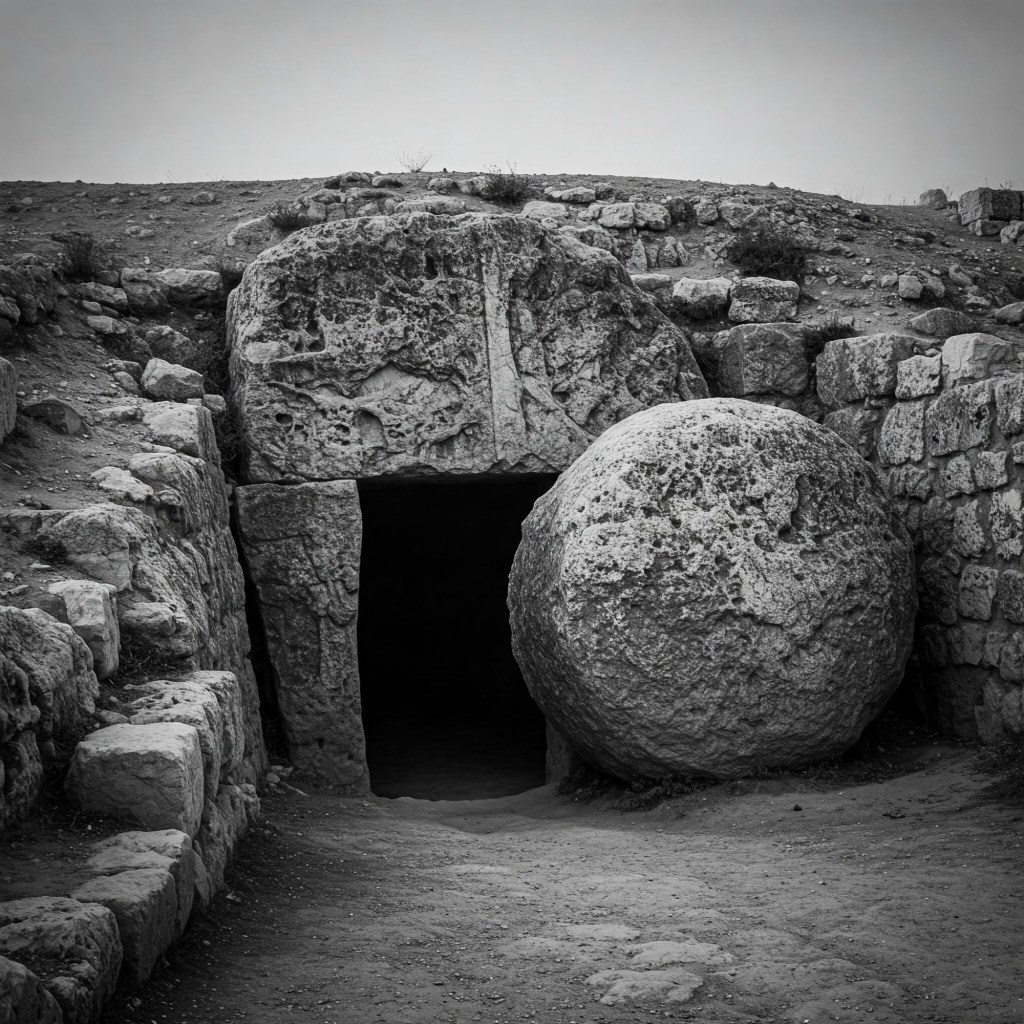
John 19:41 describes the burial site as a new tomb in a garden, unused by anyone else. Joseph’s offering of his own tomb represents a personal sacrifice. Theologically, the tomb is a temporary resting place, foreshadowing the resurrection. Two possible locations in Jerusalem are associated with this site. The Garden Tomb, located north of the Damascus Gate, is favored by some Protestants for its serene, garden-like setting and rock-hewn tomb, fitting John’s description. Alternatively, the Church of the Holy Sepulchre, supported by early Christian tradition and archaeological evidence of first-century tombs, is widely accepted by Catholic and Orthodox traditions. If you would like my opinion, I favour the Garden Tomb location over the Holy Sepulchre .But I am no biblical archaeologist! 
Regardless of the exact site, the garden tomb invites believers to trust God’s redemptive plan, even in moments of apparent defeat.
The Disciples’ Limbo and Our Hope
For the disciples, Jesus’ death was a devastating blow. They believed Him to be the Messiah, yet witnessed His execution, leaving them in fear and confusion. Unaware of the resurrection to come, they faced a limbo of shattered hopes. Their vulnerability reflects the human struggle with uncertainty. In contrast, modern believers have the benefit of hindsight, knowing that Resurrection Sunday follows Good Friday. This perspective transforms despair into hope, as Paul writes in 1 Corinthians 15:20, describing Christ as “the firstfruits of those who have fallen asleep.” The disciples’ experience encourages Christians to hold fast to faith during trials, trusting that God’s plan unfolds according to his will. 
So what do we do? 
Joseph and Nicodemus, once secretive, acted with courage to honour Jesus in His burial. Their example challenges us to proclaim our faith boldly, even in difficult circumstances. We are called to trust in the resurrection hope, knowing that God’s victory overcomes life’s darkest moments.
The darkness of Friday has been and gone, and we find ourselves in the limbo of its aftermath. Fear not though, Sunday is coming…
- Counting the Cost of Comfort (Matthew 8:19-20)
- A Determined Desire: Choosing a Life of Integrity (Psalm 101:2)
- A Heart Captivated: The Foundation of a Godly Life (Psalm 101:1)
- The Richness Within: Christ, Chorus and Christian Community (Colossians 3:16)
- The Sovereign’s Vow (Introduction to Psalm 101) 
 Andy Brown
Thank you for sharing this excellent reflection on burial of our Lord and what it meant to those involved. Too often we never think of the risks taken by Joseph and Nicodemus in aligning themselves with Jesus in His death. It challenges us to consider what we are willing to risk for our Lord. We truly are privileged to have the whole story, and to know that Resurrection Sunday is coming – hallelujah! God bless you and your family this special weekend brother 🙏
LikeLike
Joseph and Nicodemus became public by caring for the body of Jesus when it seemed all was lost and over. But then Sunday happened. I wonder what became of Joseph and Nicodemus after the resurrection. The resurrection dramatically changed the disciples.
LikeLiked by 1 person
It’s a good question, and I have no idea. I wonder if history records anything else about them?
LikeLiked by 1 person
We will find out in heaven 🙂
Not sure about historical records
LikeLiked by 1 person
Well, the other gospels suggest he was definitely searching for the kingdom of God…
Mark 15:43 (NLT)
43 Joseph of Arimathea took a risk and went to Pilate and asked for Jesus’ body. (Joseph was an honored member of the high council, and he was waiting for the Kingdom of God to come.)
LikeLiked by 1 person
Hope your resurrection Sunday went
LikeLiked by 1 person