Starving for God’s Truth (Amos 8:11) 

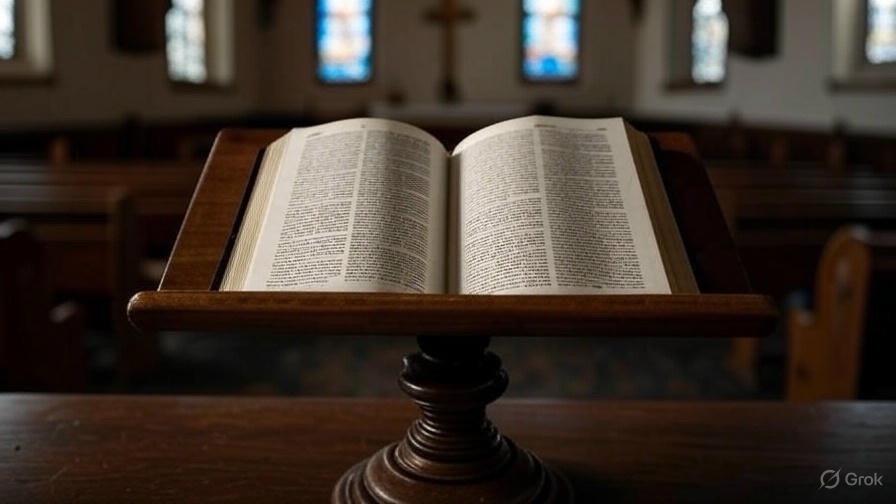
A blank Bible on a lectern indicating a famine of God‘s word 

In Amos 8:11, the prophet delivers a stark warning from God: “‘The days are coming,’ declares the Sovereign Lord, ‘when I will send a famine through the land—not a famine of food or a thirst for water, but a famine of hearing the words of the Lord.’” This Old Testament passage describes a divine judgement where God withholds His word as punishment for persistent disobedience. In our modern day, surrounded by unprecedented access to Scripture, this warning remains profoundly relevant, exposing a spiritual famine amidst apparent abundance.

In ancient Israel, God’s word through prophets was a lifeline, guiding the nation in covenant faithfulness. When the people embraced idolatry and injustice, God’s response was sometimes silence—a withdrawal of His voice. Amos 8:12 elaborates, stating that people would “stagger from sea to sea… searching for the word of the Lord, but they will not find it” (NIV). This spiritual famine was a deliberate act of judgement, leaving the nation desolate. Similarly, Hosea 4:6 declares, “My people are destroyed from lack of knowledge. Because you have rejected knowledge, I also reject you as my priests.” Here, God links spiritual ignorance to rejecting His truth, a precursor to the famine Amos foretells.

Today, such a famine seems unlikely. Smartphones and tablets provide instant access to countless Bible translations, sermons, and commentaries. A quick search yields devotionals, theological podcasts, and Christian blogs (including this one ). Yet, Amos’s warning persists. Despite this digital abundance, many churches fail to proclaim the full counsel of God’s word. Some prioritise uplifting messages over the call to repentance and faith in Christ. Others dilute the gospel, avoiding the reality of sin or the truth that “there is no other name under heaven given to mankind by which we must be saved” (Acts 4:12). This selective preaching creates a modern famine—not of Scripture’s availability, but of its faithful proclamation.

Consider the state of many churches. Is the gospel preached clearly, pointing to Christ’s atoning work and the need for repentance? Too often, sermons focus on self-help or cultural trends, neglecting the transformative power of God’s word. Hebrews 4:12 reminds us that Scripture is “living and active, sharper than any double-edged sword,” yet its edge is blunted when churches sidestep its harder truths. This echoes the judgement of Amos 8:11: God’s word is present, but its clarity and authority are withheld from those who refuse to heed it. Isaiah 55:2 questions, “Why spend money on what is not bread, and your labour on what does not satisfy?”—a challenge to those chasing spiritual substitutes over God’s truth.

This famine manifests in congregations unaware of biblical doctrines or unprepared to confront sin. It appears where the gospel is reduced to moralism, leaving souls hungry for the true “bread of life” (John 6:35). As believers, we must seek churches that faithfully proclaim God’s word in its entirety, urging repentance and pointing to Christ. We must also examine our hearts, ensuring we don’t contribute to this famine by ignoring Scripture’s call to holiness.

Amos 8:11 challenges us to hunger for God’s word, not merely its accessibility but its faithful preaching. Let’s pray for churches to boldly declare the full counsel of God, lest we wander in a self-inflicted famine, searching for truth we’ve chosen to ignore.

Transcript: Finding Hope in the midst of Turmoil -Unpacking Mica 5

For those who prefer to read rather than listen, here is a transcript of the sermon I preached yesterday on Mica five. Enjoy

Good morning everyone! It’s a pleasure to share some thoughts on a truly profound passage from the Bible today. Please forgive my notes – it’s a complex piece of scripture, and I wanted to do it justice! It has nothing to do with my age or memory, I promise!
Let’s begin with a prayer:
Father, we thank You so much for Your Word this morning. Thank You for gathering us together, Your people, to worship You. We thank You for Your majesty and Your presence among us. We thank You for this passage before us. Please help us to understand it, to learn from it, and to learn about You. We pray that what we learn today, Lord, we will apply in our lives, in Jesus’ name. Amen.
Now, who read Micah chapter 5 and fully understood it? Anyone? No? I’m not surprised! It’s quite a tricky passage, isn’t it? Even after reading many commentaries, I don’t think any single one fully agrees on its meaning. So, we’ll do our best this morning!
Layers of Meaning: Like Wallpaper in an Old House
Have you ever moved into a new house and had to decorate a room with ghastly wallpaper? You start to peel it off, only to reveal an even more hideous layer underneath. You keep going, layer after layer, until you finally expose the bare wall. I see today’s passage a little like that – lots of layers.
Micah’s prophecy moves from his present day to a future time. The clear references to Jesus and Bethlehem remind us of the coming great ruler. So, Micah is talking about his contemporary situation, but also a future time as well. It can be a little tricky to know which period he’s referring to at any given moment, but we’ll do our best.
A Quick Refresher: Understanding Micah
For those who might be new to Micah, he was a prophet around the 8th century BC, perhaps 720 BC. He spoke a lot about the Northern Kingdom of Israel and the Assyrian Empire’s threat to them. He was primarily addressing Judah, the Southern Kingdom, but often used the Northern Kingdom as a reference point. Sometimes the Bible refers to ‘Israel’ as the Northern Kingdom, sometimes as the Southern Kingdom (‘Judah’), and sometimes as the collective Israelites, the people of Israel. It can get a bit confusing, which is why some Old Testament passages are hard to follow. Do keep that in mind as you read.

  • Chapter 1: Micah focused on the people’s idolatry and their judgment for it.
  • Chapter 2: He addressed sins against the people, such as mistreating the poor and widows.
  • Chapter 3: This chapter dealt with the sins of the leaders.
  • Chapter 4: Here, the focus shifts to the ‘Mountain of the Lord’ – a hopeful, future time when all people would flow to it, perhaps referring to the coming of Jesus. It also mentions the Assyrian Empire again.
    Micah 5:1 – A Disputed Beginning
    Micah 5:1 often sparks debate about its placement. In the Hebrew Bible, it’s actually at the end of chapter 4. One commentary I read couldn’t understand why anyone would put it at the start of chapter 5. I have a theory why, though I might be completely wrong!
    We’re only looking at six verses this morning, but they are packed with powerful imagery. We must stay rooted in Micah’s immediate context: he’s speaking to people living under the looming shadow of the Assyrian Empire. While some of the prophecy certainly looks ahead, it’s easy to get lost in the imagery and forget the immediate concerns of his audience.
    Jerusalem Under Siege and Humiliation (Micah 5:1)
    Verse 1 says: “Marshal your troops, city of troops!” This refers to Jerusalem, though it’s called the ‘city of troops’ rather than ‘Jerusalem’ or ‘Daughter Zion’. It describes Jerusalem under siege, a dangerous time as the Assyrian Empire gathers.
    Then it says, “They will strike the ruler of Israel on the cheek with a rod.” This is a powerful image of humiliation. While it could be a physical blow, striking someone on the cheek with a rod was primarily about public shame. When Jesus spoke about ‘turning the other cheek’, it wasn’t about inviting further blows, but about refusing to engage in a cycle of humiliation. This is about Jerusalem, the great city of God, facing profound humiliation.
    From Humiliation to Hope: The Rise of Bethlehem (Micah 5:2)
    Then the passage shifts gears dramatically to Bethlehem: “But you, Bethlehem Ephrathah, though you are small among the clans of Judah, out of you will come for Me one who will be ruler over Israel, whose origins are from of old, from ancient times.”
    This is why I believe verses 1 and 2 belong together. You have the powerful capital city of Jerusalem, under siege and its leader humiliated, facing God’s judgement. Yet, Bethlehem, this tiny village, just a few miles from Jerusalem, the home of David, is contrasted with this mighty city. From this humble place, God calls forth a great ruler.
    Ron Hamilton and the Power of Humble Beginnings
    Have you ever heard of Ron Hamilton? He’s from Rutherglen in Scotland. Ever used daily disposable contact lenses? Well, Ron Hamilton invented them, from that small fishing village. From humble origins, a technology emerged that affects countless lives.
    In a similar way, from Bethlehem, this small town, a great ruler would be called forth by God.
    Bethlehem: The House of Bread
    Do you know what the name Bethlehem means? ‘House of Bread’. ‘Beth’ means house (think of Bethsaida, or Bethany), and ‘lechem’ means bread. So, Bethlehem is the “House of Bread”.
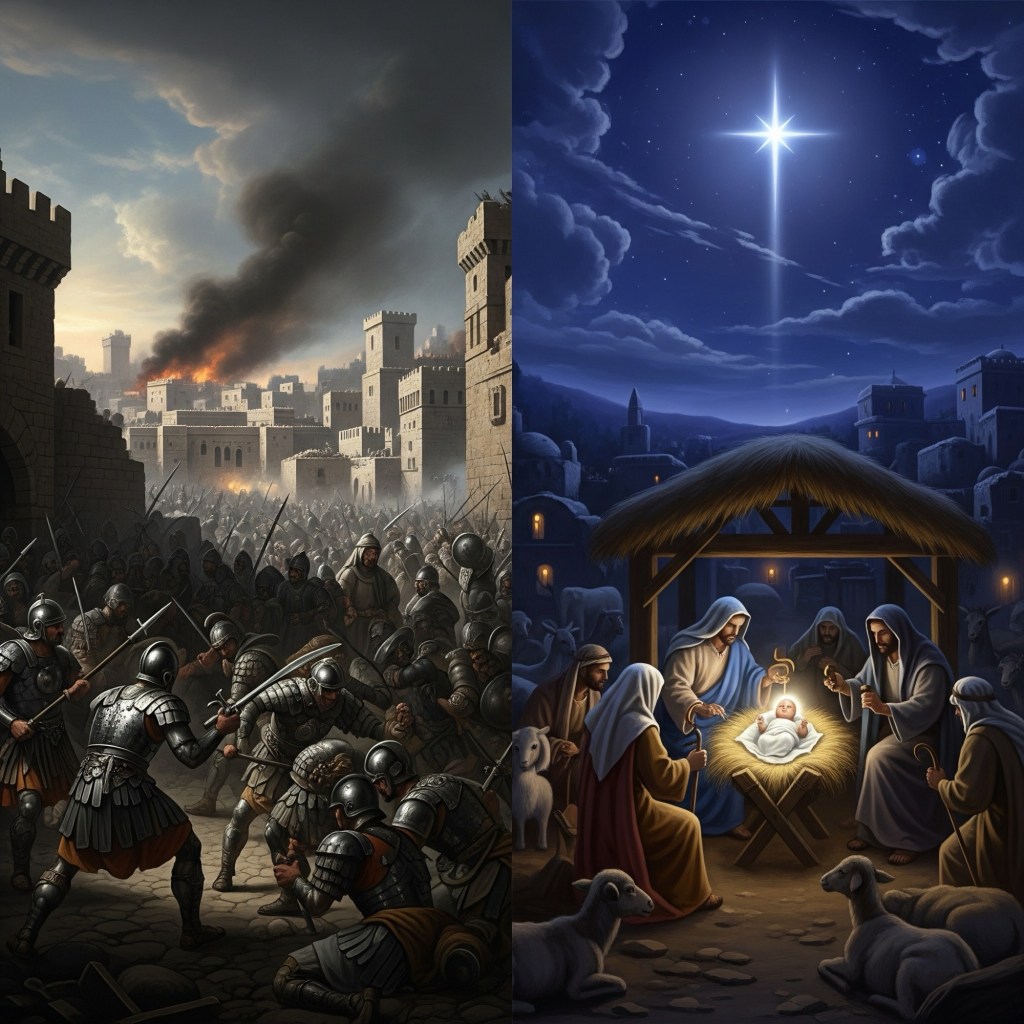
    It’s fascinating how this links to the Christmas story. In Matthew chapter 2, the wise men follow the star, arrive in Jerusalem, and Herod asks the teachers of the law where the Christ is to be born. They quote Micah 5:2, saying, “He will be born in Bethlehem.” And it’s from this ‘House of Bread’ that Jesus, who later declares, “I am the bread of life,” comes forth. There’s a beautiful connection here.
    A Ruler From Ancient Times
    The verse also states that this ruler’s “origins are from of old, from ancient times.” This isn’t just a regular human leader. This suggests a divine, Messianic figure, someone special. As Christians, we immediately think of Jesus. Micah looks ahead to a time when, despite Israel and Judah’s present troubles, God would call forth a ruler from ancient times, one who would be their deliverer.
    Israel Abandoned, Then Reunited (Micah 5:3)
    Verse 3 is interesting: “Therefore Israel will be abandoned until the time when she who is in labour gives birth and the rest of his brothers return to join the Israelites.”
    This idea of Israel being abandoned could be their punishment for turning their backs on God. We know the Northern Kingdom was carried away by the Assyrians, and while Judah avoided the Assyrians, they fell to the Babylonians and went into exile. This was God’s judgment.
    We see this throughout Israel’s history: periods of trouble and exile under the Assyrians, Babylonians, Persians, Greeks, and Romans. But the verse sets a time limit: “until the time when she who is in labour gives birth to a son.” This clearly refers back to Bethlehem and the idea of this ruler from ancient times. It’s a picture of Israel giving birth to the Messiah. This could signify an end to their troubles with the coming of the Messiah.
    For us, it’s hard not to connect the ‘woman in labour giving birth to a son’ with Mary giving birth to Jesus.
    The Rest of the Israelites and the Church
    The passage then speaks of “the rest of his brothers return to join the Israelites.” Some people link this to the modern nation of Israel being formed in 1948 and 1967, and the gathering of scattered Jewish people. While I understand why some make that connection, I personally don’t think it refers to the current nation of Israel.
    Looking at the news today, it’s clear that the nation of Israel is not living securely. We don’t want to lose sight of God’s covenant with Abraham, promising descendants as numerous as the stars and sand, and a specific land. But I don’t believe this passage should be interpreted as referring to the modern political entity of Israel.
    Instead, I think the idea of Jesus, the Messiah, uniting the rest of the brothers to join the Israelites, could be a reference to the Church. It could be about Gentiles coming to believe in Jesus and being united with God’s people, the Israelites, forming this new entity, the Church, where believers live for God.
    The Shepherd King and His Greatness (Micah 5:4)
    Verse 4 tells us: “He will shepherd His flock in the strength of the Lord, in the majesty of the name of the Lord His God. And they will live securely, for then His greatness will reach to the ends of the earth.”
    This idea of a ruler being a shepherd is fascinating. Again, Jesus declared, “I am the good shepherd.” So, this ruler is not only the ‘bread of life’ but also the ‘great shepherd’. He will shepherd His flock in the ‘majesty of the name of the Lord His God’. That word ‘majesty’ resonates when we worship and feel God’s powerful presence.
    His greatness “will reach to the ends of the earth.” This certainly points to Jesus. There are few places in the world today where Jesus’ name isn’t known. The Church began humbly in Jerusalem and spread to Judea, and then to the rest of the world. The Gospel is being preached everywhere, and we look forward to the day when it truly reaches every place, giving everyone the opportunity to know Jesus. This could also refer to a future time when Jesus returns and establishes His kingdom.
    Our Peace and Deliverance (Micah 5:5)
    Verse 5 is powerful: “And He will be our peace.” This immediately reminds us of the Christmas story, linked so well to Bethlehem. The first people to hear about Christ’s birth were the shepherds, and the angels proclaimed, “Peace on earth.” This coming ruler will be our peace.
    However, Micah immediately links this back to the Assyrian invasion. He says that this ruler “will raise up seven shepherds, even eight commanders.” This is a common Hebrew phrase, meaning ‘X and X plus one’, used for emphasis. You see it in Proverbs (“There are six things… yes, seven…”) or Amos (“For three sins… even four…”). It’s a Hebrew way of emphasising a complete and abundant number. So, it’s probably not literally seven or eight people, but a sufficient and abundant number of leaders. Seven often represents completeness in the Bible, and eight could symbolise abundance.
    These shepherds will “rule the land of Assyria with the sword, the land of Nimrod with the bare blade. He will deliver us from the Assyrians when they invade our land and march across our borders.” Nimrod, mentioned here, is a character from Genesis 10, often translated as a ‘great hunter before the Lord’, but actually meaning ‘against the Lord’. He’s an antagonist. This speaks of the enemies of Israel, the Assyrians and their allies. The sword here simply means a sword, not a metaphor for the Word of God, as some suggest.
    This is a message of hope: when the Assyrians come, God will raise up sufficient leadership to deliver His people from this difficult time. The simple words “He will deliver us from the Assyrians” are enough. That’s the hope they could cling to.
    What Does This Mean for Us Today?
    So, what can we take from this rich passage? There’s so much to think about, from contact lenses to the Bread of Life! But what can we do with it in our lives?
    I think the final phrase, “He will deliver us from the Assyrians,” holds the key. It means we can have hope and trust in God that He will make things right. This isn’t a prosperity gospel – I’m not saying God will fix all your problems immediately. We know that’s not true. Israel faced centuries of trouble and difficulty. God never promised a life free of pain.
    But in the midst of troubled times, God’s message was: there is hope. There is someone we can trust. There is a future to look forward to. Micah was speaking to his contemporaries, but also looking ahead to a future time when God would make everything right.
    Perhaps that won’t be on this side of eternity. But we can trust that God is our deliverer. He brings us hope, and if we trust in Him, we know we have a future in heaven, a time where we can rise above all the troubles of this life and know that He will make everything right.
    Whatever you’re in the middle of today – doubt, financial difficulty, health concerns, or simply feeling under siege – passages like this remind us that God has a plan. Even in trouble, we can trust and hope in Him, knowing that one day He will deliver us. Whether that hope is realised in this life or the next, God is a God of eternity. We need to be eternally minded, not solely earthly minded. While I wish I could tell you God will fix all your problems in this life, that’s not what we see. But we know He will fix everything in the next. These passages tell us we can trust in that hope God gives.
    I hope that’s encouraging to you this morning, and that you’ve learned a few things from this passage.
    Shall we pray?
    Father, we thank You for the Book of Micah. Thank You for the prophetic message given to the people of Israel and Judah in those days. We thank You and hope it was an encouragement to them. May we too see Your Word as a great hope for us. We thank You for hope, and that even when the enemy is at our door, when we face troubled times, Lord, we trust in You. Not that You’ll necessarily deliver us from every problem and pain in our life, but that You’ll be right there with us. You have promised never to leave us, never to forsake us. Lord, we know that even if we face troubles in this life, You have a plan, and we trust and hope in You. Help us to learn from Your people, who so often turned their backs on You, and help us not to turn our backs on You, Lord, but to follow You more heartily. May we lean on You and trust You. As we pray today, bless us as we think about Your Word, and what it means. We thank You, Lord Jesus, that You stepped down into this world, into this world of trouble and difficulty. You didn’t demand we lift ourselves up, but You left Your heavenly throne, came to earth as a baby in Bethlehem. We always think that Your Word is true and powerful. We thank You that You came to set us free. We pray we would follow You with our whole hearts. In Jesus’ name. Amen.
    Thank you.

Finding Hope in the Midst of Turmoil: Unlocking Micah 5

As always, it was a pleasure to preach at our church this morning. Today’s passage was particularly challenging, and I must admit I found it quite hard to bring the message together. Here’s the passage, followed by the audio of what I said. Apologies for the audio quality which was not the best.

Micah 5:1-6 (NLT)
1 Mobilize! Marshal your troops!
The enemy is laying siege to Jerusalem.
They will strike Israel’s leader
in the face with a rod.
A Ruler from Bethlehem
2 But you, O Bethlehem Ephrathah,
are only a small village among all the people of Judah.
Yet a ruler of Israel,
whose origins are in the distant past,
will come from you on my behalf.
3 The people of Israel will be abandoned to their enemies
until the woman in labor gives birth.
Then at last his fellow countrymen
will return from exile to their own land.
4 And he will stand to lead his flock with the LORD’s strength,
in the majesty of the name of the LORD his God.
Then his people will live there undisturbed,
for he will be highly honored around the world.
5 And he will be the source of peace.
When the Assyrians invade our land
and break through our defenses,
we will appoint seven rulers to watch over us,
eight princes to lead us.
6 They will rule Assyria with drawn swords
and enter the gates of the land of Nimrod.
He will rescue us from the Assyrians
when they pour over the borders to invade our land.

The Word of God: A Lamp Unto Our Feet (Psalm 119:105)

Psalm 119:105 states, “Your word is a lamp to my feet and a light to my path.” This verse underscores the importance of studying and following God’s Word, while also suggesting that its guidance often illuminates only the next few steps of our journey, not the entire path. Imagine a traveller navigating a dark forest with a modest torch. The beam reveals just enough to avoid a stumble or choose a trail, but the path’s end remains hidden. This is how God’s Word functions: a guide for the immediate step, requiring faith for the destination.

A lit lamp 

The forest analogy highlights Scripture’s role. The traveller’s torch lights the ground ahead, but not the journey’s end. Similarly, we crave certainty about our future—careers, relationships, or spiritual growth—but God’s Word is a lamp, not a floodlight. It provides clarity for the present, urging us to act faithfully while trusting God for what lies beyond. Studying Scripture equips us to discern the next right step. For example, Micah 6:8—“act justly, love mercy, walk humbly with your God”—guides moral choices, while Philippians 4:6-7 offers peace through prayer. Immersing ourselves in the Bible keeps the lamp fuelled, preventing us from stumbling in life’s uncertainties.

The lamp’s limited glow also teaches faith. The traveller presses on, trusting the torch for each step. Likewise, God’s Word may not reveal our ultimate purpose, but it shows enough to move forward. Proverbs 3:5-6 reinforces this: “Trust in the Lord with all your heart, and do not lean on your own understanding. In all your ways acknowledge Him, and He will make your paths straight.” Obeying the next step—applying for a job, reconciling a relationship, or resisting temptation—aligns us with God’s plan, even if the full path is unclear.

This perspective frees us from overthinking. We often wait for a grand revelation, when God asks only for obedience in the obvious next step. Matthew 5:23-24 urges reconciliation; James 4:7 calls us to resist temptation. The lamp shines on these choices, and our task is to act, trusting God for the rest. Over time, as we obey, the straight path promised in Proverbs emerges, leading to unexpected opportunities or deeper fulfilment.

Ultimately, we need not map the entire journey. God, the master cartographer, knows the way. Our role is to keep His Word close, study it diligently, and follow its light one step at a time. Open your Bible, seek God’s wisdom, and obey the next step. Trust Him, as Proverbs advises, and let Him make your path straight. The forest may be dark, but with God’s Word as your lamp, you’ll never walk alone.

The Holiness of God and the Lesson of Uzzah: A Reflection on 1 Chronicles 13

When we read the account of Uzzah in 1 Chronicles 13, we encounter a moment that can feel shocking, even unsettling. Uzzah, in a seemingly instinctive act, reaches out to steady the Ark of the Covenant as it wobbles, only to be struck down by God. At first glance, this seems harsh, perhaps even unfair. Why would God respond so severely to a man trying to protect something sacred? Yet, as we unpack this passage, we uncover profound truths about God’s holiness, the seriousness of worship, and the chasm between humanity and God—a chasm bridged only by Jesus Christ.

An AI generated image of oxen pulling a wooden cart with the ark of the covenant resting upon it 

In 1 Chronicles 13, King David is leading a joyful procession to bring the Ark of the Covenant to Jerusalem. The ark, a symbol of God’s presence, is being transported on a cart. As the oxen stumble, Uzzah reaches out to steady the ark, and God’s anger results in his immediate death. The text records, “And when they came to the threshing floor of Chidon, Uzzah put out his hand to take hold of the ark, for the oxen stumbled. And the anger of the Lord was kindled against Uzzah, and he struck him down because he put out his hand to the ark, and he died there before God” (1 Chronicles 13:9-10, ESV). To our modern sensibilities, Uzzah’s action seems reasonable, even commendable. He was trying to prevent the ark from falling to the ground. Yet, the severity of God’s response reveals a deeper spiritual reality: God’s holiness is not to be underestimated.

God’s holiness is perfect, unblemished, and utterly distinct from humanity. The ark was not merely a sacred object; it was the earthly representation of God’s presence, and God had given clear instructions for its handling (Numbers 4:15). Only the Levites were to carry the ark, using poles on their shoulders, and no one was to touch it directly. By placing the ark on a cart—a method borrowed from the Philistines (1 Samuel 6:7)—and allowing Uzzah, who was not a Levite, to touch it, the Israelites were disregarding God’s commands. Theologian R.C. Sproul offers a striking perspective: the muddy ground, untouched by human sin, was less offensive to God’s holiness than human hands tainted by sin. Uzzah’s act, though well-intentioned, violated the sanctity of God’s presence.

This leads us to our first key lesson: we cannot underestimate God’s holiness or the depth of our sinfulness. In our contemporary world, it’s easy to approach God casually, as if He were a friend or equal. Yet, God’s holiness sets Him infinitely apart. Isaiah 6:3 declares, “Holy, holy, holy is the Lord Almighty,” and in His presence, even the prophet Isaiah cried out, “Woe to me! I am ruined!” (Isaiah 6:5). Our sin creates a profound separation from God, and no amount of good intentions can bridge that gap. Uzzah’s story reminds us that God’s standards are not ours. His holiness demands reverence, and our sinfulness falls far short.

The second lesson from this passage is that how we worship and approach God matters deeply. The Israelites’ failure to follow God’s instructions for transporting the ark was not a minor oversight; it reflected a lack of seriousness about God’s word. Worship is not a free-for-all where anything goes. God has revealed how He desires to be worshipped, and while we live in an era of grace through Christ, this does not mean we approach God flippantly. Jesus Himself said, “God is spirit, and his worshippers must worship in the Spirit and in truth” (John 4:24). Our worship should be heartfelt, but it must also align with God’s truth as revealed in Scripture.

Uzzah’s story, though sobering, points us to the hope we have in Jesus Christ. The separation between God’s holiness and our sinfulness, so starkly illustrated in 1 Chronicles 13, finds its resolution at the cross. Jesus, the sinless Son of God, lived the holy life we could not and died in our place, taking the penalty for our sin. Through His death and resurrection, we receive His righteousness as a gift (2 Corinthians 5:21). Because of Christ, we can now “approach God’s throne of grace with confidence” (Hebrews 4:16). Where Uzzah faced death for touching the ark, we, through Jesus, are invited to draw near to God as His children.

As we reflect on Uzzah’s story, let us be humbled by God’s holiness and convicted to approach Him with reverence. Let us also rejoice in the gospel, which bridges the unbridgeable. May our worship be shaped by God’s word and empowered by His Spirit, and may we live in the confidence that Christ has made a way for us to stand in God’s holy presence.


Don’t forget, Andy‘s brand-new book has recently been published on Amazon! from Doubt to Disciples: Unlocking the Great Commission. Head over to the books section to find out more- Books


Beyond Doubt: John 20: 19–31

As ever, it was a tremendous privilege to speak at this morning’s church service. Continuing our Easter services, we were looking at the gospel of John and share below my sermon which I hope you enjoy.

A cartoon image of doubting Thomas standing in the middle of a room looking sceptical 

Hope Beyond Judgement (Micah 4:1-8)

Introduction

Ever relied on a GPS, only to end up completely lost? My father-in-law did—he entered the wrong address in his sat nav and ended up driving around a residential estate looking for a major Metropolitan Hospital! I don’t know what he thought was going to happen – that he’d round the corner and suddenly find this huge hospital right there among the houses! Well, in Micah chapter 4, we round a metaphorical corner from chapters 1, 2, and 3. The stark warnings of sin and judgement vanish, and we find ourselves faced with this passage of hope.

I hesitated to tackle this Old Testament text—it’s challenging, and we often avoid these scriptures, instead favouring a New Testament epistle or a historical narrative or Psalm. In the book of Acts however, the apostles masterfully preached Christ using only the Old Testament, as it was the only Bible they had. This is a skill I fear we’ve largely forgotten.

Let’s explore Micah’s context, unpack this vision of hope, examine its interpretations, and consider what it means for us—sinners redeemed by grace. Here’s the passage:

Micah 4:1–8 (NIV):
“In the last days the mountain of the Lord’s temple will be established as the highest of the mountains; it will be exalted above the hills, and peoples will stream to it. Many nations will come and say, ‘Come, let us go up to the mountain of the Lord, to the temple of the God of Jacob. He will teach us his ways, so that we may walk in his paths.’ The law will go out from Zion, the word of the Lord from Jerusalem. He will judge between many peoples and will settle disputes for strong nations far and wide. They will beat their swords into plowshares and their spears into pruning hooks. Nation will not take up sword against nation, nor will they train for war anymore. Everyone will sit under their own vine and under their own fig tree, and no one will make them afraid, for the Lord Almighty has spoken. All the nations may walk in the name of their gods, but we will walk in the name of the Lord our God for ever and ever. ‘In that day,’ declares the Lord, ‘I will gather the lame; I will assemble the exiles and those I have brought to grief. I will make the lame my remnant, those driven away a strong nation. The Lord will rule over them in Mount Zion from that day and forever. As for you, watchtower of the flock, stronghold of Daughter Zion, the former dominion will be restored to you; kingship will come to Daughter Jerusalem.’”

The Dark Before the Dawn: Micah 1–3 and Historical Context

Picture Judah 2,700 years ago, dwarfed by the menacing Assyrian Empire, ready to strike. Micah, a prophet from rural Moresheth, spoke into this tension. His real alarm, though, was sin. Chapter 1 blasts the people for chasing idols over God—“Their rebellion is their ruin” (Micah 1:5–7). Sin estranges us too—dishonesty, selfishness, neglect. Chapter 2 exposes the wealthy exploiting the poor (2:1–2), while false prophets dismiss guilt (2:11). Chapter 3 condemns corrupt leaders, priests, and prophets, predicting Zion’s ruin (3:12). Sin pervades everything—we’re no exception, deserving judgment. Yet God pivots in chapter 4, offering hope through a Savior.

A Vision of Hope: Summary of Micah 4:1–8

Micah 4:1–8 bursts with promise. Verse 1 begins with “the last days”. To Micah, this is a time in the future and the debate about the “last days” goes on – are we in the last “last days” now? The temple’s mountain rises supreme—an idiom for God’s kingdom or sovereign rule—drawing a parallel to Daniel 2, and the Stone not cut with human hands, which grows to become a great mountain – God’s kingdom and rule.

In verse 2, Gentiles seek God’s ways, and His law flows out from Jerusalem. In verse 3, God resolves conflicts, and the famous picture of turning swords into plowshares is used—this passage a mirror of Isaiah 2:4 and scholars debate which came first. Each person rests “under their own vine and fig tree,” (v4) symbols of peace, secure and unafraid. Verse 5 tells us God’s people stay faithful despite others’ idols. Verses 6–7 depict God gathering the broken—lame, exiles—forming a strong nation under His eternal reign. The section closes with Jerusalem’s dominion returning, a watchtower looking over a flock. This hope, unearned by sinners, comes through a Messiah.

Interpreting the Promise: Major Viewpoints

What does this all mean? Let’s explore the major interpretations.

Jewish View
Jews see this as the Messianic Age—a future when a Davidic king restores Jerusalem’s glory (v. 7). Nations embrace God’s law (v. 2), war ceases (v. 3), and exiled Israel returns (vv. 6–8)—God’s peace through His rule, still awaited.

Christian View 1: Fulfilled in Christ
Some Christians argue Jesus fulfilled this. His cross conquered sin (Romans 3:23–24), making the church the exalted mountain (Acts 15:14–17). Peace begins now (Ephesians 2:14), welcoming the broken (Luke 4:18), with His kingdom launched at the resurrection (v. 8).

Christian View 2: Now and Not Yet
Others see a two-part story. The cross starts it—forgiveness today (1 John 1:8–9)—but Christ’s return completes it, ending war (Revelation 21:4). The church grows (v. 2), His reign maturing from hearts to all (v. 8).

Christian View 3: Millennial Kingdom
A third view expects Jesus to reign 1,000 years (Revelation 20:1–6). Jerusalem rises (v. 1), nations come (v. 2), peace reigns (v. 3), and the broken are restored (vv. 6–7) under His throne (v. 8).

Jews await a Messiah; Christians see Jesus—past, present, or future. Every Christian lens points to Him, our hope against sin through His cross or return.

Living the Vision Today: Practical Application

How do we respond? First, admit our sin. Like Judah—idolatry, greed, lust or whatever—we falter (Romans 3:10). Yet Christ’s cross redeems us (John 3:16). Only our God can transform the wickedness of sin (Micah 1-3) into the saving hope of Christ’s kingdom (Micah 4). We respond by trusting Him. We can’t save ourselves—it’s His gift (Ephesians 2:8–9). Rest in that cross—Jesus paid it all.

This is no mere nod to God – and it should turn our lives upside down. Many people say they believe in God or call themselves Christian, but are their lives surrendered fully to Jesus? The devil believes in God too right?

Conclusion

I have deliberately not pointed to one particular interpretation here, claiming it to be true. I will leave you to study that out for yourselves. However you interpret this prophecy though, I hope we can all agree it points to our hope in Christ. Let’s live like people who believe He will return one day, and perhaps soon.

Come Lord Jesus, come!

Glorify the Lord – Andy Brown

Bringing glory to God is, in essence, why we are here on this Earth. I suppose there are many ways in which we can glorify the Lord. In fact, I would be keen to hear your thoughts on that, so do comment below. What does it mean to you to “glorify the Lord?” How do…
— Read on andy-brown.org/2022/09/27/glorify-the-lord/

The Cast List (Matthew 1:2-17)

In my last post – Son of David, Son of Abraham, we began to look at the Gospel according to Matthew. We only covered one verse last time, and so I hope to cover a little more ground this time. In that post, I also encouraged you to take a glance at the list of names found in today’s passage. You will see it reads like a “cast list” and something you might find at the start or end of a movie. The text scrolls and we skim over it, wanting to rush ahead to the action. If we do that though, we miss out on some hidden treasures.

I won’t share all the verses from this passage here, but refer to specific ones as we go. A list of names like this is called a “genealogy” and you can find many examples throughout the Bible. They are important for a variety of reasons. In the Jewish culture of the time, your family heritage was incredibly important, and none more so than if you were claiming to be the long-awaited Messiah!

Like me, when you read these names you might recognise a few of them – particularly at the top. Abraham, Isaac, and Jacob for instance, are well known to us as key figures from the Old Testament. Similarly, King David, and his son, King Solomon stand out too. Each name however, represents the life of a person, and while we may gloss over them, God does not. He knows each person deeply.

The first thing to note is that Matthew’s genealogy is a list of the ancestors of Jesus through Joseph – his adopted father. The Bible is very careful to never call Joseph Jesus’ father, as Jesus’ true Father is God Himself.

16 and Jacob the father of Joseph, the husband of Mary, and Mary was the mother of Jesus who is called the Messiah.

Matthew 1:16 (NIV)

We see this here in verse 16, where Joseph is described as the husband of Mary, and Mary the mother of Christ. Later on in Matthew 2, when the family flees to Egypt, likewise we will see the angel telling Joseph to take the Child and His mother Mary and not “your” Child (Matthew 2:13).

This is not because Joseph is unimportant – far from it! In fact, he legally adopts Christ in essence and that means that Jesus is a descendent of David in the legal sense.

Luke’s Gospel also presents a genealogy, and yet it is different. Firstly, it is arranged in reverse order and is an ascending genealogy. Secondly, there are a number of different names and it traces a different path up through the family lines. Does that matter? Absolutely it does! Luke’s genealogy is in fact traced through Mary, and is the bloodline of Christ. Matthew’s is the legal line of Christ.

and Josiah the father of Jeconiah and his brothers at the time of the exile to Babylon.

Matthew 1:11 (NIV)

When I asked you to look over the list of names, I wonder if this one stood out to you? Jeconiah. This particular king in David’s line is important, and holds the secret to why there should be a Virgin Birth.

Jeremiah 22 says:

This is what the Lord says:
“Record this man as if childless,
a man who will not prosper in his lifetime,
for none of his offspring will prosper,
none will sit on the throne of David
or rule anymore in Judah.”

Jeremiah 22:30 (NIV)

So awful is this king of Judah, that God curses his bloodline and says that none of his descendants shall ever sit on David’s throne! Did God not just shoot Himself in the foot? If He curses the kingly line, how can the Messiah ever be brought forth? The answer – a virgin shall conceive.

Had Joseph’s blood contributed to Jesus’ lineage, then God’s curse on the bloodline would have applied to Him. What the comparison to Luke’s genealogy shows us is that instead of tracing Mary’s line through David and Solomon, it instead goes via David and another of his son’s – Nathan. This means Jesus carries the blood of the king, and yet avoids the curse. Jesus is both a legal and blood relative of King David, and does so without failing foul of the curse.

Another interesting feature of the genealogy as presented by Matthew is the presence of the following women.

  • Tamar in verse 3
  • Rahab in voice 5
  • Ruth in verse 5
  • Uziah’s Wife – that is, Bathsheba – in verse 6

If you are not too familiar with the Old Testament, then these names might not mean a great deal to you. Tamar’s story is more complex than meets the eye, and having been let down by her father-in-law Judah, she essentially tricks him into sleeping with her and becomes pregnant. Rahab, although served the people of Israel, was a prostitute. Ruth was from a place called Moab, an enemy of Israel. Bathsheba, although likely had little choice in the matter, was an adulteress. All of their stories are complex, and often they were mistreated at the hands of more powerful men. Yet, whichever way you cut it, you find Christ’s heritage is made up of one sinner after another.

The passage concludes with the following:

Thus there were fourteen generations in all from Abraham to David, fourteen from David to the exile to Babylon, and fourteen from the exile to the Messiah

Matthew 1:17 (NIV)

We see that Matthew’s genealogy is divided into three sections, each with 14 names. It is not the only 7 or multiple of 7 we see in this passage, and in fact, the number 7 crops up time and time again. This is not to say that there is some secret code hidden in the biblical text, but instead infers that there is some kind of design weaved into the generations. For example, I am told that the number of vowels are a multiple of seven. This, alone, may be coincidental, but there are those who believe there are many such things in this genealogy and while any one of them could be a coincidence on its own, taking them together makes the odds astronomically small that this happened by accident. I’ll leave you to study that out for yourself and decide if there’s anything in it.

For us, the key thing is the text itself, not anything subtly underneath. Matthew’s aim here is to demonstrate the heritage of Christ. These records are evidence of who Jesus is, and that He descends from both Abraham and David – as we discussed last time. For the Jewish people today still awaiting their Messiah, no one could demonstrate their ancestral line to any degree as clearly as this.

So, with that in mind, let us press on and find out what else we can learn about Jesus from Matthew’s Gospel.

900 years (audio)

As always, it was a great honour to speak at my church service yesterday morning. This time, in particular, was special as the church celebrated its 900th anniversary!

A paint by numbers of the church building, contributed to by the entire church family

I share below a recording of the message, based on Luke 4.

Apologies that the sound quality is not the best, but I hope you’re still able to hear what I say clearly.

Enjoy and God bless, and here’s to the next 900 years!

The Ten Commandments – Andy Brown

Sharing an older post today on the 10 Commandments. I hope you enjoy! 

Yesterday I wrote about one of the proverbs, and it was ultimately a post about stealing. You can read it here – It’s Not Really Stealing… I referred to one of the Ten Commandments which clearly tells us we should not steal. It got me thinking about the Commandments as a whole and so perhaps…
— Read on andy-brown.org/2020/05/01/the-ten-commandments/

Then Wisdom (Proverbs 2:5-8) – Andy Brown (Best of 2022)

Over the course of 2022, I have written a series of posts in the book of proverbs. This particular post had the most views, so I share it with you again today as part of my best of the year. 

In yesterday’s post – If Wisdom – we saw and understood that wisdom required certain things from us. A choice was given to us, and we could opt to follow the path of insight or to tread the way of foolishness. What are the benefits of wisdom though? We posed the question yesterday, if I…
— Read on andy-brown.org/2022/01/18/then-wisdom-proverbs-25-8/