From Secret Faith to Bold Devotion: John 19:38–42

Following Jesus’ crucifixion, John 19:38–42 describes the burial of His body, a moment of devotion amidst fear and uncertainty. This passage introduces Joseph of Arimathea and Nicodemus, two figures who step forward to honour Jesus in death. This study explores the significance of Jesus’ burial, Jewish customs, the garden tomb’s possible locations, and the disciples’ limbo, encouraging Christians to proclaim their faith boldly. The burial of Jesus reveals both human fear and profound devotion, pointing to the hope of resurrection.
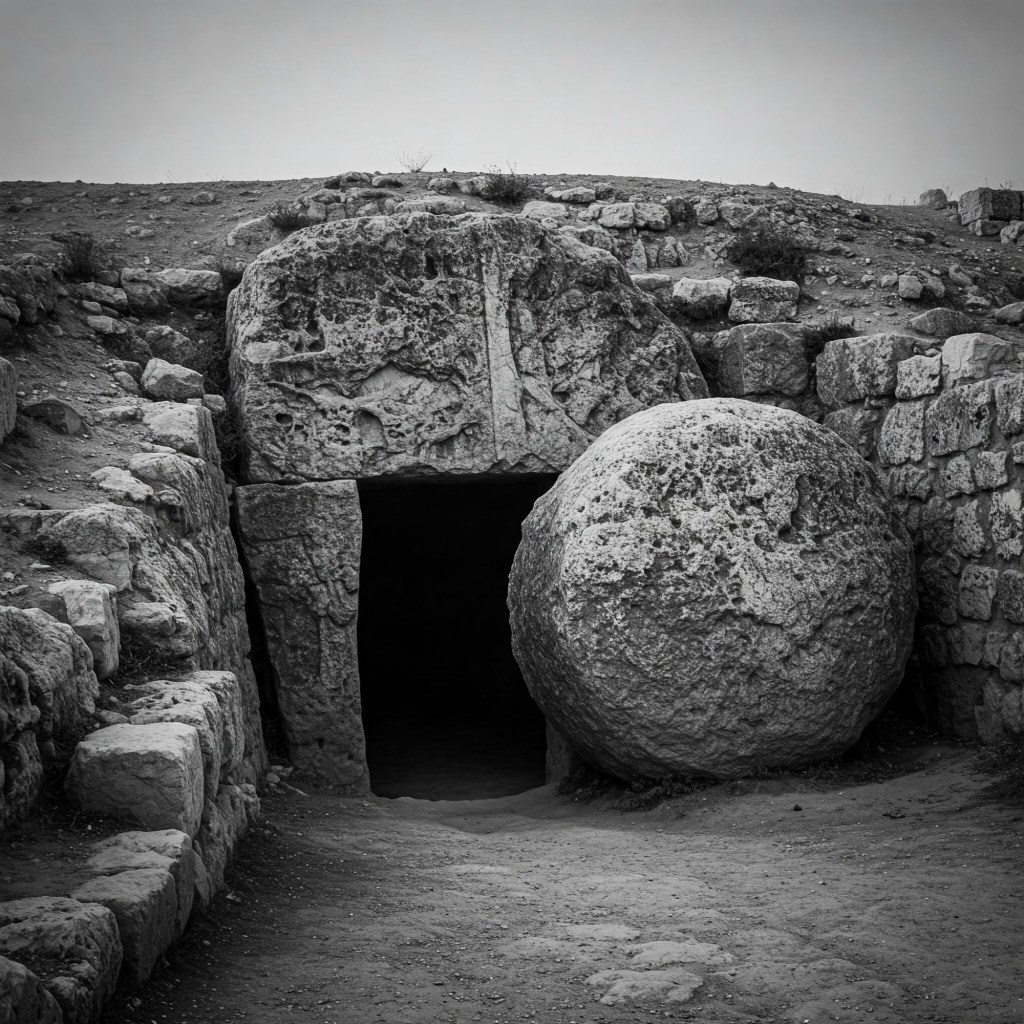
An AI generated image of the garden tomb in black-and-white set against grey sky. The entrance to the tomb is partially open, with a large stone across the right hand side of it. 

Here’s the passage in full : John 19:38–42 (ESV)

“After these things Joseph of Arimathea, who was a disciple of Jesus, but secretly for fear of the Jews, asked Pilate that he might take away the body of Jesus, and Pilate gave him permission. So he came and took away his body. Nicodemus also, who earlier had come to Jesus by night, came bringing a mixture of myrrh and aloes, about seventy-five pounds in weight. So they took the body of Jesus and bound it in linen cloths with the spices, as is the burial custom of the Jews. Now in the place where he was crucified there was a garden, and in the garden a new tomb in which no one had yet been laid. So because of the Jewish day of Preparation, since the tomb was close at hand, they laid Jesus there.”

Secret Disciples: Joseph and Nicodemus

Joseph of Arimathea, a wealthy member of the Sanhedrin, is described as a “secret disciple” of Jesus, concealing his faith due to fear of the Jews. His position in Jewish society made public allegiance to Jesus risky, potentially threatening his status and safety. Yet, in a bold act, Joseph approaches Pilate to request Jesus’ body, an action that could have exposed him to scrutiny. Similarly, Nicodemus, who previously visited Jesus at night (John 3:1–2), likely out of fear, joins Joseph in this act of devotion. He brings approximately seventy-five pounds of myrrh and aloes, an extravagant amount of spices, signaling his commitment. Their actions challenge modern Christians to examine their own faith. Many face pressure to hide their beliefs in hostile or secular environments. Rather than concealing faith, believers are called to proclaim it sensitively but unashamedly, as Jesus instructs in Matthew 5:16: “Let your light shine before others.” How can we move from secrecy to courageous witness in our daily lives?

Jewish Burial Customs in the Passage

In the first century, Jewish burial practices were rooted in respect for the deceased and adherence to purity laws. Deuteronomy 21:23 required prompt burial to avoid defilement, especially before the Sabbath. The body was typically washed, wrapped in linen cloths, and anointed with spices like myrrh and aloes to honor the deceased and mask the odour of decay. In John 19:38–42, Joseph and Nicodemus meticulously follow these customs. They wrap Jesus’ body in linen with the spices Nicodemus provides, a quantity far exceeding typical burials, reflecting deep reverence. Their care fulfills Isaiah 53:9, which prophesies the Messiah’s burial with the rich. This deliberate act underscores Jesus’ dignity, even in death.

The Garden Tomb: Location and Significance

John 19:41 describes the burial site as a new tomb in a garden, unused by anyone else. Joseph’s offering of his own tomb represents a personal sacrifice. Theologically, the tomb is a temporary resting place, foreshadowing the resurrection. Two possible locations in Jerusalem are associated with this site. The Garden Tomb, located north of the Damascus Gate, is favored by some Protestants for its serene, garden-like setting and rock-hewn tomb, fitting John’s description. Alternatively, the Church of the Holy Sepulchre, supported by early Christian tradition and archaeological evidence of first-century tombs, is widely accepted by Catholic and Orthodox traditions. If you would like my opinion, I favour the Garden Tomb location over the Holy Sepulchre .But I am no biblical archaeologist! 

Regardless of the exact site, the garden tomb invites believers to trust God’s redemptive plan, even in moments of apparent defeat.

The Disciples’ Limbo and Our Hope

For the disciples, Jesus’ death was a devastating blow. They believed Him to be the Messiah, yet witnessed His execution, leaving them in fear and confusion. Unaware of the resurrection to come, they faced a limbo of shattered hopes. Their vulnerability reflects the human struggle with uncertainty. In contrast, modern believers have the benefit of hindsight, knowing that Resurrection Sunday follows Good Friday. This perspective transforms despair into hope, as Paul writes in 1 Corinthians 15:20, describing Christ as “the firstfruits of those who have fallen asleep.” The disciples’ experience encourages Christians to hold fast to faith during trials, trusting that God’s plan unfolds according to his will. 

So what do we do? 

Joseph and Nicodemus, once secretive, acted with courage to honour Jesus in His burial. Their example challenges us to proclaim our faith boldly, even in difficult circumstances. We are called to trust in the resurrection hope, knowing that God’s victory overcomes life’s darkest moments.

The darkness of Friday has been and gone, and we find ourselves in the limbo of its aftermath. Fear not though, Sunday is coming…

Hope Beyond Judgement (Micah 4:1-8)

Introduction

Ever relied on a GPS, only to end up completely lost? My father-in-law did—he entered the wrong address in his sat nav and ended up driving around a residential estate looking for a major Metropolitan Hospital! I don’t know what he thought was going to happen – that he’d round the corner and suddenly find this huge hospital right there among the houses! Well, in Micah chapter 4, we round a metaphorical corner from chapters 1, 2, and 3. The stark warnings of sin and judgement vanish, and we find ourselves faced with this passage of hope.

I hesitated to tackle this Old Testament text—it’s challenging, and we often avoid these scriptures, instead favouring a New Testament epistle or a historical narrative or Psalm. In the book of Acts however, the apostles masterfully preached Christ using only the Old Testament, as it was the only Bible they had. This is a skill I fear we’ve largely forgotten.

Let’s explore Micah’s context, unpack this vision of hope, examine its interpretations, and consider what it means for us—sinners redeemed by grace. Here’s the passage:

Micah 4:1–8 (NIV):
“In the last days the mountain of the Lord’s temple will be established as the highest of the mountains; it will be exalted above the hills, and peoples will stream to it. Many nations will come and say, ‘Come, let us go up to the mountain of the Lord, to the temple of the God of Jacob. He will teach us his ways, so that we may walk in his paths.’ The law will go out from Zion, the word of the Lord from Jerusalem. He will judge between many peoples and will settle disputes for strong nations far and wide. They will beat their swords into plowshares and their spears into pruning hooks. Nation will not take up sword against nation, nor will they train for war anymore. Everyone will sit under their own vine and under their own fig tree, and no one will make them afraid, for the Lord Almighty has spoken. All the nations may walk in the name of their gods, but we will walk in the name of the Lord our God for ever and ever. ‘In that day,’ declares the Lord, ‘I will gather the lame; I will assemble the exiles and those I have brought to grief. I will make the lame my remnant, those driven away a strong nation. The Lord will rule over them in Mount Zion from that day and forever. As for you, watchtower of the flock, stronghold of Daughter Zion, the former dominion will be restored to you; kingship will come to Daughter Jerusalem.’”

The Dark Before the Dawn: Micah 1–3 and Historical Context

Picture Judah 2,700 years ago, dwarfed by the menacing Assyrian Empire, ready to strike. Micah, a prophet from rural Moresheth, spoke into this tension. His real alarm, though, was sin. Chapter 1 blasts the people for chasing idols over God—“Their rebellion is their ruin” (Micah 1:5–7). Sin estranges us too—dishonesty, selfishness, neglect. Chapter 2 exposes the wealthy exploiting the poor (2:1–2), while false prophets dismiss guilt (2:11). Chapter 3 condemns corrupt leaders, priests, and prophets, predicting Zion’s ruin (3:12). Sin pervades everything—we’re no exception, deserving judgment. Yet God pivots in chapter 4, offering hope through a Savior.

A Vision of Hope: Summary of Micah 4:1–8

Micah 4:1–8 bursts with promise. Verse 1 begins with “the last days”. To Micah, this is a time in the future and the debate about the “last days” goes on – are we in the last “last days” now? The temple’s mountain rises supreme—an idiom for God’s kingdom or sovereign rule—drawing a parallel to Daniel 2, and the Stone not cut with human hands, which grows to become a great mountain – God’s kingdom and rule.

In verse 2, Gentiles seek God’s ways, and His law flows out from Jerusalem. In verse 3, God resolves conflicts, and the famous picture of turning swords into plowshares is used—this passage a mirror of Isaiah 2:4 and scholars debate which came first. Each person rests “under their own vine and fig tree,” (v4) symbols of peace, secure and unafraid. Verse 5 tells us God’s people stay faithful despite others’ idols. Verses 6–7 depict God gathering the broken—lame, exiles—forming a strong nation under His eternal reign. The section closes with Jerusalem’s dominion returning, a watchtower looking over a flock. This hope, unearned by sinners, comes through a Messiah.

Interpreting the Promise: Major Viewpoints

What does this all mean? Let’s explore the major interpretations.

Jewish View
Jews see this as the Messianic Age—a future when a Davidic king restores Jerusalem’s glory (v. 7). Nations embrace God’s law (v. 2), war ceases (v. 3), and exiled Israel returns (vv. 6–8)—God’s peace through His rule, still awaited.

Christian View 1: Fulfilled in Christ
Some Christians argue Jesus fulfilled this. His cross conquered sin (Romans 3:23–24), making the church the exalted mountain (Acts 15:14–17). Peace begins now (Ephesians 2:14), welcoming the broken (Luke 4:18), with His kingdom launched at the resurrection (v. 8).

Christian View 2: Now and Not Yet
Others see a two-part story. The cross starts it—forgiveness today (1 John 1:8–9)—but Christ’s return completes it, ending war (Revelation 21:4). The church grows (v. 2), His reign maturing from hearts to all (v. 8).

Christian View 3: Millennial Kingdom
A third view expects Jesus to reign 1,000 years (Revelation 20:1–6). Jerusalem rises (v. 1), nations come (v. 2), peace reigns (v. 3), and the broken are restored (vv. 6–7) under His throne (v. 8).

Jews await a Messiah; Christians see Jesus—past, present, or future. Every Christian lens points to Him, our hope against sin through His cross or return.

Living the Vision Today: Practical Application

How do we respond? First, admit our sin. Like Judah—idolatry, greed, lust or whatever—we falter (Romans 3:10). Yet Christ’s cross redeems us (John 3:16). Only our God can transform the wickedness of sin (Micah 1-3) into the saving hope of Christ’s kingdom (Micah 4). We respond by trusting Him. We can’t save ourselves—it’s His gift (Ephesians 2:8–9). Rest in that cross—Jesus paid it all.

This is no mere nod to God – and it should turn our lives upside down. Many people say they believe in God or call themselves Christian, but are their lives surrendered fully to Jesus? The devil believes in God too right?

Conclusion

I have deliberately not pointed to one particular interpretation here, claiming it to be true. I will leave you to study that out for yourselves. However you interpret this prophecy though, I hope we can all agree it points to our hope in Christ. Let’s live like people who believe He will return one day, and perhaps soon.

Come Lord Jesus, come!

Palm Sunday talk – Andy Brown

A sermon I preached on Palm Sunday several years ago now… Hope you enjoy
— Read on andy-brown.org/2022/04/10/palm-sunday-talk/

Humility, Compassion and Authority

As ever, it was a great pleasure to speak at my church yesterday morning.

We have been studying the book of Luke, and yesterdays passage cover the first 17 verses of Luke 7.

I share below a copy of the recording, which I hope you enjoy. The microphone picked up a fair bit of background noise which I hope does not spoil your enjoyment.

900 years (audio)

As always, it was a great honour to speak at my church service yesterday morning. This time, in particular, was special as the church celebrated its 900th anniversary!

A paint by numbers of the church building, contributed to by the entire church family

I share below a recording of the message, based on Luke 4.

Apologies that the sound quality is not the best, but I hope you’re still able to hear what I say clearly.

Enjoy and God bless, and here’s to the next 900 years!

Just as He said He would – Andy Brown

On this Resurrection Sunday, I share the message I gave at last year’s sunrise service at our church.

He is risen! Just as he said he would! Praise the living God! 

Happy Easter! It was my privilege to share for a few minutes this morning at our early morning sunrise service on this Resurrection Sunday. I share below a recording of the message which I hope you enjoy. May you be eternally blessed this Easter weekend! A message from Andy on Easter Sunday morningA message from…
— Read on andy-brown.org/2022/04/17/just-as-he-said-he-would/

This Sunday at Church: Encourage the Encourager

Who are the encouragers in your life? What can you do today to give them a boost? Have a great Sunday!

This Sunday at Church I want to encourage you to do the following: Encourage the Encourager. Do you know the encourager at church? They seem to be …

This Sunday at Church: Encourage the Encourager

Where do you stand? – Andy Brown

Sincere apologies that I have not had much time to write lately. In lieu of that, I share an older post with you today. This post was released in the height of the coronavirus pandemic but I hope it’s words are still very much relevant today. 

31 “But when the Son of Man comes in his glory, and all the holy angels with him, then he will sit on the throne of his glory. 32 Before him all the nations will be gathered, and he will separate them one from another, as a shepherd separates the sheep from the goats. 33…
— Read on andy-brown.org/2020/03/23/where-do-you-stand/

This Sunday at Church: Praying for your Church’s Outreach Effort

I often share from this wonderful series on a Sunday. Today’s post is particularly powerful so I really do encourage you to give it a read.

This Sunday at Church I want to encourage you to do the following: Praying for your church outreach effort.  It might mean someone’s eternity with …

This Sunday at Church: Praying for your Church’s Outreach Effort

I’m Sorry – Andy Brown (Best of 2022)

Not exactly one of my most popular posts from this year, but I really like it! So I’m sharing it with you today. Hopefully you won’t have much cause to use this advice in the coming year, but just in case! 

I was thinking about apologising this week, not that there was a particular incident which I needed to say sorry for, but instead I was reflecting on how bad we are at it – generally speaking! Is that through lack of practise I wonder? We all make mistakes, and yet we often fail to apologise…
— Read on andy-brown.org/2022/02/03/im-sorry/

Preaching to the Choir – Andy Brown (Best of 2022)

Are you preaching to the choir? Is that wasteful, or does the choir need your encouragement as well? It was a great pleasure yesterday evening to meet (on video) a couple of fellow Christian bloggers, and lovely to share some of our stories, questions and experiences of ministering through this medium. It was humbling to…
— Read on andy-brown.org/2022/04/09/preaching-to-the-choir/

One Way – Andy Brown (RB)

Jesus said to him, “I am the way, and the truth, and the life. No one comes to the Father except through me. John 14:6 (ESV) We take another little break from the ATBOB series to think about something I feel is important for us to discuss. The other evening, I caught an episode of…
— Read on andy-brown.org/2018/05/24/one-way/