The Holiness of God and the Lesson of Uzzah: A Reflection on 1 Chronicles 13

When we read the account of Uzzah in 1 Chronicles 13, we encounter a moment that can feel shocking, even unsettling. Uzzah, in a seemingly instinctive act, reaches out to steady the Ark of the Covenant as it wobbles, only to be struck down by God. At first glance, this seems harsh, perhaps even unfair. Why would God respond so severely to a man trying to protect something sacred? Yet, as we unpack this passage, we uncover profound truths about God’s holiness, the seriousness of worship, and the chasm between humanity and God—a chasm bridged only by Jesus Christ.

An AI generated image of oxen pulling a wooden cart with the ark of the covenant resting upon it 

In 1 Chronicles 13, King David is leading a joyful procession to bring the Ark of the Covenant to Jerusalem. The ark, a symbol of God’s presence, is being transported on a cart. As the oxen stumble, Uzzah reaches out to steady the ark, and God’s anger results in his immediate death. The text records, “And when they came to the threshing floor of Chidon, Uzzah put out his hand to take hold of the ark, for the oxen stumbled. And the anger of the Lord was kindled against Uzzah, and he struck him down because he put out his hand to the ark, and he died there before God” (1 Chronicles 13:9-10, ESV). To our modern sensibilities, Uzzah’s action seems reasonable, even commendable. He was trying to prevent the ark from falling to the ground. Yet, the severity of God’s response reveals a deeper spiritual reality: God’s holiness is not to be underestimated.

God’s holiness is perfect, unblemished, and utterly distinct from humanity. The ark was not merely a sacred object; it was the earthly representation of God’s presence, and God had given clear instructions for its handling (Numbers 4:15). Only the Levites were to carry the ark, using poles on their shoulders, and no one was to touch it directly. By placing the ark on a cart—a method borrowed from the Philistines (1 Samuel 6:7)—and allowing Uzzah, who was not a Levite, to touch it, the Israelites were disregarding God’s commands. Theologian R.C. Sproul offers a striking perspective: the muddy ground, untouched by human sin, was less offensive to God’s holiness than human hands tainted by sin. Uzzah’s act, though well-intentioned, violated the sanctity of God’s presence.

This leads us to our first key lesson: we cannot underestimate God’s holiness or the depth of our sinfulness. In our contemporary world, it’s easy to approach God casually, as if He were a friend or equal. Yet, God’s holiness sets Him infinitely apart. Isaiah 6:3 declares, “Holy, holy, holy is the Lord Almighty,” and in His presence, even the prophet Isaiah cried out, “Woe to me! I am ruined!” (Isaiah 6:5). Our sin creates a profound separation from God, and no amount of good intentions can bridge that gap. Uzzah’s story reminds us that God’s standards are not ours. His holiness demands reverence, and our sinfulness falls far short.

The second lesson from this passage is that how we worship and approach God matters deeply. The Israelites’ failure to follow God’s instructions for transporting the ark was not a minor oversight; it reflected a lack of seriousness about God’s word. Worship is not a free-for-all where anything goes. God has revealed how He desires to be worshipped, and while we live in an era of grace through Christ, this does not mean we approach God flippantly. Jesus Himself said, “God is spirit, and his worshippers must worship in the Spirit and in truth” (John 4:24). Our worship should be heartfelt, but it must also align with God’s truth as revealed in Scripture.

Uzzah’s story, though sobering, points us to the hope we have in Jesus Christ. The separation between God’s holiness and our sinfulness, so starkly illustrated in 1 Chronicles 13, finds its resolution at the cross. Jesus, the sinless Son of God, lived the holy life we could not and died in our place, taking the penalty for our sin. Through His death and resurrection, we receive His righteousness as a gift (2 Corinthians 5:21). Because of Christ, we can now “approach God’s throne of grace with confidence” (Hebrews 4:16). Where Uzzah faced death for touching the ark, we, through Jesus, are invited to draw near to God as His children.

As we reflect on Uzzah’s story, let us be humbled by God’s holiness and convicted to approach Him with reverence. Let us also rejoice in the gospel, which bridges the unbridgeable. May our worship be shaped by God’s word and empowered by His Spirit, and may we live in the confidence that Christ has made a way for us to stand in God’s holy presence.


Don’t forget, Andy‘s brand-new book has recently been published on Amazon! from Doubt to Disciples: Unlocking the Great Commission. Head over to the books section to find out more- Books


From Secret Faith to Bold Devotion: John 19:38–42

Following Jesus’ crucifixion, John 19:38–42 describes the burial of His body, a moment of devotion amidst fear and uncertainty. This passage introduces Joseph of Arimathea and Nicodemus, two figures who step forward to honour Jesus in death. This study explores the significance of Jesus’ burial, Jewish customs, the garden tomb’s possible locations, and the disciples’ limbo, encouraging Christians to proclaim their faith boldly. The burial of Jesus reveals both human fear and profound devotion, pointing to the hope of resurrection.

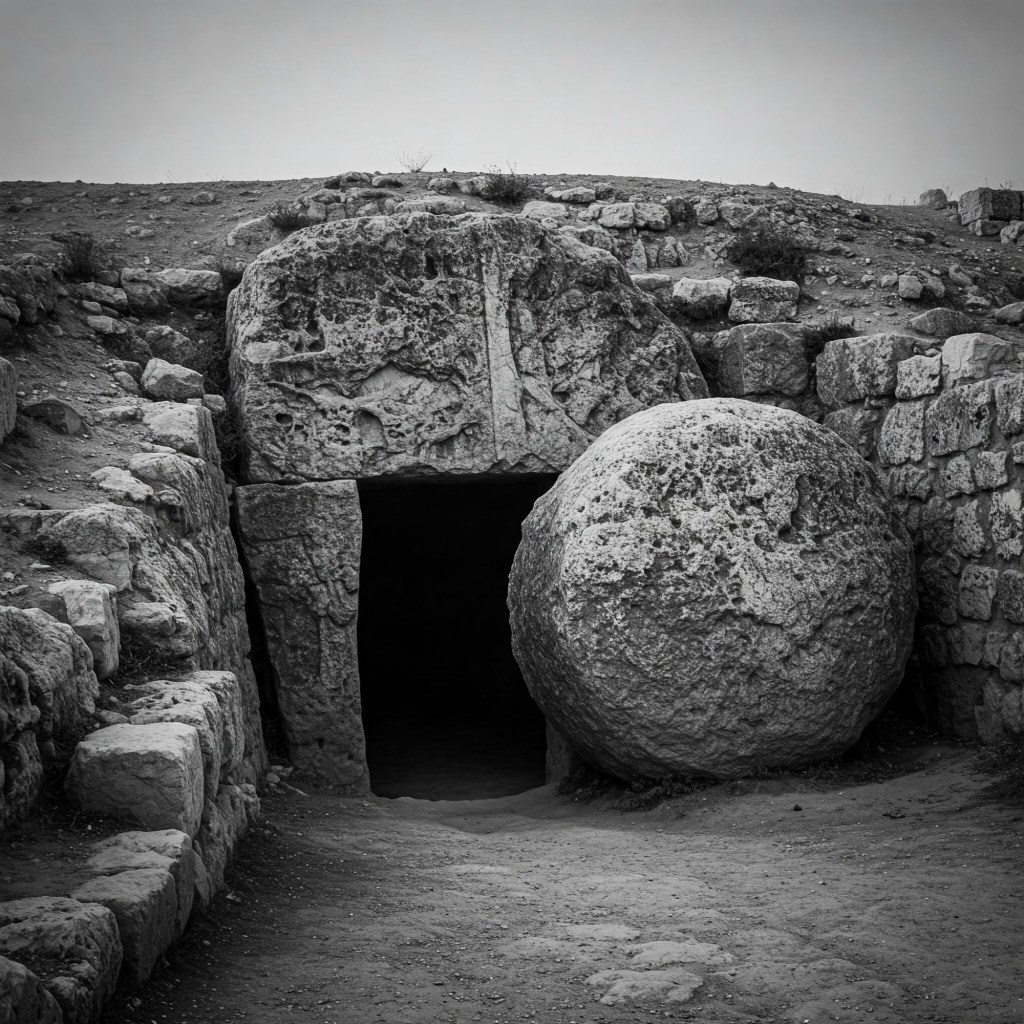
An AI generated image of the garden tomb in black-and-white set against grey sky. The entrance to the tomb is partially open, with a large stone across the right hand side of it. 

Here’s the passage in full : John 19:38–42 (ESV)

“After these things Joseph of Arimathea, who was a disciple of Jesus, but secretly for fear of the Jews, asked Pilate that he might take away the body of Jesus, and Pilate gave him permission. So he came and took away his body. Nicodemus also, who earlier had come to Jesus by night, came bringing a mixture of myrrh and aloes, about seventy-five pounds in weight. So they took the body of Jesus and bound it in linen cloths with the spices, as is the burial custom of the Jews. Now in the place where he was crucified there was a garden, and in the garden a new tomb in which no one had yet been laid. So because of the Jewish day of Preparation, since the tomb was close at hand, they laid Jesus there.”

Secret Disciples: Joseph and Nicodemus

Joseph of Arimathea, a wealthy member of the Sanhedrin, is described as a “secret disciple” of Jesus, concealing his faith due to fear of the Jews. His position in Jewish society made public allegiance to Jesus risky, potentially threatening his status and safety. Yet, in a bold act, Joseph approaches Pilate to request Jesus’ body, an action that could have exposed him to scrutiny. Similarly, Nicodemus, who previously visited Jesus at night (John 3:1–2), likely out of fear, joins Joseph in this act of devotion. He brings approximately seventy-five pounds of myrrh and aloes, an extravagant amount of spices, signaling his commitment. Their actions challenge modern Christians to examine their own faith. Many face pressure to hide their beliefs in hostile or secular environments. Rather than concealing faith, believers are called to proclaim it sensitively but unashamedly, as Jesus instructs in Matthew 5:16: “Let your light shine before others.” How can we move from secrecy to courageous witness in our daily lives?

Jewish Burial Customs in the Passage

In the first century, Jewish burial practices were rooted in respect for the deceased and adherence to purity laws. Deuteronomy 21:23 required prompt burial to avoid defilement, especially before the Sabbath. The body was typically washed, wrapped in linen cloths, and anointed with spices like myrrh and aloes to honor the deceased and mask the odour of decay. In John 19:38–42, Joseph and Nicodemus meticulously follow these customs. They wrap Jesus’ body in linen with the spices Nicodemus provides, a quantity far exceeding typical burials, reflecting deep reverence. Their care fulfills Isaiah 53:9, which prophesies the Messiah’s burial with the rich. This deliberate act underscores Jesus’ dignity, even in death.

The Garden Tomb: Location and Significance

John 19:41 describes the burial site as a new tomb in a garden, unused by anyone else. Joseph’s offering of his own tomb represents a personal sacrifice. Theologically, the tomb is a temporary resting place, foreshadowing the resurrection. Two possible locations in Jerusalem are associated with this site. The Garden Tomb, located north of the Damascus Gate, is favored by some Protestants for its serene, garden-like setting and rock-hewn tomb, fitting John’s description. Alternatively, the Church of the Holy Sepulchre, supported by early Christian tradition and archaeological evidence of first-century tombs, is widely accepted by Catholic and Orthodox traditions. If you would like my opinion, I favour the Garden Tomb location over the Holy Sepulchre .But I am no biblical archaeologist! 

Regardless of the exact site, the garden tomb invites believers to trust God’s redemptive plan, even in moments of apparent defeat.

The Disciples’ Limbo and Our Hope

For the disciples, Jesus’ death was a devastating blow. They believed Him to be the Messiah, yet witnessed His execution, leaving them in fear and confusion. Unaware of the resurrection to come, they faced a limbo of shattered hopes. Their vulnerability reflects the human struggle with uncertainty. In contrast, modern believers have the benefit of hindsight, knowing that Resurrection Sunday follows Good Friday. This perspective transforms despair into hope, as Paul writes in 1 Corinthians 15:20, describing Christ as “the firstfruits of those who have fallen asleep.” The disciples’ experience encourages Christians to hold fast to faith during trials, trusting that God’s plan unfolds according to his will. 

So what do we do? 

Joseph and Nicodemus, once secretive, acted with courage to honour Jesus in His burial. Their example challenges us to proclaim our faith boldly, even in difficult circumstances. We are called to trust in the resurrection hope, knowing that God’s victory overcomes life’s darkest moments.

The darkness of Friday has been and gone, and we find ourselves in the limbo of its aftermath. Fear not though, Sunday is coming…

The Cross and the Crown: Reflecting on John 19:17–24 This Good Friday

As Christians gather on this Good Friday, we pause to reflect on the sacrifice of Jesus Christ, the pivotal moment of our faith. John 19:17–24 captures the raw reality of the crucifixion, where Jesus is declared “King of the Jews” and His clothes are divided by soldiers. This passage reveals Jesus as the sovereign King of all, fulfilling ancient prophecies and completing His mission as the Savior of humanity. On this sacred day, we are called to marvel at His love and respond with heartfelt worship.

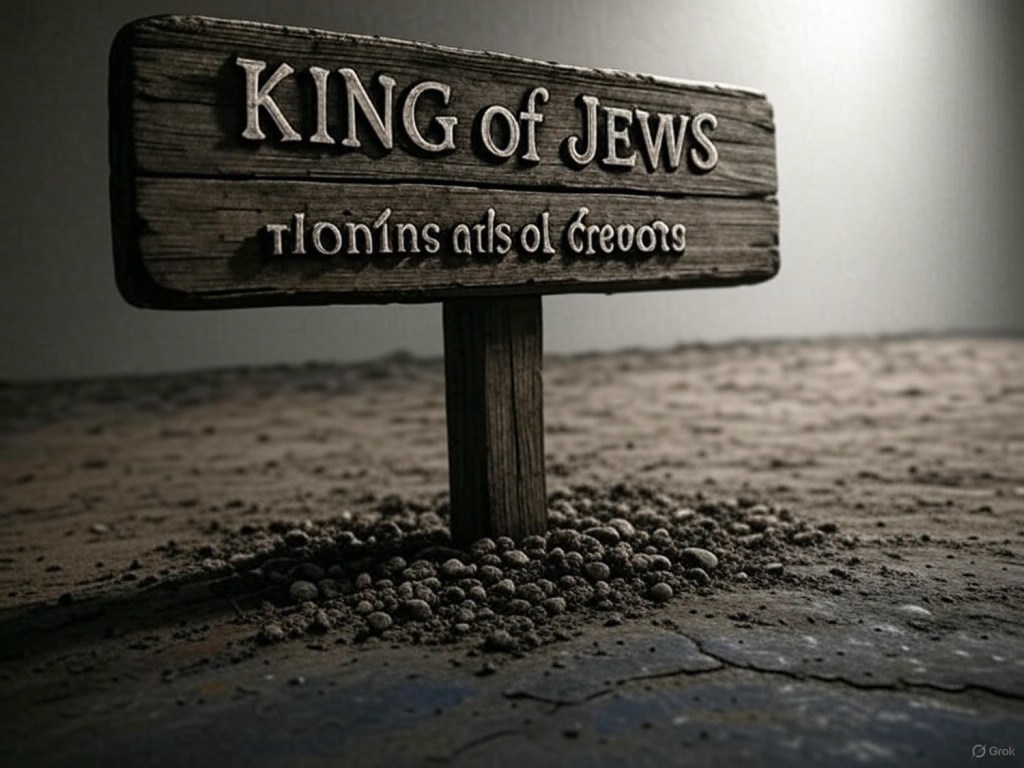
A wooden sign is planted in the ground, surrounded by small pebbles and dirt. The sign has the text “KING of JEWS” prominently displayed in large, bold letters. Below this, there is a line of text in a different script that reads ” πλοκίης αἰς οἱ ςρεοοης” which are random Greek letters for illustration . The background is a plain, slightly textured surface with a gradient of light and shadow.

Jesus: King of the Jews and King of All

John 19:17–19 recounts Jesus’ journey to the cross: “Carrying the cross by himself, he went to the place called Place of the Skull… There they nailed him to the cross… Pilate also had an inscription written and put on the cross. It read, ‘Jesus of Nazareth, the King of the Jews’” (NLT). The title “King of the Jews,” though meant as mockery by Pilate, proclaimed a profound truth. Despite opposition, Pilate refused to change the inscription (John 19:22), unwittingly affirming Jesus’ identity.

Jesus’ kingship transcends earthly boundaries. He is not only the King of the Jews but the “King of kings and Lord of lords” (Revelation 19:16, NLT). On the cross, His reign was established through sacrifice, challenging the powers of this world and offering hope to all who believe. Good Friday reminds us that Jesus’ kingship demands our allegiance. As Christians, we are called to live under His loving authority, trusting His sovereign plan even in the face of suffering.

The Soldiers and the Fulfillment of Prophecy

The scene at the cross continues in John 19:23–24: “When the soldiers had crucified Jesus, they divided his clothes among the four of them. They also took his robe, but it was seamless… So they said, ‘Rather than tearing it apart, let’s throw dice for it.’ This fulfilled the Scripture that says, ‘They divided my garments among themselves and threw dice for my clothing’” (NLT). This moment directly fulfills Psalm 22:18, written centuries earlier, proving Jesus as the promised Messiah.

This single fulfilled prophecy points to a greater truth: Jesus’ entire life and death align with God’s redemptive plan. From His birth in Bethlehem (Micah 5:2) to His suffering (Isaiah 53), Jesus fulfilled every Messianic prophecy, culminating in His sacrificial death. Good Friday marks the climax of His mission to save humanity, as He bore the weight of our sins on the cross. Even the soldiers’ callous actions, dividing His clothes, served God’s purpose, demonstrating His sovereignty over every detail. As we reflect on this, we stand in awe of Jesus’ obedience and God’s faithfulness.

Good Friday: The Weight and Wonder of the Cross

Good Friday is a day of somber reflection and profound gratitude.

Jesus’ death was the ultimate act of love, as He “gave his life to purchase freedom for everyone” (1 Timothy 2:6, NLT). John 19:17–24 anchors us in the reality of the cross—Jesus endured unimaginable pain to atone for our sins, fulfilling the Law and the prophets. His kingship, declared in the inscription, and His fulfillment of prophecy, seen in the soldiers’ actions, assure us of His victory over sin and death.

On this day, we are invited to pause and contemplate the cost of our salvation. The cross reveals both the depth of human sin and the boundless love of God. As we consider Jesus’ sacrifice, we find hope in His reign as King, knowing that His death was not the end but the beginning of eternal life for all who believe. Good Friday calls us to lift our eyes to the cross, where our Savior triumphed.

A Call to Worship

In response to Jesus’ kingship and sacrifice, our hearts turn to worship. Good Friday is a time to gather in worship services, pray, or meditate on Scripture, giving thanks for all Jesus has done. Reflect on His love, which led Him to the cross, and commit to living under His reign daily. Let this day inspire a life of worship, where every action honors Jesus as King and Savior. As Psalm 95:6 urges, “Come, let us worship and bow down. Let us kneel before the Lord our maker” (NLT).

Where do you stand? – Andy Brown

Sincere apologies that I have not had much time to write lately. In lieu of that, I share an older post with you today. This post was released in the height of the coronavirus pandemic but I hope it’s words are still very much relevant today. 

31 “But when the Son of Man comes in his glory, and all the holy angels with him, then he will sit on the throne of his glory. 32 Before him all the nations will be gathered, and he will separate them one from another, as a shepherd separates the sheep from the goats. 33…
— Read on andy-brown.org/2020/03/23/where-do-you-stand/

Parable Surprises – Wedding Banquet

While the phrase is weeping and gnashing of teeth are not entirely encouraging, they are important biblical concepts. this blog post offers some interesting insights into their meaning, and some more general thoughts on this particular parable which I will encourage you to read.

I do not like to share posts too often, as I do not want to weary my readership! But there are some truly amazing writers on WordPress, so do explore for yourselves and find them!

Weddings are awesome, but sometimes full of tension and surprises. To plan a wedding is one of the more complex projects I have been involved with. …

Parable Surprises – Wedding Banquet

Eternity in the Balance (Best of 2021)

andy-brown.org/2021/02/08/eternity-in-the-balance/

Over the next few days, I will be sharing some of the most read posts of this year.

This post, from way back in February, discuss is the idea of eternal punishment and how we can avoid it! I know that may not seem like the most uplifting of themes… But there is nothing more important!

What are your thoughts on this subject? Do leave me a comment or question.

Thanks for reading!

Death is Random (PoW)

Pearls of Wisdom

Death is coming, and it’s random

I know that probably isn’t the most uplifting piece of wisdom you’ve ever heard, but it is true! Death is not something we should spend our entire lives thinking about, but it does happen to us all and we need to be prepared for it.

We tend to avoid thinking about it if we can, and otherwise take a herd mentality to cope with it. What I mean is this:

  • It won’t happen to me, I’m too young
  • It won’t happen to me, I’m fit and healthy
  • It won’t happen to me, I’ve got the money to pay for excellent health care      
  • It won’t happen to me, I’ve got longevity in my genes
  • It won’t happen to me, I live in a safe town or neighbourhood

Death is random however. While any one of these factors may reduce the risk of death in your life, the fact is neither money, nor age, nor healthy living can ever stop death from coming to us all sooner or later – and I pray it’s later!

I once heard of a serial killer who seemingly had no profile of victims he attacked. That made him one of the more terrifying examples because no one was safe. If he only targeted young women, then older women and men would feel “safe.”

Each of us must come to terms with our own mortality. Just as each of us have been born, each of us will one day face death.

For the Christian, death holds little fear. When our time comes, we will step out of our earthly bodies and into the presence of the Lord. There we will remain for all eternity.

Whether you are young or old, healthy or sick, rich or poor; you do not know when your time on Earth will be up. Do not gamble with your eternal future. Set it in stone right now by putting your faith in Jesus Christ.

You do this by simply asking Him to be in charge of your life, asking Him to forgive you of the things you’ve done wrong, and by starting to live your life following Him. If you make that choice today, please do get in touch as I would love to celebrate with you and give you some pointers.

Do not put off thinking about death, as unpleasant as it may seem. Life is temporary, but eternity, well, it goes on forever!

Check out my post One Way to hear more about Jesus

Inseparable

To be honest, I have been mulling this post over for a couple of days. It is not controversial in any way, it is just that I have struggled to articulate what God has shown me. It is not some huge revelation either, simply that God met me where I was at, and through His Word spoke directly into my situation. Has such a thing ever happened to you? I’m sure it has…

A few days ago I wrote a post entitled Ask and Believe – linked here – where I prayed about something and the answer came. In an entirely opposite way, I prayed for something else and unfortunately the exact opposite happened. It did not shake my faith or anything so grand, as I am slowly learning to trust in God’s will for my life. The unanswered prayer led me to a choice I did not want to have to make, and neither could I put it off. I have since been anxious that I made the wrong decision.

In those moments of fear and worry, I was directed to read the following Bible verses. The comfort they brought is really the intangible substance I am struggling to describe. Perhaps it is best to simply let the words speak for themselves.

For I am convinced that neither death nor life, neither angels nor demons,[a] neither the present nor the future, nor any powers, 39 neither height nor depth, nor anything else in all creation, will be able to separate us from the love of God that is in Christ Jesus our Lord.

Romans 8:38-39 (NIV)

Paul was entirely convinced, that is – fully persuaded – that nothing can separate us from the love of God found in Christ Jesus. I was not convinced, based on my initial feelings, until God so gently reminded me of this truth.

The things that Paul lists here are heavy hitters. Death, demons, the powers of hell – none of these things will ever be able to remove us from God’s love.

I have been reading these verses over and over, and letting them minister to me. There is nothing – simply nothing – in all creation that can pull us away from the gravity of God’s love. We are inseparable.

When our prayers do not get the answer we wanted, or when we face times of great difficulty, it can be all too easy to start to doubt God’s love. Yet in Christ and what He did at the cross, there is an immovable, unchanging, eternal testimony of that love.

God’s love does not equal instant access to a 100% prayer record, nor a complete trouble-free existence, but it does mean that no matter what happens, He will be right there with you in the thick of it. He is trustworthy. You can fully rely on Him. That love gives you an assurance that when you one day stand before Him, there will be nothing that separates you from His presence. When we put our trust in Christ, receiving that love and submitting to Him, our sins are washed away and our place with Him is irrevocable.

I needed that assurance this week. Perhaps you will need it today? Put Romans 8 before your eyes, read it aloud and trust that you cannot be separated from His unfailing love.

No created thing can come between you and God’s love when you are fully committed to Christ. There is but One who is not created, and that is God Himself. You are anchored and fixed in that love. Draw on that truth this day and always.

Today You Will Be With Me

Despite the current state of the world, and life here in the UK, I actually quite enjoyed the Easter celebrations. Of course, I was disappointed not to have been able to meet with family or friends, or to gather as a church, but we made the best of it.

I have been thinking about the two criminals who were crucified with Christ – well, one of them in particular.

As I mentioned on Good Friday’s post – Seven Sayings of Jesus at the Cross– we learn that one of the criminals turned in faith to Jesus in his dying moments. Yet Matthew’s Gospel records both of the criminals having hurled insults at Him. This is quite the turnaround for one man, and look at the reward Christ offers him.

Jesus said to him, “Assuredly I tell you, today you will be with me in Paradise.”

Luke 23:43 (WEB)

I know that I said this on Friday, but it is worth repeating. It is never too late to turn to Jesus. No matter what you have done, and no matter how far short you fall, God will never turn you away if you sincerely surrender yourself to His Son.

Yesterday I heard of a family friend who sadly passed away from COVID-19. The man was not old, nor particularly unhealthy (although he did have a condition which made him more vulnerable to this virus). The illness started off rather mildly but has now led to his death. It is very sad, but a reminder that none of us know how long we have on this Earth. Whether COVID or not, we must all die some day and we must make sure we are ready to face God.

Are you?

I’ve digressed slightly, but hopefully that is an important reminder for us all.

So, the criminal turns to Jesus and Jesus says these words: “Assuredly I tell you, today you will be with me in Paradise.”

English Bibles are translations of the original language. For the New Testament, that was mostly Greek. To emphasise a point, sometimes we read a repetition such as “Truly, truly…” or “Mary, Mary…” This is to catch our attention such that we really take in what Jesus is about to say.

Likewise, here, Jesus says “Assuredly…” Assuredly. Absolutely. Definitely. I guarantee… Jesus is assuring this man in no uncertain terms that he will join Christ in Paradise. Comforting this criminal in his last moments, Jesus confirms on him salvation and a place in eternal life.

Scholars have debated what Jesus meant by “today” here. Does it imply that at Jesus’ and the criminal’s death, they both entered straight into Paradise? Some suggest that Jesus descended into the abode of the dead – Sheol in Hebrew – and still others say into hell itself. If so, how could He or the criminal be in Paradise “today?”

Let me give you my thoughts, for what they are worth!

Today is a subjective term. If I say to you, “I’ll meet you later today,” then we both have a reasonable idea of what I mean. But what if I am in a different time zone? Then “Today” becomes slightly more blurred.

It boils down to physics, and what Einstein called “relativity.” Time is relative to your perspective. It is a physical property dependent on gravity and so when we leave these physical bodies, time no longer applies to us.

God is infinite. This doesn’t mean He has lots of time on His hands, but rather that He is outside of time. The criminal arrived at Paradise that same day to him, but from our point of view, time has carried on as before. It may even be that when each of us die, we all arrive in eternity at the same “moment” because there are no moments on the other side.

Anyway, I don’t want to get bogged down in this, but just want to point out that “today” is a relative thing.

Moe important are Christ’s words after “today” – “…you will be with Me…”

There is no greater thing than being with Christ. There are so many blessings to being a part of God’s family, and yet all pale in comparison to actually knowing Jesus.

Yes most certainly, and I count all things to be a loss for the excellency of the knowledge of Christ Jesus, my Lord, for whom I suffered the loss of all things, and count them nothing but refuse, that I may gain Christ

Philippians 3:8 (WEB)

These words are truly, truly humbling to me. I love the Bible, and thirst for knowledge of it. I love being part of a church, and certainly love knowing that I will go to heaven when I die. But can I really say, as Paul does above, that I count everything else as refuse (sometimes rendered “dung”) in comparison to knowing Jesus? Not nearly enough.

Let’s spend our isolation doing fruitful things. Let’s make the most of this time. Let’s spend it getting to know Jesus Christ our Lord and Saviour.

What will you do “today?”

Are you ready for the bridegroom?

When writing this blog, I sometimes prepare a post in advance and schedule it for release. This is particularly useful on days when I know I am going to be busy and probably won’t get the time to write. Since posting daily over the last couple of weeks, this is increasingly important.

Today was a day when I had a post already written and scheduled, yet as I was praying this morning, I had the sense that I needed to write something different.

The pre-written post will come out another day of course, so won’t go to waste, but I felt especially pressed to share on the parable of the ten virgins today.

Jesus told a story about ten virgins. This sounds a little odd to our ears, but what He was referring to was ten young women who were prepared for marriage. In His day, betrothed women would await the coming of their bridegroom. They would not know when exactly he would come, so they would have to keep watch and be ready.

The parable comes from Matthew’s Gospel, and goes like this:

Then the Kingdom of Heaven will be like ten virgins who took their lamps and went out to meet the bridegroom. 2 Five of them were foolish, and five were wise. 3 Those who were foolish, when they took their lamps, took no oil with them, 4 but the wise took oil in their vessels with their lamps. 5 Now while the bridegroom delayed, they all slumbered and slept. 6 But at midnight there was a cry, ‘Behold! The bridegroom is coming! Come out to meet him!’ 7 Then all those virgins arose, and trimmed their lamps.[a] 8 The foolish said to the wise, ‘Give us some of your oil, for our lamps are going out.’ 9 But the wise answered, saying, ‘What if there isn’t enough for us and you? You go rather to those who sell, and buy for yourselves.’ 10 While they went away to buy, the bridegroom came, and those who were ready went in with him to the wedding feast, and the door was shut. 11 Afterward the other virgins also came, saying, ‘Lord, Lord, open to us.’ 12 But he answered, ‘Most certainly I tell you, I don’t know you.’ 13 Watch therefore, for you don’t know the day nor the hour in which the Son of Man is coming.

Matthew 25:1-13 (WEB)

Jesus is deliberately contrasting the five wise virgins with the five unwise ones. The five who were wise went out well prepared. They took sufficient oil with them, ready for the potentially long wait. The other five were not well prepared and so came up short. While they were away getting their oil, they missed the coming of the bridegroom and were locked outside.

There is a clear warning for all of us here. We must prepare and be ready for the coming of the Bridegroom. That is, we must be ready for when Jesus returns.

We must not only prepare once, but live prepared. We do not know the day or the hour when He might return, and so we must treat every day like it is the one where we see His coming.

When I look at my life, I sometimes try to imagine Jesus returning. What will HE find me doing when He appears? I hope He finds me being a good witness, living in obedience and I’m not wasting my time on pointless TV or worse sinfulness.

My point is to simply tel you to be ready for His appearing. Make sure you are right with Jesus, and that you have trusted your life to Him. Time is finite for us, and we will all only have so many opportunities to respond to God’s call. It really will be too late one day, so don’t put it off.

I could end the post here, but the parable has more to say than this. What I have said above is not untrue, but let’s look at it again.

All ten virgins were awaiting the coming of the bridegroom. Verse one tells us that all ten took up their lamps and went out. The way I describe the warning from the parable above sounds more like a warning to those outside of the church – that is, those who don’t know Jesus. Yet, maybe this parable is meant for the church itself, and not those outside.

The church is described as the “Bride of Christ,” and so this parable is indeed fitting to be applied to it. The virgins, wise or otherwise, all went out to meet their bridegroom. The whole church went out to meet Christ, but some were not ready. This parable may in fact be a warning to those in the church that we should not lapse in our readiness for Christ.

We do not want to be counted among the unwise virgins, locked out of the wedding feast because we were not ready.

Whichever way you apply the parable – to the world or to the church, the message is the same. Be ready for Jesus.

How can you do that today?

You must start and continue to trust in Him. Your good works cannot save you. The only thing that can deal with our sin once and for all is the precious blood of Jesus. He shed that blood on the cross so that you could go free.

If you are part of a church, yet have not made a commitment to Jesus, then you are one of the unwise. Church attendance does not save you, only Jesus does. That is not to say that church is unimportant of course, but it is not enough.

Set aside some time to pray to the Father. Don’t wait until tomorrow; do it today! Talk to God about where you are spiritually. Confess your sins, and ask Him to forgive you. He is so willing to do so! Ask Him to help you prepare for the coming of Christ. Whether it is one hour, one day or one century away, there is no better time than now to be ready.

Where do you stand?

31 “But when the Son of Man comes in his glory, and all the holy angels with him, then he will sit on the throne of his glory. 32 Before him all the nations will be gathered, and he will separate them one from another, as a shepherd separates the sheep from the goats. 33 He will set the sheep on his right hand, but the goats on the left. 34 Then the King will tell those on his right hand, ‘Come, blessed of my Father, inherit the Kingdom prepared for you from the foundation of the world; 35 for I was hungry and you gave me food to eat. I was thirsty and you gave me drink. I was a stranger and you took me in. 36 I was naked and you clothed me. I was sick and you visited me. I was in prison and you came to me.’

37 “Then the righteous will answer him, saying, ‘Lord, when did we see you hungry and feed you, or thirsty and give you a drink? 38 When did we see you as a stranger and take you in, or naked and clothe you? 39 When did we see you sick or in prison and come to you?’

40 “The King will answer them, ‘Most certainly I tell you, because you did it to one of the least of these my brothers,[c] you did it to me.’ 41 Then he will say also to those on the left hand, ‘Depart from me, you cursed, into the eternal fire which is prepared for the devil and his angels; 42 for I was hungry, and you didn’t give me food to eat; I was thirsty, and you gave me no drink; 43 I was a stranger, and you didn’t take me in; naked, and you didn’t clothe me; sick, and in prison, and you didn’t visit me.’

44 “Then they will also answer, saying, ‘Lord, when did we see you hungry, or thirsty, or a stranger, or naked, or sick, or in prison, and didn’t help you?’

45 “Then he will answer them, saying, ‘Most certainly I tell you, because you didn’t do it to one of the least of these, you didn’t do it to me.’ 46 These will go away into eternal punishment, but the righteous into eternal life.”

Matthew 25:31-46 (WEB)

I know this is a long passage to start this post with, but I wanted you to be able to read the whole thing and let its challenging words sink in. 

Where do you stand? On the left, or on the right? And I don’t mean politically…

When the news about the corona virus first broke in the early part of this year, I’ll admit to being a little flippant about it. I never imagined it would impact the lives of us all in such ways. 

Reading the news and various social media feeds, I see a rather bleak picture and many individuals who are very scared right now. I thank God that this virus is no worse than it is, but certainly appreciate the heavy impact it will have on many families – particularly those who are vulnerable or elderly. 

It makes you think, doesn’t it? Some doctors are urging we discuss and prepare for the fact that this virus may take the lives of those we love. Are we ready for that? 

I mentioned in my post the other day – Coronavirus – that some had claimed this virus was a sign of the End Times. If you’re not sure what I mean by that, the Bible teaches that one day Jesus will return for His people. There are many diverse views about exactly how this will happen, but essentially all Christians agree HE will return sooner or later. There are certain signs which precede His coming and perhaps this virus is one of them. You can do your own study on that. 

Either way though, the Corona virus gives us pause. It is an opportunity to face the big questions in life. What happens when we die? Are we prepared for the return of the Lord Jesus? Where can we turn when it feels like the world is falling apart? 

Do you have adequate answers to these questions? 

The passage above from Matthew’s Gospel is often called the parable of the sheep and the goats. It depicts the end of time when we will all stand before Jesus’ throne and He will judge us. This is known as the Great White Throne judgement. I’m not entirely sure it is right to call this a parable, as it may not be an illustration at all, but precisely how it will be. 

There is much we could say about this passage. One of the scarier elements is that those who thought they were doing well, were not, and those who did no think they were doing so well, were commended. 

So, where do you stand? Are you a sheep or a goat? It is a question we must all ask ourselves, and answer honestly. Ignoring the question is not an option. We must not wait until we get there to find out, as it will then be too late. 

How can you be sure? How can you know whether you will be counted among the sheep or the goats? The passage itself suggests it is not about what we do, as those who did “spiritual” things were counted as goats. 

The answer does not lie in the activities we participated in, nor in our own “good works.” Our best works are going to look rather shabby when we stand before the Throne of God. 

There is only one way to heaven, and His Name is Jesus Christ. The difference between the sheep and the goats is that the sheep put their lives in the hands of the Good Shepherd. The goats went their own way. 

If you want to find out more about the way to heaven, then check out my post – One Way. 

For the vast majority of people, this Coronavirus will not take their life – praise God. But the questions posed above are still important. None of us can beat the clock, and every one of us will – sadly – die one day. Even if we are the generation to see the return of Jesus Christ, then we sill need to be prepared. Are you? 

So what will it be? Are you a sheep or a goat?

Faith and Unbelief

I want to draw this mini series on healing to a close by thinking about a passage from Matthew 17. There is, of course, much more to say about the subject of healing and this was not meant to be an exhaustive study.

One of the major questions people have is, “Why was I not healed when I asked?” Great question! Some will say that it is not always God’s will to heal, in which case, that is one possible answer. I personally don’t hold that view, but understand I am perhaps in the minority.

There are some things we can learn from Matthew 17, which says:

As they approached the crowd, a man came up to Jesus, knelt down in front of him, 15 and said, “Sir, have mercy on my son, because he is an epileptic and suffers terribly. Often he falls into fire and often into water. 16 I brought him to your disciples, but they couldn’t heal him.”

17 Jesus replied, “You unbelieving and perverted generation! How long must I be with you? How long must I put up with you? Bring him here to me!” 18 Then Jesus rebuked the demon and it came out of him, and the boy was healed that very hour.

19 Then the disciples came to Jesus privately and asked, “Why couldn’t we drive it out?”

20 He told them, “Because of your lack of faith. I tell all of you with certainty, if you have faith like a grain of mustard seed, you can say to this mountain, ‘Move from here to there,’ and it will move, and nothing will be impossible for you. 21 But this kind does not come out except by prayer and fasting.”

Matthew 17:14-21 (ISV)

These events happen shortly after the Transfiguration of Jesus. He and the chosen disciples returned from the mountaintop to the unfolding scene described above.

A man approaches Jesus, seeking healing for his son who is described as an epileptic. He had first gone to the disciples, and the text clearly states that they (the disciples) were not able to heal the boy.

Before we dig into this, look at Jesus’ reaction… was He pleased by this turn of events? Clearly not! In fact, He had some rather strong words to say about it.

Jesus replied, “You unbelieving and perverted generation! How long must I be with you? How long must I put up with you? Bring him here to me!”

Matthew 17:17 (ISV)

Jesus was clearly not impressed with this situation. He did not react with comforting words, or reassure the disciples that it was not their fault. Instead, He rebukes them! Obviously Jesus was here expecting them to be able to minister to this young boy. If not, He would have said so – “Don’t worry lads, this was too difficult for you to achieve. I’ll have to do it myself.” No, instead He criticises them for their unbelief.

Jesus healed the boy immediately. Don’t miss that fact. He clearly wanted this person well, and delivered him from this sickness.

Verse 19 is important. The disciples ask a similar question to what we often ask, “Why couldn’t we heal him?” Or rather, “Why didn’t it work when I prayed?”

The very fact that they asked this question shows that they expected him to recover from this sickness. If they didn’t expect that, then they would have just moved on. It also shows that they had prayed for and healed others, but for some reason this time it had not worked.

What is Jesus’ answer?

He told them, “Because of your lack of faith. I tell all of you with certainty, if you have faith like a grain of mustard seed, you can say to this mountain, ‘Move from here to there,’ and it will move, and nothing will be impossible for you. 21 But this kind does not come out except by prayer and fasting.”

Matthew 17:20-21 (ISV)

Let’s read these same verses in other translations so we get a proper picture.

The NIV says:

He replied, “Because you have so little faith. Truly I tell you, if you have faith as small as a mustard seed, you can say to this mountain, ‘Move from here to there,’ and it will move. Nothing will be impossible for you.”

Matthew 17:20-21 (NIV)

The ESV says:

He said to them, “Because of your little faith. For truly, I say to you, if you have faith like a grain of mustard seed, you will say to this mountain, ‘Move from here to there,’ and it will move, and nothing will be impossible for you.”

Matthew 17:20-21 (ESV)

And the KJV says:

And Jesus said unto them, Because of your unbelief: for verily I say unto you, If ye have faith as a grain of mustard seed, ye shall say unto this mountain, Remove hence to yonder place; and it shall remove; and nothing shall be impossible unto you.

21 Howbeit this kind goeth not out but by prayer and fasting.

Matthew 17:20-21 (KJV)

So, put simply, Jesus says you couldn’t heal this boy because of “something”. This “something” is translated slightly differently in the verses above. I think the differences are critical to understanding what Jesus was saying.

The “something” is:

  • Little faith
  • Lack of faith
  • Unbelief

Let’s look at each of these in turn.

Little Faith

If this is correctly translated, then I struggle to understand this verse. Jesus says, you couldn’t do it because of your “little faith” and then says, “You only need little faith to move a mountain.” This is an apparent contradiction. On one hand, little faith is not enough and the other it can move mountains.

Lack of faith

This, if correct, makes more sense to me. Jesus says they lacked faith to heal, but points out they only need faith the size of a mustard seed to perform a miracle.

The issue I have with this is reflected in some of the comments I received in earlier blog posts on this subject.

An individual seeks prayer for healing, does not immediately receive it and is then told they “lack faith” for healing. They come away feeling condemned, unworthy and offended. It leaves them in a worse state than they were before.

Let me say this categorically. If you seek prayer for healing, and the individual or church tells you that you lack faith for it, they are letting you down and you should walk away. Such a person is not ministering to you, but judging you. They lack compassion and beyond that, I think they lack understanding of what the Bible teaches.

Am I saying you don’t need faith to be healed? Of course not, clearly having no faith in healing would prevent healing, but that is not the situation above. When a faithful believer seeks healing, they do so “in faith”. If they lacked faith, they would not come forward to ask for prayer in the first place! Something else is happening here.

Unbelief

The KJV translates this as “unbelief” rather than “little” or “lack” of “faith”.

In the Greek, we see that “unbelief” is the word – apistia – and “faith” used here as in “mustard seed sized faith” is – pistis. They are two different words – although clearly connected. This leads me to conclude that actually the KJV is probably the more accurate translation here, and even that “unbelief” is something different to little or no faith.

Many suggest that faith and unbelief are somehow mutually exclusive. If you have faith, then you have no unbelief, and vice versa. I don’t believe this to be true however, and don’t take “unbelief” to mean the same thing as “disbelief”.

In Mark 9, a man approaches Jesus seeking help. Jesus tells him not to doubt, and to only believe.

And straightway the father of the child cried out, and said with tears, Lord, I believe; help thou mine unbelief.

Mark 9:24 (KJV)


Jesus did not correct this man, saying, “You’ve got it all wrong! You can’t have belief and unbelief at the same time!” So it seems possible to me that we can both believe and “unbelieve” at the same time. That, in my mind, is distinct from “believing” and “disbelieving”, which clearly cannot be done at the same time.

I think that this man believed, but that he also had unbelief. We might use the word “doubt” instead.

It is entirely possible that we should have faith in God, and yet have doubts at the same time. We don’t question God’s existence, or our salvation, but perhaps we do have doubts about God’s will to heal, or our ability to receive. Many feel unworthy and so have faith that God heals, but doubt God heals them.

I believe that a sufficient amount of doubt can hinder our faith. So how do we deal with it?

We lack space here to truly deal with the matter at hand, but here are a few ideas of mine.

Focus on the right things

Our minds generally guide the direction of our lives. IF our minds are focused on the wrong things, then that can certainly increase our doubts. If we focus on the problem, rather than the solution, which is Christ, then we cannot help but have doubts.

If you are seeking healing, are you spending time with Jesus and understanding what His Word says about the subject? Or are you googling the symptoms you have and telling everyone how terrible you feel? Don’t misunderstand, i’m not saying you cannot talk about your problems or gain understanding of things through research, but we must try to do these things in a positive way.

Paul says in Colossi ans 3 that we must keep our minds set on the “higher things” that is, the things that are above and not on the things that are below. I’m not talking about “positive mental attitude” here, as that alone saves no one. Rather, I’m saying we should train our minds to focus on the things of God – His promises – instead of the garbage this world offers.

And finally…

What I have said over the last few posts is by no means definitive evidence of guaranteed healing. Nor was that my intention. The subject of healing is more complex than we have had time to really get to grips with .

Some of you will disagree with much of what I have said, and that’s ok. I, like all of us, am still growing and learning. If nothing else, then I hope that what you have read has given you pause for thought. If you disagree, then that’s fine, but I have tried to evidence my points from the Bible and offer alternatives to the traditional views.

I state simply that I believe God wants His people to be well. The healthier we are, the better we can serve Him. The longer our lives are, the more opportunity we have to share our faith with others. That’s not to say anyone who is sick cannot do these things, but what more could we do if we were not hampered by ill-health.

If nothing else, then please pray about these things and seek the Lord for yourself. Pray for me also, not only that I would have a deeper understand of God and His Word, but that I too may be in good health. Thank you.