The Holiness of God and the Lesson of Uzzah: A Reflection on 1 Chronicles 13

When we read the account of Uzzah in 1 Chronicles 13, we encounter a moment that can feel shocking, even unsettling. Uzzah, in a seemingly instinctive act, reaches out to steady the Ark of the Covenant as it wobbles, only to be struck down by God. At first glance, this seems harsh, perhaps even unfair. Why would God respond so severely to a man trying to protect something sacred? Yet, as we unpack this passage, we uncover profound truths about God’s holiness, the seriousness of worship, and the chasm between humanity and God—a chasm bridged only by Jesus Christ.

An AI generated image of oxen pulling a wooden cart with the ark of the covenant resting upon it 

In 1 Chronicles 13, King David is leading a joyful procession to bring the Ark of the Covenant to Jerusalem. The ark, a symbol of God’s presence, is being transported on a cart. As the oxen stumble, Uzzah reaches out to steady the ark, and God’s anger results in his immediate death. The text records, “And when they came to the threshing floor of Chidon, Uzzah put out his hand to take hold of the ark, for the oxen stumbled. And the anger of the Lord was kindled against Uzzah, and he struck him down because he put out his hand to the ark, and he died there before God” (1 Chronicles 13:9-10, ESV). To our modern sensibilities, Uzzah’s action seems reasonable, even commendable. He was trying to prevent the ark from falling to the ground. Yet, the severity of God’s response reveals a deeper spiritual reality: God’s holiness is not to be underestimated.

God’s holiness is perfect, unblemished, and utterly distinct from humanity. The ark was not merely a sacred object; it was the earthly representation of God’s presence, and God had given clear instructions for its handling (Numbers 4:15). Only the Levites were to carry the ark, using poles on their shoulders, and no one was to touch it directly. By placing the ark on a cart—a method borrowed from the Philistines (1 Samuel 6:7)—and allowing Uzzah, who was not a Levite, to touch it, the Israelites were disregarding God’s commands. Theologian R.C. Sproul offers a striking perspective: the muddy ground, untouched by human sin, was less offensive to God’s holiness than human hands tainted by sin. Uzzah’s act, though well-intentioned, violated the sanctity of God’s presence.

This leads us to our first key lesson: we cannot underestimate God’s holiness or the depth of our sinfulness. In our contemporary world, it’s easy to approach God casually, as if He were a friend or equal. Yet, God’s holiness sets Him infinitely apart. Isaiah 6:3 declares, “Holy, holy, holy is the Lord Almighty,” and in His presence, even the prophet Isaiah cried out, “Woe to me! I am ruined!” (Isaiah 6:5). Our sin creates a profound separation from God, and no amount of good intentions can bridge that gap. Uzzah’s story reminds us that God’s standards are not ours. His holiness demands reverence, and our sinfulness falls far short.

The second lesson from this passage is that how we worship and approach God matters deeply. The Israelites’ failure to follow God’s instructions for transporting the ark was not a minor oversight; it reflected a lack of seriousness about God’s word. Worship is not a free-for-all where anything goes. God has revealed how He desires to be worshipped, and while we live in an era of grace through Christ, this does not mean we approach God flippantly. Jesus Himself said, “God is spirit, and his worshippers must worship in the Spirit and in truth” (John 4:24). Our worship should be heartfelt, but it must also align with God’s truth as revealed in Scripture.

Uzzah’s story, though sobering, points us to the hope we have in Jesus Christ. The separation between God’s holiness and our sinfulness, so starkly illustrated in 1 Chronicles 13, finds its resolution at the cross. Jesus, the sinless Son of God, lived the holy life we could not and died in our place, taking the penalty for our sin. Through His death and resurrection, we receive His righteousness as a gift (2 Corinthians 5:21). Because of Christ, we can now “approach God’s throne of grace with confidence” (Hebrews 4:16). Where Uzzah faced death for touching the ark, we, through Jesus, are invited to draw near to God as His children.

As we reflect on Uzzah’s story, let us be humbled by God’s holiness and convicted to approach Him with reverence. Let us also rejoice in the gospel, which bridges the unbridgeable. May our worship be shaped by God’s word and empowered by His Spirit, and may we live in the confidence that Christ has made a way for us to stand in God’s holy presence.


Don’t forget, Andy‘s brand-new book has recently been published on Amazon! from Doubt to Disciples: Unlocking the Great Commission. Head over to the books section to find out more- Books


Transcription of Beyond Doubt: John 20: 19-31 

For those who prefer to read rather than listen, please see below an edited transcript of my sermon which I shared with you yesterday. 

Peace, Power, and Purpose: Meeting the Risen Lord

Good morning. It’s wonderful to share some thoughts with you today. I was due to speak a little while ago but was unwell, so I’m really pleased to be here now.

Thinking back, I believe I spoke around Easter last year too.
Last year, we looked at the resurrection story through the book of Luke, focusing on the road to Emmaus. This year, we’ve been considering it through John’s Gospel, and today’s passage (John 20:19-31) actually overlaps a little with the end of that Emmaus story, describing events later on that same Resurrection Sunday evening. The disciples from Emmaus may well have been in the very room we read about today. What we know for sure is that Thomas wasn’t with them. We’ll explore more about Thomas, also known as Didymus (the twin), in a few minutes.

There’s a lot in this passage, perhaps more than we can fully unpack in one go, but I hope we can learn a great deal from this powerful story.

In the Locked Room

The passage begins on the evening of that first Easter Sunday. The disciples were gathered together, having been through the tumultuous events of Holy Week. They had witnessed Jesus’ actions in the temple, seen him wash their feet, and then watched him be arrested, illegally tried, crucified, and die.

That very day, they’d also heard the astonishing reports from the women at the tomb – that Jesus’ body was gone. John tells us he and Peter had run to the tomb themselves and confirmed it was empty. Some had even reported seeing the Lord.

Now, huddled together in a locked room, they were terrified. They were afraid of the Jewish leaders who had been willing to kill their leader and wouldn’t hesitate to kill them too. So they were locked away, probably praying, certainly fearful.

Suddenly, Jesus appears among them. He comes and stands right there. There’s some discussion about whether this was a truly supernatural appearance, like a sudden ‘poof’, or if perhaps Jesus simply used a key to enter the locked room. The text itself simply says he “appeared among them”.
However, regardless of how he entered, the event itself is undeniably supernatural. Just a day or two before, this man was dead, crucified. They had seen him die. And now he stands before them, alive. If that isn’t supernatural, I’m not sure what is.

He shows them his hands and his side, displaying the wounds. There is no mistake; this is Jesus, resurrected from the dead.


Peace Be With You


Three times in this passage, Jesus says to the disciples, “Peace be with you.” Considering their backdrop of being locked away and terrified, Jesus appearing and offering this peace is incredibly comforting and reassuring.

They had been unsure about who he was, much like the disciples on the road to Emmaus initially didn’t fully recognise him. By showing them the wounds, Jesus demonstrated his identity. Just as perhaps the Emmaus disciples recognised him as he broke bread (maybe seeing his hands then), Jesus confirms he is the one who was crucified. This is no hoax, no trick.

The Three Things Jesus Said

In that room that night, Jesus says or does three significant things. Let’s look at each one:

“As the Father has sent me, I am sending you.” These words echo the sentiment of the Great Commission, although that event occurred later on a mountain in Galilee (Matthew 28). Here, Jesus is already giving his disciples their mission. He is sending them out into the world. This wasn’t just for the original twelve (or eleven, as it was then); it is for us too. We are not called just to gather inside the church walls, as wonderful as that is, but also to go out and tell everyone about Jesus. As one church worker I heard put it, Jesus didn’t say “Get your programme together and invite them in.” He said, “Go.” We are to go and meet people where they are, in our communities, and tell them about Jesus.

He breathes on them and says, “Receive the Holy Spirit.” This might seem strange to us today, but it’s deeply symbolic. It reminds us of Genesis, where God formed Adam from dust and breathed the breath of life into him. The Old Testament word ‘Ruach’ can mean wind, breath, or spirit. Here, Jesus is breathing life and the Spirit into them. This wasn’t the full outpouring of the Spirit at Pentecost (which we will celebrate in a few weeks), but rather a promise, a ‘down payment’ if you like, of the Spirit that would empower them fully after Jesus’ ascension. Jesus gives them the Spirit because this great mission he’s sending them on is not something they can do in their own strength or wisdom. It’s not about how clever or good we are at talking; it’s about the power and presence of the Spirit working through us and in the hearts of those who hear.

He says, “If you forgive anyone’s sins, their sins are forgiven; if you do not forgive them, they are not forgiven.” This is perhaps the most challenging verse in the passage, and there isn’t necessarily one single, easy interpretation.

Some have suggested this refers to church discipline, where the church has the authority to ‘forgive’ or ‘withhold forgiveness’ in a disciplinary sense. However, the context here isn’t really about church discipline.

Others see it as a specific, apostolic gift given only to this particular group of disciples, not extending to others or future believers. But I struggle with this too.

Consider the story of the paralysed man brought to Jesus (Mark 2:1-12). When they lowered him through the roof, Jesus didn’t immediately heal him; he said, “Son, your sins are forgiven.” The religious leaders were outraged, rightly observing, “Who can forgive sins but God alone?” Jesus then proved his authority to forgive sins by healing the man, demonstrating the invisible (forgiveness) through the visible (healing). They were correct: ultimate forgiveness of sins against God is God’s prerogative alone. While we forgive one another personally, we don’t have the authority to grant divine forgiveness on God’s behalf.

Also, think about Thomas not being present that night. If this was a special apostolic gift to forgive sins, it would be unfortunate for him to have missed out!
I believe the most consistent interpretation is that this verse refers to the declaration of forgiveness. As the disciples (and we) go out and preach the Good News, when people respond to Christ, believe in him, and follow him, we can confidently declare that their sins have been forgiven by God. Conversely, when people reject Christ, we can declare that they remain unforgiven, because forgiveness is found only in Jesus. It’s a power to announce the reality of a person’s standing before God based on their response to the gospel, rather than the ability to dispense or withhold forgiveness ourselves.

Doubting Thomas

The passage moves on to Thomas. John specifically notes that Thomas, also known as Didymus, was not with them when Jesus first appeared. We don’t know why – maybe he was running an errand! When the others excitedly told him, “We have seen the Lord!”, Thomas’s response was firm: “Unless I see the nail marks in his hands and put my finger where the nails were, and put my hand into his side, I will not believe.”


Because of this, he is often labelled “Doubting Thomas.” But perhaps that’s a little unfair. This is the same Thomas who, earlier in John’s Gospel (John 11), when Jesus decided to go to Jerusalem knowing it meant his death, bravely said to the other disciples, “Let us also go, that we may die with him.” Those are not the words of someone uncommitted!


Thomas didn’t want to rely on second-hand accounts. He needed to see, touch, feel, and know for himself that this extraordinary, unbelievable claim – that Jesus was alive after crucifixion – was true. He needed tangible proof. His demand highlights the reality of Jesus’ crucifixion and wounding. (Incidentally, this verse also definitively counters recent claims by some scholars that Jesus wasn’t nailed to the cross; Thomas’s demand for the “nail marks” and Old Testament prophecy about him being “pierced” are clear biblical evidence).


My Lord and My God


Eight days later (a week later, if you count inclusively), the disciples were together again, and this time Thomas was with them. Once more, Jesus appears among them, presumably in a similar manner. Again, he says, “Peace be with you.”


Then, he turns directly to Thomas. “Put your finger here; see my hands. Reach out your hand and put it into my side. Stop doubting and believe.”


The text doesn’t explicitly say whether Thomas actually touched him. What it does say is his immediate response: “My Lord and my God!”


What an incredible confession! It’s a step beyond Peter’s earlier confession of Jesus as the Christ, the Messiah. Here, Thomas recognises, after everything they had witnessed, that Jesus is indeed God in human form.


Jesus’ resurrected body, perhaps, had supernatural capabilities – appearing in a locked room, for instance. But importantly, it also carried the wounds inflicted on his earthly body. Those scars remained. One day, we too will have new, perfect bodies in heaven, free from pain and decay. But there will be one person in heaven who carries scars – Jesus. Those wounds will serve as an eternal reminder of the immense sacrifice he made for us. They are badges of honour that we will worship for all eternity.


“My Lord and my God,” Thomas declared.


Why John Wrote


John concludes this passage by stating, “Jesus performed many other signs in the presence of his disciples, which are not recorded in this book. But these are written that you may believe that Jesus is the Messiah, the Son of God, and that by believing you may have life in his name.” (John 20:30-31)


John is crystal clear about his purpose. He didn’t record every single thing Jesus did, but he carefully selected specific events and teachings for two reasons:

So that you might know that Jesus is the Messiah, the long-awaited one prophesied in the Old Testament.

So that by believing in him, by putting your trust in this Messiah, you might have eternal life.
This directly ties back to the commission Jesus gave his disciples: “As the Father has sent me, I am sending you.” John wrote his Gospel so that people might know who Jesus is and believe. Likewise, the disciples were sent out to tell the world who Jesus is so that others might believe and have eternal life.


In the same way, you and I today have that same mission. We are sent out to tell everyone about Jesus, so they too might believe he is the Messiah and have eternal life. So they too might join Thomas in saying, “My Lord and my God.”
Can We Say It?


“My Lord and my God.” These are not words to be said lightly. Where is Jesus in the tapestry of your life – your work, your home, your family, your leisure? Is he just somewhere in the picture, or is he at the very top? Is he your primary focus, your absolute priority in all things? Is he both your Lord and your God?


If he is truly both of those things, then nothing else can be more important. This doesn’t mean the other things in life are unimportant – our work, family, and how we spend our time all matter. But Jesus must be our ultimate priority.


The challenge for each of us today is: Can we honestly and truthfully say, alongside Thomas, “My Lord and my God”?


We don’t have the benefit of seeing Jesus physically with our own eyes today. Thomas saw Jesus and believed. But Jesus said to him, “Because you have seen me, you have believed; blessed are those who have not seen and yet have believed.”


That’s us. We haven’t seen Jesus physically, not like Thomas did. Yet, we believe. And Jesus calls us blessed because of that belief.


That seems a wonderful place to end. We are blessed because we know Jesus, and we believe in him even without seeing him. As we go out from here, let us carry the message of Jesus, encouraging others to say, “My Lord and my God,” and ensuring that we can honestly and truthfully say it ourselves, meaning it with our lives.


Amen.


Let’s pray.
Heavenly Father, we thank you for your word and its truth. Lord Jesus, we know Thomas came to you with doubts, and you graciously encouraged him. Lord, if we have doubts today, we pray that you would also encourage us. We thank you that you bless us even though we haven’t seen you physically; we know you are real. We pray, Lord, that we will keep you in your rightful place in our lives, first and foremost above everything else. We pray today that we can say, “My Lord and my God,” and truly mean those words, living out that commitment authentically. We pray that we would receive your Holy Spirit, empowering us to go out and take the good news of the gospel into our communities, our homes, our streets, our workplaces – into the lives of everyone we encounter. Help us to tell them not only that Jesus is the Messiah, but that by believing in and trusting him, they might inherit eternal life. Help us to go and make disciples. Help us to tell people how wonderful you are. In Jesus’ name, Amen.

Beyond Doubt: John 20: 19–31

As ever, it was a tremendous privilege to speak at this morning’s church service. Continuing our Easter services, we were looking at the gospel of John and share below my sermon which I hope you enjoy.

A cartoon image of doubting Thomas standing in the middle of a room looking sceptical 

From Secret Faith to Bold Devotion: John 19:38–42

Following Jesus’ crucifixion, John 19:38–42 describes the burial of His body, a moment of devotion amidst fear and uncertainty. This passage introduces Joseph of Arimathea and Nicodemus, two figures who step forward to honour Jesus in death. This study explores the significance of Jesus’ burial, Jewish customs, the garden tomb’s possible locations, and the disciples’ limbo, encouraging Christians to proclaim their faith boldly. The burial of Jesus reveals both human fear and profound devotion, pointing to the hope of resurrection.

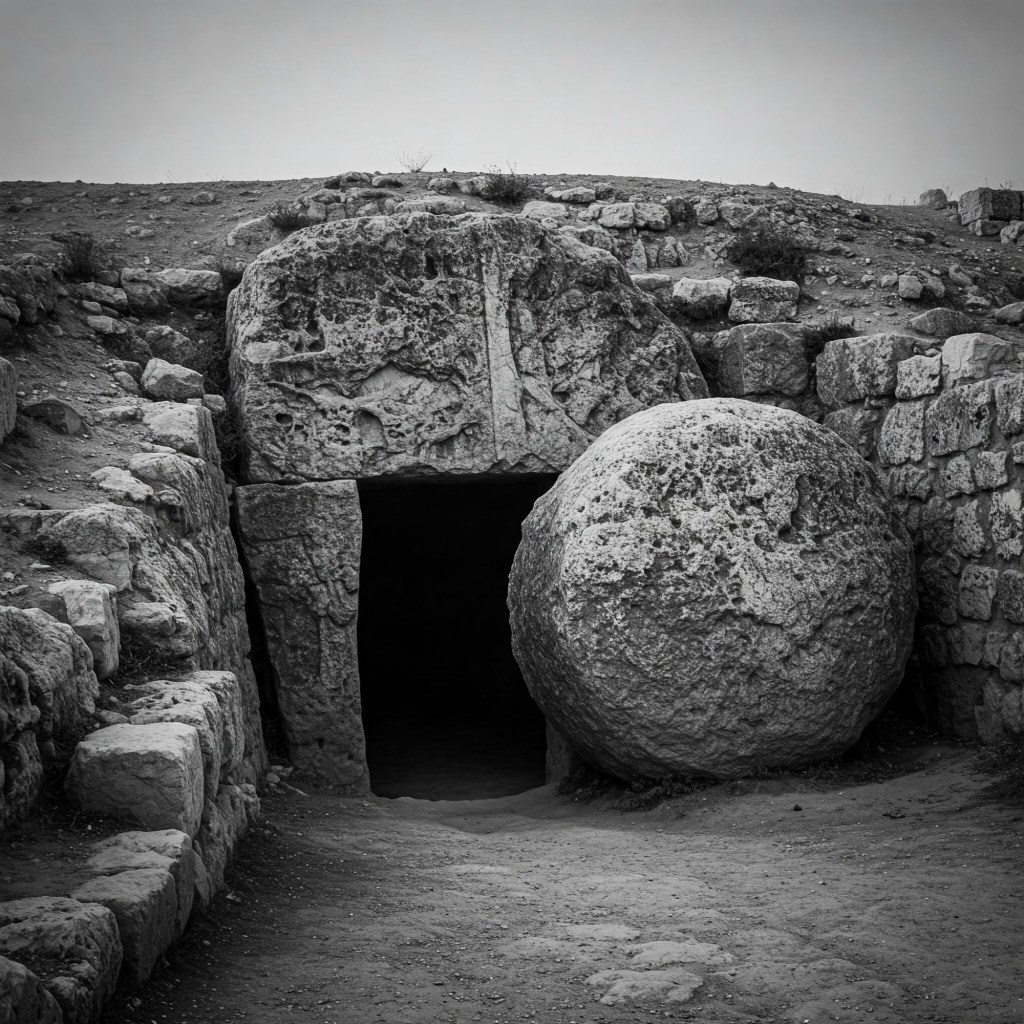
An AI generated image of the garden tomb in black-and-white set against grey sky. The entrance to the tomb is partially open, with a large stone across the right hand side of it. 

Here’s the passage in full : John 19:38–42 (ESV)

“After these things Joseph of Arimathea, who was a disciple of Jesus, but secretly for fear of the Jews, asked Pilate that he might take away the body of Jesus, and Pilate gave him permission. So he came and took away his body. Nicodemus also, who earlier had come to Jesus by night, came bringing a mixture of myrrh and aloes, about seventy-five pounds in weight. So they took the body of Jesus and bound it in linen cloths with the spices, as is the burial custom of the Jews. Now in the place where he was crucified there was a garden, and in the garden a new tomb in which no one had yet been laid. So because of the Jewish day of Preparation, since the tomb was close at hand, they laid Jesus there.”

Secret Disciples: Joseph and Nicodemus

Joseph of Arimathea, a wealthy member of the Sanhedrin, is described as a “secret disciple” of Jesus, concealing his faith due to fear of the Jews. His position in Jewish society made public allegiance to Jesus risky, potentially threatening his status and safety. Yet, in a bold act, Joseph approaches Pilate to request Jesus’ body, an action that could have exposed him to scrutiny. Similarly, Nicodemus, who previously visited Jesus at night (John 3:1–2), likely out of fear, joins Joseph in this act of devotion. He brings approximately seventy-five pounds of myrrh and aloes, an extravagant amount of spices, signaling his commitment. Their actions challenge modern Christians to examine their own faith. Many face pressure to hide their beliefs in hostile or secular environments. Rather than concealing faith, believers are called to proclaim it sensitively but unashamedly, as Jesus instructs in Matthew 5:16: “Let your light shine before others.” How can we move from secrecy to courageous witness in our daily lives?

Jewish Burial Customs in the Passage

In the first century, Jewish burial practices were rooted in respect for the deceased and adherence to purity laws. Deuteronomy 21:23 required prompt burial to avoid defilement, especially before the Sabbath. The body was typically washed, wrapped in linen cloths, and anointed with spices like myrrh and aloes to honor the deceased and mask the odour of decay. In John 19:38–42, Joseph and Nicodemus meticulously follow these customs. They wrap Jesus’ body in linen with the spices Nicodemus provides, a quantity far exceeding typical burials, reflecting deep reverence. Their care fulfills Isaiah 53:9, which prophesies the Messiah’s burial with the rich. This deliberate act underscores Jesus’ dignity, even in death.

The Garden Tomb: Location and Significance

John 19:41 describes the burial site as a new tomb in a garden, unused by anyone else. Joseph’s offering of his own tomb represents a personal sacrifice. Theologically, the tomb is a temporary resting place, foreshadowing the resurrection. Two possible locations in Jerusalem are associated with this site. The Garden Tomb, located north of the Damascus Gate, is favored by some Protestants for its serene, garden-like setting and rock-hewn tomb, fitting John’s description. Alternatively, the Church of the Holy Sepulchre, supported by early Christian tradition and archaeological evidence of first-century tombs, is widely accepted by Catholic and Orthodox traditions. If you would like my opinion, I favour the Garden Tomb location over the Holy Sepulchre .But I am no biblical archaeologist! 

Regardless of the exact site, the garden tomb invites believers to trust God’s redemptive plan, even in moments of apparent defeat.

The Disciples’ Limbo and Our Hope

For the disciples, Jesus’ death was a devastating blow. They believed Him to be the Messiah, yet witnessed His execution, leaving them in fear and confusion. Unaware of the resurrection to come, they faced a limbo of shattered hopes. Their vulnerability reflects the human struggle with uncertainty. In contrast, modern believers have the benefit of hindsight, knowing that Resurrection Sunday follows Good Friday. This perspective transforms despair into hope, as Paul writes in 1 Corinthians 15:20, describing Christ as “the firstfruits of those who have fallen asleep.” The disciples’ experience encourages Christians to hold fast to faith during trials, trusting that God’s plan unfolds according to his will. 

So what do we do? 

Joseph and Nicodemus, once secretive, acted with courage to honour Jesus in His burial. Their example challenges us to proclaim our faith boldly, even in difficult circumstances. We are called to trust in the resurrection hope, knowing that God’s victory overcomes life’s darkest moments.

The darkness of Friday has been and gone, and we find ourselves in the limbo of its aftermath. Fear not though, Sunday is coming…

The Cross and the Crown: Reflecting on John 19:17–24 This Good Friday

As Christians gather on this Good Friday, we pause to reflect on the sacrifice of Jesus Christ, the pivotal moment of our faith. John 19:17–24 captures the raw reality of the crucifixion, where Jesus is declared “King of the Jews” and His clothes are divided by soldiers. This passage reveals Jesus as the sovereign King of all, fulfilling ancient prophecies and completing His mission as the Savior of humanity. On this sacred day, we are called to marvel at His love and respond with heartfelt worship.

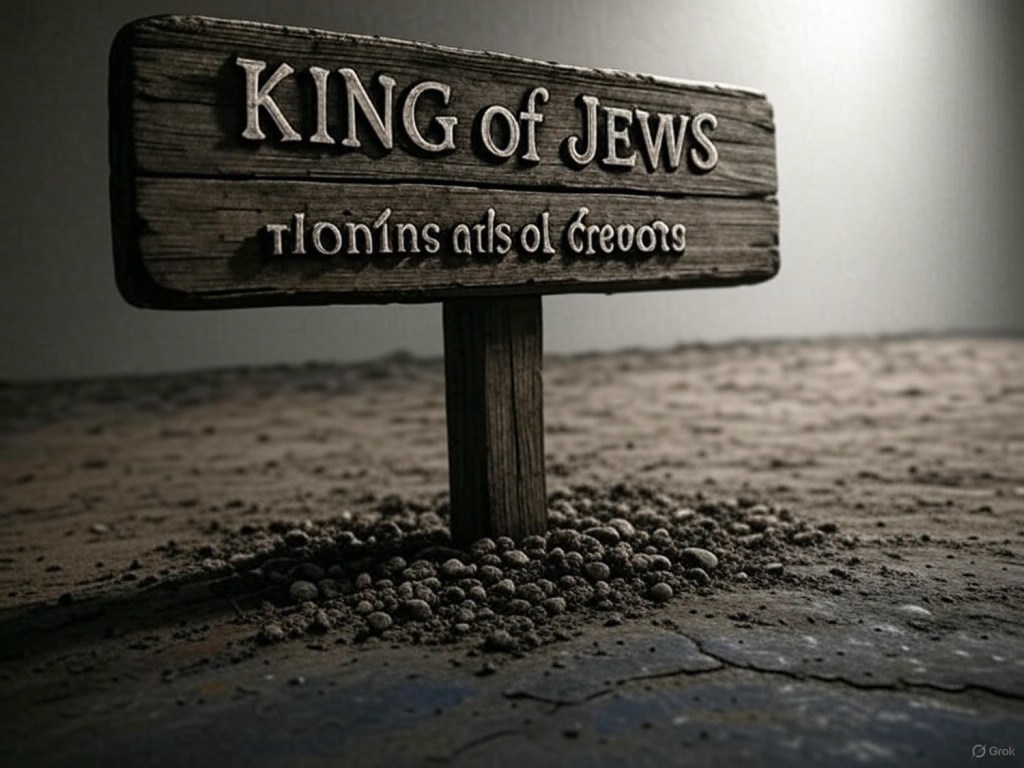
A wooden sign is planted in the ground, surrounded by small pebbles and dirt. The sign has the text “KING of JEWS” prominently displayed in large, bold letters. Below this, there is a line of text in a different script that reads ” πλοκίης αἰς οἱ ςρεοοης” which are random Greek letters for illustration . The background is a plain, slightly textured surface with a gradient of light and shadow.

Jesus: King of the Jews and King of All

John 19:17–19 recounts Jesus’ journey to the cross: “Carrying the cross by himself, he went to the place called Place of the Skull… There they nailed him to the cross… Pilate also had an inscription written and put on the cross. It read, ‘Jesus of Nazareth, the King of the Jews’” (NLT). The title “King of the Jews,” though meant as mockery by Pilate, proclaimed a profound truth. Despite opposition, Pilate refused to change the inscription (John 19:22), unwittingly affirming Jesus’ identity.

Jesus’ kingship transcends earthly boundaries. He is not only the King of the Jews but the “King of kings and Lord of lords” (Revelation 19:16, NLT). On the cross, His reign was established through sacrifice, challenging the powers of this world and offering hope to all who believe. Good Friday reminds us that Jesus’ kingship demands our allegiance. As Christians, we are called to live under His loving authority, trusting His sovereign plan even in the face of suffering.

The Soldiers and the Fulfillment of Prophecy

The scene at the cross continues in John 19:23–24: “When the soldiers had crucified Jesus, they divided his clothes among the four of them. They also took his robe, but it was seamless… So they said, ‘Rather than tearing it apart, let’s throw dice for it.’ This fulfilled the Scripture that says, ‘They divided my garments among themselves and threw dice for my clothing’” (NLT). This moment directly fulfills Psalm 22:18, written centuries earlier, proving Jesus as the promised Messiah.

This single fulfilled prophecy points to a greater truth: Jesus’ entire life and death align with God’s redemptive plan. From His birth in Bethlehem (Micah 5:2) to His suffering (Isaiah 53), Jesus fulfilled every Messianic prophecy, culminating in His sacrificial death. Good Friday marks the climax of His mission to save humanity, as He bore the weight of our sins on the cross. Even the soldiers’ callous actions, dividing His clothes, served God’s purpose, demonstrating His sovereignty over every detail. As we reflect on this, we stand in awe of Jesus’ obedience and God’s faithfulness.

Good Friday: The Weight and Wonder of the Cross

Good Friday is a day of somber reflection and profound gratitude.

Jesus’ death was the ultimate act of love, as He “gave his life to purchase freedom for everyone” (1 Timothy 2:6, NLT). John 19:17–24 anchors us in the reality of the cross—Jesus endured unimaginable pain to atone for our sins, fulfilling the Law and the prophets. His kingship, declared in the inscription, and His fulfillment of prophecy, seen in the soldiers’ actions, assure us of His victory over sin and death.

On this day, we are invited to pause and contemplate the cost of our salvation. The cross reveals both the depth of human sin and the boundless love of God. As we consider Jesus’ sacrifice, we find hope in His reign as King, knowing that His death was not the end but the beginning of eternal life for all who believe. Good Friday calls us to lift our eyes to the cross, where our Savior triumphed.

A Call to Worship

In response to Jesus’ kingship and sacrifice, our hearts turn to worship. Good Friday is a time to gather in worship services, pray, or meditate on Scripture, giving thanks for all Jesus has done. Reflect on His love, which led Him to the cross, and commit to living under His reign daily. Let this day inspire a life of worship, where every action honors Jesus as King and Savior. As Psalm 95:6 urges, “Come, let us worship and bow down. Let us kneel before the Lord our maker” (NLT).

Humility, Compassion and Authority

As ever, it was a great pleasure to speak at my church yesterday morning.

We have been studying the book of Luke, and yesterdays passage cover the first 17 verses of Luke 7.

I share below a copy of the recording, which I hope you enjoy. The microphone picked up a fair bit of background noise which I hope does not spoil your enjoyment.

Why Does God Allow Suffering? – Andy Brown

We take a little break from the book of Acts to consider this question today. Many individuals over the centuries have tried to answer this one, and the vast majority were cleverer than I am! I offer a few thoughts here which I hope you find helpful. The argument often goes something like this. If…
— Read on andy-brown.org/2020/06/29/why-does-god-allow-suffering/

Inseparable

To be honest, I have been mulling this post over for a couple of days. It is not controversial in any way, it is just that I have struggled to articulate what God has shown me. It is not some huge revelation either, simply that God met me where I was at, and through His Word spoke directly into my situation. Has such a thing ever happened to you? I’m sure it has…

A few days ago I wrote a post entitled Ask and Believe – linked here – where I prayed about something and the answer came. In an entirely opposite way, I prayed for something else and unfortunately the exact opposite happened. It did not shake my faith or anything so grand, as I am slowly learning to trust in God’s will for my life. The unanswered prayer led me to a choice I did not want to have to make, and neither could I put it off. I have since been anxious that I made the wrong decision.

In those moments of fear and worry, I was directed to read the following Bible verses. The comfort they brought is really the intangible substance I am struggling to describe. Perhaps it is best to simply let the words speak for themselves.

For I am convinced that neither death nor life, neither angels nor demons,[a] neither the present nor the future, nor any powers, 39 neither height nor depth, nor anything else in all creation, will be able to separate us from the love of God that is in Christ Jesus our Lord.

Romans 8:38-39 (NIV)

Paul was entirely convinced, that is – fully persuaded – that nothing can separate us from the love of God found in Christ Jesus. I was not convinced, based on my initial feelings, until God so gently reminded me of this truth.

The things that Paul lists here are heavy hitters. Death, demons, the powers of hell – none of these things will ever be able to remove us from God’s love.

I have been reading these verses over and over, and letting them minister to me. There is nothing – simply nothing – in all creation that can pull us away from the gravity of God’s love. We are inseparable.

When our prayers do not get the answer we wanted, or when we face times of great difficulty, it can be all too easy to start to doubt God’s love. Yet in Christ and what He did at the cross, there is an immovable, unchanging, eternal testimony of that love.

God’s love does not equal instant access to a 100% prayer record, nor a complete trouble-free existence, but it does mean that no matter what happens, He will be right there with you in the thick of it. He is trustworthy. You can fully rely on Him. That love gives you an assurance that when you one day stand before Him, there will be nothing that separates you from His presence. When we put our trust in Christ, receiving that love and submitting to Him, our sins are washed away and our place with Him is irrevocable.

I needed that assurance this week. Perhaps you will need it today? Put Romans 8 before your eyes, read it aloud and trust that you cannot be separated from His unfailing love.

No created thing can come between you and God’s love when you are fully committed to Christ. There is but One who is not created, and that is God Himself. You are anchored and fixed in that love. Draw on that truth this day and always.

God doesn’t forgive issues (PoW)

Pearls of Wisdom

God does not forgive issues; He forgives sin

Every so often, I put out a shorter post which I call Pearls of Wisdom. The usual format is a short phrase or “pearl” with a few words from me highlighting its wisdom. I mention it here as I’ve not done one in a while, and I know there are a few newer readers. (Thanks for joining me!)

I listened to a sermon this week, and the preacher happened to mention the above phrase. It struck me that when we minimise sin (referring to it as slip, mistake or issue) we also minimise what God has done to resolve it.

We may not like to use the word sin or sinful to describe our behaviour, and so water it down with words like issues. All this does is serve to weaken our resolve against sin in all its forms.

God hates sin, and so should we. Christ’s great work at the cross did not achieve the forgiveness of “issues” but of sin and its wickedness.

The older I get, the more I realise the depth of my sinfulness. Not that I consider myself worse than anyone else, it is rather that the more I get to know Christ, it becomes apparent how far short I fall of His wonderful holiness.

Sin is a dreadful thing, and it carries a heavy cost. We Christians can be thankful that this cost is fully paid for by Christ. Let us not minimise His work by softening sin down to mere mishaps. Sin is sin, and yet God forgives it through the blood of Jesus! Hallelujah!

Rejoice in this truth today, and be blessed!

Three Days

For us, Easter Saturday sits between the devastating day of the cross on Good Friday, and the joy of the resurrection to come on Easter Day. I prefer the name “Resurrection Sunday” but perhaps that’s a discussion for another time!

For the friends of Jesus two thousand years ago, many of them were not ready or waiting for the resurrection at all. This day would have been a day of loss and grief for them. All of their hopes and dreams had been smashed. They had expected Jesus to evict the Romans and set Himself up as King. Quite the opposite had happened! Their Messiah had been lost. 

Would they have started to doubt themselves? Would they have been asking one another – was this really the Christ after all? They had seen so many miracles and wonder works, yet they had not expected Him to die like a common criminal. 

It may seem somewhat baffling to us that the disciples had not heard the words Jesus had spoken. In advance of these things, He had told them that it would happen. And even beyond His words, the Scriptures foretold it all. But I think we can forgive them for not seeing that in the prophecies of the Old Testament. 

From that time on Jesus began to explain to his disciples that he must go to Jerusalem and suffer many things at the hands of the elders, the chief priests and the teachers of the law, and that he must be killed and on the third day be raised to life.

Matthew 16:21 (NIVUK)


For what I received I passed on to you as of first importance[a]: that Christ died for our sins according to the Scriptures, 4 that he was buried, that he was raised on the third day according to the Scriptures, 5 and that he appeared to Cephas,[b] and then to the Twelve.

1 Corinthians 15:3-5 (NIVUK)

The verse above from the Gospel of Matthew shows that Jesus taught His disciples that He would die, and three days later rise to new life. Likewise, Paul (in hindsight of course) shares the same thing. Paul says however “according to the Scripture.” So the Old Testament must have predicted this in advance.

But where?

When reading Old Testament prophecies, we must understand that often they do not merely say “The Son of God will come, and His name will be Jesus, and after dying He will come back to life after three days…” That would be convenient for Bible scholars of course, but we must not forget the Old Testament was written by many people over hundreds of years. Despite this, it really is astonishingly coherent, and clearly shows the hand of the divine behind it. 

The first place I want to point to is the lie – or rather death – of Jonah the prophet. Sometimes called “The Reluctant Prophet,” because he ran in the total opposite direction to where God was sending him, Jonah is a fascinating character. 

You probably know his story from Sunday School, if you ever went, and may well be familiar with his being swallowed by a large fish or whale. 

Now the Lord provided a huge fish to swallow Jonah, and Jonah was in the belly of the fish three days and three nights.

Jonah 1:17 (NIVUK)

We see here that Jonah spent three days and three nights in the belly of the fish. Reading on to Jonah 2, I think it is clear that Jonah actually died in the sea or sea creature. He talks about the abode of the dead, or “the pit” so it seems likely he did actually die. If not though, the point remains. 

Bible prophecy is often pattern and not prediction. that means it establishes a pattern of events which will occur again in the future. Jonah’s three days and three nights of “death” are a pointer towards Christ’s own experience of three days in the grave. 

Similarly, Abraham’s sacrificing of Isaac is another picture. I’ve spoken before about this passage from Genesis 22, and personally believe it is a prophecy acted out by Abraham of what God would one day do with His own Son Jesus. 

We read in Genesis 22 that from the time when God gave the command for Isaac to be sacrificed, to the time Abraham arrived at Mount Moriah was precisely three days. 

Early the next morning Abraham got up and loaded his donkey. He took with him two of his servants and his son Isaac. When he had cut enough wood for the burnt offering, he set out for the place God had told him about. 4 On the third day Abraham looked up and saw the place in the distance.

Genesis 22:3-4 (NIVUK)

In the Jewish mind, and so in Abraham’s mind, Isaac was essentially dead from the moment God had given the command. It was a three day journey, as we read above, until the events unfolded and Issac was returned to Abraham. So another son lost to “death” for three days. 

There is more we could explore, but it would and should take an entire lifetime to examine the Old Testament and unveil the prophecies which spoke of Christ’s death and resurrection centuries in advance. 

Many will tell you that you can’t prove God exists, or there is no evidence that the Bible is true, it’s just a personal matter of faith. Not true. A comprehensive study of God’s Word will show you that there is incontrovertible evidence of biblical truth. The more you study it, the more you will realise it is not only true, but the only real truth we can rely upon. 

Jesus died for you. Three days later He rose from the dead. Many witnesses saw it. You don’t have the luxury to ignore it or deny it. So what will you do with this truth today? 

Seven Sayings of Jesus at the Cross

It is Good Friday and the day we remember Jesus’ crucifixion. I find days like this quite difficult to write on, because so much has already been said. What can I possibly hope to add to the many faithful people who have penned words on this subject over the centuries?

I woke early this morning, and as I lay in bed, I thought about the crucifixion and what I might say about it.My thoughts turned to some of the things that Jesus said while He was nailed to the cross. So we will spend some time today considering His words. 

Jesus spoke seven “Last Words” at the cross, as they are sometimes called, and we will go through each in turn. 

Jesus said, “Father, forgive them, for they don’t know what they are doing.”

Luke 23:34 (WEB)

None of us really know who we are until we are put under immense pressure. When all is well, life is good and we go with the flow. But when hard times fall, the weight of worry can reveal who we really are. It can bring out of us the character that lies beneath. That is also true for Jesus, and we see the absolute perfection of His character in this first saying. 

Jesus, in terrible agony and suffering, takes the time to pray for the ones who have done this to Him. He would have had every right to call down legions of angels to destroy those who would even dare to dream of doing such a thing to Him. Yet He prays for them…

I could point out what we could all learn from such an example. I could say that we all should prefer others to ourselves. But today, on this Good Friday, I want to emphasise the unimaginable love of our Saviour. As His very creation turned on Him, He prayed for their forgiveness. Jesus truly deserves our worship!

Jesus said to him, “Assuredly I tell you, today you will be with me in Paradise.”

Luke 23:43 (WEB)

These words of Christ were spoken to one of the criminals crucified with Him. In Matthew’s Gospel, we read that both criminals hurled insults at Jesus (see Matthew 27:44). Yet, one of them now turns to Christ in his dying moments. Facing his death, the criminal realises that there is indeed a God to face on the other side. As he looks to the side and sees the Innocent Christ on the cross, he realises he needs a Saviour. 

Again, we see the quality of Christ here. In pain we cannot imagine, He still offers words of comfort and forgiveness to this lowly robber. 

It shows us also that while we still have breath in our bodies, it is not too late to turn to Jesus. 

Therefore when Jesus saw his mother, and the disciple whom he loved standing there, he said to his mother, “Woman, behold, your son!” 27 Then he said to the disciple, “Behold, your mother!” From that hour, the disciple took her to his own home.

John 19:26-27 (WEB)

Once again we read words of Christ not about Him or His suffering, as you might expect from a man nailed to a cross. Instead, we see further selflessness from the Son of God, this time commending His earthly mother to the disciple whom He loved. Knowing the sorrow in His mother’s heart, He took a moment to ensure she was cared for. Jesus entrusted Mary into John’s care, and even now fulfilling the Ten Commandments and honouring His mother. 

About the ninth hour Jesus cried with a loud voice, saying, “Eli, Eli, lima sabachthani?” That is, “My God, my God, why have you forsaken me?”Psalm 22:1

Matthew 27:46 (WEB)

Up until now, the words of Jesus we have studied have been words for the benefit of others. Now we glimpse the degree of pain He must have felt. Jesus here quotes Psalm 22, and I encourage you to read it today. 

Psalm 22 was written a long time before Jesus was born, and even before crucifixion itself was invented. Yet the psalm paints a picture of a horrendous crucifixion. It is a clear prophecy of Christ’s death at the cross. 

There are many reasons to be convinced that Jesus Christ was and is the Son of God. For me, the many hundreds of prophecies that He fulfilled are more than enough evidence of this truth. 

After this, Jesus, seeing that all things were now finished, that the Scripture might be fulfilled, said, “I am thirsty.”

John 19:28 (WEB)

A great thirst is one of the consequences of a crucifixion death. Much has been written on the medical impacts of such a death, and most victims would have died of suffocation. They would hang by their limbs, pushing up to take each breath. Eventually they would weaken and no longer be able to breathe. That is why the Romans would sometimes break the legs, preventing the victim from pushing upwards any longer. 

Jesus, it seems, did not die this way and was already dead when they came to break His legs. This, too was fulfilment of a prophecy which said none of His bones would be broken. 

You might imagine that such a slow and terrible death would leave the victim incredibly thirsty, and so His words are a clear sign of this. 

The words themselves are fulfilment of prophecy too. 

When Jesus therefore had received the vinegar, he said, “It is finished.” Then he bowed his head, and gave up his spirit.

John 19:30 (WEB)

It is finished. Jesus completed His work. The plan that had been instigated the very moment of the Fall in the Garden of Eden, had reached its goal. Sin’s full payment had been made. Every man and woman who now looked to that cross for salvation would find it. 

Jesus, crying with a loud voice, said, “Father, into your hands I commit my spirit!” Having said this, he breathed his last.

Luke 23:46 (WEB)

Jesus very last words. Completing His work, He gives up His spirit into His Father’s hands. Those who stood by knew this was no mere man. Even the Centurion confessed that this was indeed the Son of God. 

Jesus, at His death, trusted His spirit to His Father. Every day and in every way, you and I should learn to trust the Father to a greater degree. Every time we worry or fear, we are saying that we do not trust Him. If we do not trust God in the everyday, how can we trust Him with our eternal security? 

One day every one of us will “give up their spirit” and enter eternity. Only those who put their faith and trust in Jesus’ work at the cross will find peace that side. Let this Good Friday be the one where you give yourself wholly to Christ. Don’t live in doubt anymore, put your trust in Him now and forever. 

Jesus died for you. He suffered on your behalf. He paid the full price for your sin. Do not let that go to waste! Accept that gracious gift and be forever free!

Pearl of Wisdom #12

Beating yourself up is a symptom of pride.

In the past, when I made a mistake I would tend to beat myself up about it. The length and severity of my “self-beating” would depend on how serious I perceived the mistake to be.

And let’s call it what it is – not a mistake, but a sin. A falling short of God’s standards.

I’d think to myself, “How could I have done such a thing? I’m supposed to be a Christian! I’m better than that, and I shouldn’t be doing such things! I’m so unworthy. I just can’t do anything right!” And so on and so forth.

Read back what I used to say to myself again. How many times did I use the term “I” or something similar to it?

Answer: a lot.

How could I have done such a thing? Well, because I’m only human, I’m not perfect and I’m still on a journey with Jesus. As long as I live and breath, I’ll never be perfect in and of myself, only in Christ.

It is a symptom of pride. Believing we are above sin or simple mistakes indicates that we have a proud heart.

Often we think that beating ourselves up is a humble thing to do – far from it. In fact, it is suggestive that we don’t think Christ’s punishment was enough, and that we somehow need to add to it.

If you sin this week, don’t spend any time beating yourself up. It’s a waste of time. Just accept Christ’s work and forgiveness and move on.