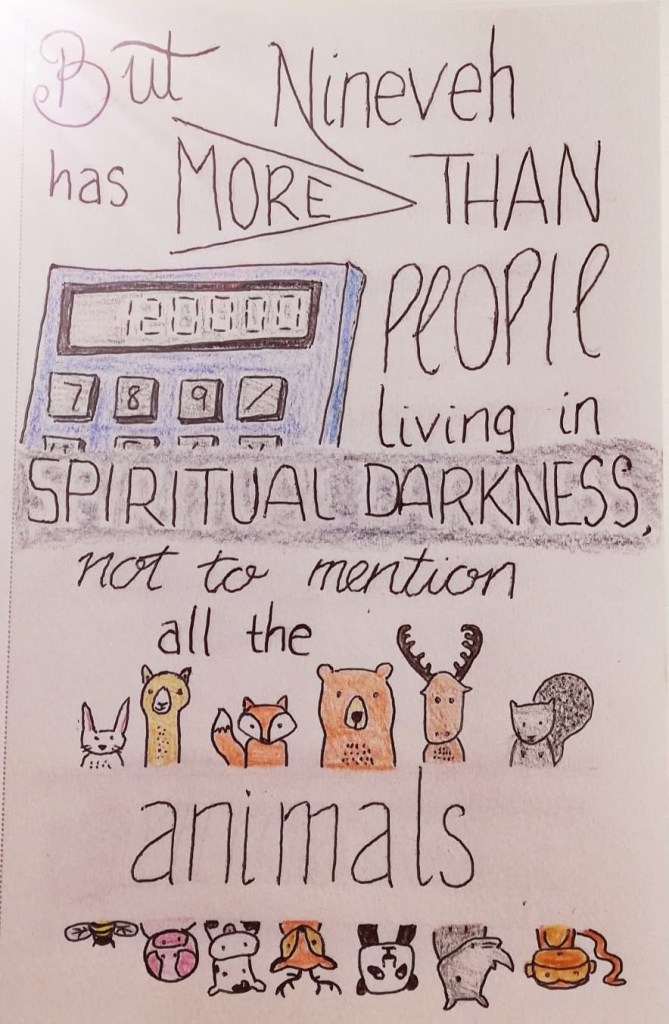
What about the animals?

Jonah 4:11 (NLT) But Nineveh has more than 120,000 people living in spiritual darkness, not to mention all the animals. Shouldn’t I feel sorry for such a great city?”

As I write this, I’m overlooking a sort of forest woodland. In the last few minutes I have seen an abundance of nature! I’ve seen ducks, squirrels, deer, rabbits and even what I think was a stoat.

Due to the Coronavirus, the woodland has largely been abandoned at the moment. I suspect that the sudden drop in guests will quite badly affect the wildlife here. Over time I am sure they have become somewhat dependent on the food given to them by visitors. This area will be closed to the public for several weeks leaving the animals to fend for themselves for a while.

While the sudden drop in available food will be a bit of a shock to them, I am not overly worried about them. God cares for people, but He cares for His creation also.

There have been a number of posts on social media about panic buying and stockpiling. As a result, many food banks and charities have seen a dip in food donations. This is not limited to charities offering support for people either, and a number of animal rescue shelters are struggling too. The Coronavirus is affecting the whole world in myriad ways.

The verse above is quoted from the book of Jonah in the Old Testament. In fact, it is the closing verse of that book. Most people recall that Jonah was once swallowed by a big fish, but in case you don’t know the rest of the story, here is a brief summary.

God called Jonah to preach to the non-Jewish (Gentile) city of Nineveh. Instead, Jonah heads in the complete opposite direction and boards a ship to Tarshish. A great storm swamps the ship, and in the end Jonah confesses to the crew that he is the cause of their struggle. Ultimately they have to throw him overboard to still the storm.

It is at this point – more or less – that Jonah is swallowed by the fish. The fish later spews up the reluctant prophet on to the shoreline, and Jonah finally goes to Ninevah as he was instructed.

Jonah did not want to go to Ninevah and preach because he was afraid the people would listen to him… He knew that if they heard his message, they would repent and turn back to God – and God would forgive them. Imagine that?

After he gives his message, he goes and sits outside the city to see what would happen. The sun is burning hot, and he grows weary. God causes a vine to grow up beside him and offer him some shelter. Later however, a worm comes along and eats the root of the vine so it withers and Jonah loses his shade.

It’s something of an odd story right? Indeed it is, but it is really about who is in charge. God is running the show throughout, and He gives Jonah the vine and quickly takes it away to demonstrate to Jonah that he has no control in the situation. God wants Jonah to realise that He cares for the people of Ninevah.

The book of Jonah closes with the verse above. God tells Jonah He is right to care for the 120,000 people living there. We don’t know what happened to Jonah after this, but let’s hope he learned a lesson!

Perhaps 15 years ago, I had a dog who was very poorly. They had a particularly bad night, and we had to contact an emergency vet. The next day I happened to be reading this closing chapter of Jonah. I’ll always remember that because I recall very vividly this final verse. As well as the 120,000 people, God specifically mentions the animals also.

The word animals here is sometimes translated as cattle, so perhaps refers to farm animals or bovine species. Whatever it refers to though, it is clear that God cares for the animals also.

Animals are a part of God’s creation. While they are not as important as people, they are important. We have a responsibility to take care of them, and must certainly not mistreat them.

Spare a thought this week for all those affected by the Coronavirus. We must prioritise helping people with various needs at this time. We, the church, may not be able to gather together in large numbers, but we can and must continue to be Jesus’ hands and feet on the Earth. Call an isolated family member. Check on an elderly neighbour. Let’s do what we can to share God’s love in this difficult time.

As well as those things, and if you’re not overstretched, do consider whether there are ways to take care of God’s creation also. You might consider grabbing a can of dog food to pass on to a struggling pet owner. Perhaps you could walk a friend’s dog. Maybe, like me, there is a nearby animal shelter who could do with a helping hand at this difficult time.

Like many, I’m deeply disappointed to read stories of fighting in supermarkets and immoral seller hiking up prices. There are plenty of positives stories also, and we – the church – should be leading the way in that.

How can you be a blessing to those around you at this time? And remember, God cares about the animals also.

The Sinfulness of my Sin

I acknowledged my sin to thee, and my iniquity have I not hid. I said, I will confess my transgressions to the LORD; and thou forgavest the iniquity of my sin. Selah.

Psalm 32:5 (WEB)

The sinfulness of my sin… captivating title right? And I know what you are thinking – two blog posts in two days? What’s gotten into Andy?!

I’m pleased to report that all is well, and I’m not self-isolating with nothing to do. In fact, I am very conscious of how everyone is feeling right now, and hoping that a few extra blog posts will be well received.

A few weeks ago I spoke on Psalm 32. You can listen to that message here. It is a wonderful Psalm and I only had a short time to discuss it. This post covers one of the things I did not have time to explore.

The totality of the Psalm is about sin and repentance. It points out the depth of our wrongdoing, the wonder outs grace of God and our responsibility to confess and acknowledge our sin.

There is an interesting little phrase in verse 5 which says God forgives the “iniquity of our sin.” We might say the “sinfulness of our sin.”

Some translations of the Bible render this as the “guilt of our sin,” but this doesn’t quite cover it in my view.

If God forgives our sin, then what does it mean for Him to forgive the iniquity of our sin?

It is like saying the “saltiness of salt,” or the “chocolatey-ness of chocolate…” What is the psalmist getting at here?

Often when we say “Sorry,” we are not really sorry for what we did, but rather are sorry we got caught. When we see hardened criminals breaking down in tears in the dock of the courtroom, it is often about the loss of their freedom, money or reputation. Being sorry for the consequences of sin is of course very natural, and a great reason not to do it in the first place. But are we sorry for the sin itself? If we never got caught, are we truly repentant for the thing we did?

The sinfulness of our sin is the badness of our sin. It is to recognise that sin is wrong, not because it has terrible consequences, but because it is wrong in the sight of God.

When we are truly repentant, we are sorry to God for falling short of His perfection. We are saying that the thing we did – the things we all do – are very wrong irrespective of consequence and punishment.

God forgives us not just from the punishment of sin through Jesus’ death at the cross, but for sin’s sinfulness also. God forgives us for the wickedness of our sin, and all of its consequences. That is not to say that we are free from any consequence on Earth of course, just rob a bank to see what I mean. God can forgive a robber, but they’ll still go to jail for it.

The point is that we need to recognise that our sin is wrong. It is wrong in and of itself. The consequences are indeed terrible, if facing them without Christ, but the sinfulness alone is wicked before God.

As you reflect on and confess your own sins, ask yourself if you are sorry for what they are, or for their consequence.

Spend some time this week to reflect on where you have fallen short, and on the One who forgives all of your sins and covers all of your iniquity. Come to Jesus at the cross and surrender your whole life to Him. It will be the best decision you ever made!

Where To Draw the Line

Last time, I wrote about how to defend yourself against deception. This time, I want to think about where we draw the line when it comes to Bible teachers we disagree with.

What I mean is, no single teacher has everything 100% correct. And if you are looking for a theologically perfect teacher, then you will be searching for a very long time. All of us are on a journey, including those with a gift to teach, and so there may be elements of their teaching which is not quite correct.

Myt question, therefore, is where do we draw the line?

Clearly if someone is teaching blatant heracy, we should avoid them like the plague. You probably don’t need me to tell you that! If they teach that Christ is not the only way to God, or that we can earn our way into heaven (as examples) then have nothing to do with them.

But even though we, or an angel from heaven, should preach to you any “good news” other than that which we preached to you, let him be cursed. 9 As we have said before, so I now say again: if any man preaches to you any “good news” other than that which you received, let him be cursed.

Galatians 1:8-9 (WEB)

Usually however, false teaching is rarely so obvious.

I was listening to a sermon the other day and was learning from what was being said. At one point however, the speaker made a comment about God’s Sovereignty. As you know, this is something I’ve been thinking about over the last year and so I was perhaps more attentive to such a statement than I might otherwise have been.

What they actually said is not relevant here, but it suggested they had a more liberal view of what God’s Sovereignty actually meant. It was a passing remark, and not a full statement of their beliefs. What if though, they had a mistaken or false view of God’s Sovereignty? Should I abandon the teaching altogether and forget all that they said?

The doctrine of God’s Sovereignty, like some others, is a critical doctrine and so likely affects all other aspects of our faith. If we have a wrong belief about such a foundational truth, then that will likely have a knock effect on what else we believe.

There are some issues in the Bible which I think are fundamental. I mentioned some of these above, but would also include the inerrancy of Scripture and the deity of Christ. There are other matters however, which are perhaps less clear cut and there is space for believers to disagree (agreeably).

So how can we decide if we should listen to and accept one Bible teacher’s lessons over another?

There is no easy answer I’m afraid. I cannot give you a single formula where you can plug in certain factors and get out a Yes or No answer.

We must start with what I discussed last time. We must attempt to gain a systematic and complete view of Scripture. The better we understand the Bible as a complete message, the easier it will be to detect false teaching when we encounter it. And by “false teaching” it could be mistaken teaching rather than deliberately deceptive.

As I said last time, we must interpret Scripture in the light of other Scripture. We must not take individual verses and make a new doctrine out of them. Context helps us understand what the message is meant to be.

Secondly, i think we should take each case in its own right. There may be a difference between us listening to a single message from someone, and us choosing to regularly sit under their teaching. A single message may be fine, but when we sit under someone’s teaching for a length of time, we will inevitably be learning more about their perspective and theology.

While of course we need to be on guard, I also don’t think we should be closed minded. Within reason, I try to listen to a variety of teachers in order to try to gain a wider perspective. That’s not to say I swallow any and every teaching that comes along, but if you only listen to one teacher, you only get that one perspective.

Finally, and perhaps most importantly, we must take everything back to God in prayer and His Word. If you encounter a teaching which you are not sure about, then take the time to see what the Bible says about it. Instead of just listening to a teacher, discuss it with the Teacher. Be a Berean!

Now these were more noble than those in Thessalonica, in that they received the word with all readiness of the mind, examining the Scriptures daily to see whether these things were so.

Acts 17:11 (WEB)


But the Counselor, the Holy Spirit, whom the Father will send in my name, he will teach you all things, and will remind you of all that I said to you.

John 14:26 (WEB)

Understanding the Bible is not an easy or simple task. It is a complex book, but it is meant for believers. If you know the Lord and are seeking to follow Him with your life, then the Bible is there for you. Speak to God about it and He will teach you from it. It may take a lifetime to learn, but it is worth every effort you put in.

I hope this has been helpful.

Get into the Word (PoW#23)

Pearl of Wisdom #23

If you get into the Word of God, then the Word of God will get into you!

You will never be a strong or successful Christian unless you get into the Word of God in the Bible. Consider the Bible as your spiritual food!

As you begin to study the Word of God and absorb it’s truths, those truths will begin to shape your life. As you get into the Word, it will begin to get into you as well.

This means that when you need it, the Holy Spirit can bring the Word to your memory. He can bring that Word to life in any situation. The Bible describes the Word of God as a “sword of the Spirit,” and the Spirit can put that “sword” in your hand when you need it.

As you read and study the Bible, the truths you learn will change your mind – how you think. It will shine light on areas you need God’s help with, and it will encourage and strengthen you.

Get into the Word this week, and let that Word shape your life!

Willing to Pay the Price? (PoW#22)

Pearl of Wisdom #22

Don’t expect what other people have, unless you’re willing to pay the price they paid to get it.

Some say we live in the age of entitlement. People have a tendency to want or even expect what other people have – without being willing to pay the price they paid to get it.

Some newly weds or homeowners expect the same standard of living as their retired parents, not realising it took their parents their entire lives working and saving to be in a position to live that way.

We want to lose weight and be fit and healthy, but don’t want to spend the hours in the gym we need to. We want the “body” but aren’t willing to let go of the chocolate!

The same can be true of churches and ministries. We see a “big church” (which is not necessarily a measure of success) and want our church to be the same. A Bible teacher draws in a crowd of hundreds, and we feel we ought to have at least the same.

What we often fail to understand is that these things all come at a cost and a sacrifice. Whether in ministry or in business or life in general, success takes time and patience. We may be watching the end result of years of hard work, expecting to have it all in a few weeks.

I encourage you to have goals and dreams, but set realistic expectations. Don’t look at others and covet what they have. Do what they did to get it. Learn from them, and strive towards your goals.

And remember, we usually only ever see the “edited highlights” of a person’s life. Instagram and Facebook are very selective windows into a person’s world.

Be blessed this week.

Humble Pie (PoW#21)

Pearl of Wisdom #21

Humility isn’t thinking less of yourself, rather it is thinking of yourself less.

Humility isn’t exactly something we celebrate much in our culture. When we look to celebrities, we offer see arrogance, selfishness and pride.

Many of us misunderstand what true humility is. We believe that a humble person is someone who beats themselves up constantly, who treads themselves down and thinks very little of themselves.

That is not biblical humility.

Humility is not about mistreating ourselves, instead it’s about moving ourselves out of the way and keeping God in His proper place in our lives.

A humble person is someone who is totally reliant on Jesus. They don’t think of themselves more or less than they ought, and instead keep their minds on Christ.

Pride can be seen in arrogance of course, but it can also be seen in self-loathing. Pride is simply putting the emphasis on “us” rather than God.

Try to be humble this week. Don’t loathe yourself, love Jesus!

Make me “usable” (PoW#20)

Pearl of Wisdom #20

Don’t seek to be used by God, instead seek to be usable.

Many of us want to be used by God in some special way to do a great work for Him. There is nothing wrong with such a goal, and it comes from our love for Him.

We ask God to use us, but often times God won’t answer this prayer. It’s not that He doesn’t want to, but rather He doesn’t want us to be harmed. God cares more about us, than about how He can use us. He loves us, not what we can do for Him.

Think of it this way; He will not put us into a situation we cannot handle, bringing harm to us and to others, just to get something done. He would rather help us grow to a point where we can serve Him in this world.

Don’t ask God to “use you”, instead ask Him to help develop your character so that He can use you. When we become “usable” we no longer need to worry about God putting us into positions of service. Once we are mature or have the experience we need, God will put us to work to bless others.

God loves you more than you know.

Life is not a dress rehearsal (PoW#19)

Pearl of Wisdom #19

Life is not a dress rehearsal

We only get one shot at life, and it is often far shorter than we would like. There is no dress rehearsal, and we do not get a second chance.

We must make the most of every single day!

All of us look back over our lives and wish we had done certain things differently. We recall wasted opportunities or mistakes, and wonder what might have been. This is not without value, but we cannot live in the past.

Even if you have wasted every day up to now, you can still make the best of whatever time you have left. Don’t waste it! Time is the one thing you cannot get more of.

You can’t change what has been, but you can do whatever you can to make the most of the rest of your life. Be blessed.

Success and Pre-success (PoW#18)

Pearl of Wisdom #18

You are not a failure; you just haven’t succeeded yet

You are not a failure until you truly give up. Everyone else is just “pre-successful”.

Thomas Edison, although perhaps not the true inventor of the light bulb, never gave up. He “invented” numerous ways of how not to make a light bulb, until he finally got one that worked. And he only needed one.

Whatever it is you are trying to achieve, don’t ever consider yourself a failure. Until you are successful at your goal, you are just learning all the ways not to do it, and if you keep trying, you will make it one day.

Never give up! Push on and keep trying! You can do the things that God has put on your heart to do! Don’t ever let the word “failure” come out of your mouth – instead, just consider it a practice run!

Faith and Unbelief

I want to draw this mini series on healing to a close by thinking about a passage from Matthew 17. There is, of course, much more to say about the subject of healing and this was not meant to be an exhaustive study.

One of the major questions people have is, “Why was I not healed when I asked?” Great question! Some will say that it is not always God’s will to heal, in which case, that is one possible answer. I personally don’t hold that view, but understand I am perhaps in the minority.

There are some things we can learn from Matthew 17, which says:

As they approached the crowd, a man came up to Jesus, knelt down in front of him, 15 and said, “Sir, have mercy on my son, because he is an epileptic and suffers terribly. Often he falls into fire and often into water. 16 I brought him to your disciples, but they couldn’t heal him.”

17 Jesus replied, “You unbelieving and perverted generation! How long must I be with you? How long must I put up with you? Bring him here to me!” 18 Then Jesus rebuked the demon and it came out of him, and the boy was healed that very hour.

19 Then the disciples came to Jesus privately and asked, “Why couldn’t we drive it out?”

20 He told them, “Because of your lack of faith. I tell all of you with certainty, if you have faith like a grain of mustard seed, you can say to this mountain, ‘Move from here to there,’ and it will move, and nothing will be impossible for you. 21 But this kind does not come out except by prayer and fasting.”

Matthew 17:14-21 (ISV)

These events happen shortly after the Transfiguration of Jesus. He and the chosen disciples returned from the mountaintop to the unfolding scene described above.

A man approaches Jesus, seeking healing for his son who is described as an epileptic. He had first gone to the disciples, and the text clearly states that they (the disciples) were not able to heal the boy.

Before we dig into this, look at Jesus’ reaction… was He pleased by this turn of events? Clearly not! In fact, He had some rather strong words to say about it.

Jesus replied, “You unbelieving and perverted generation! How long must I be with you? How long must I put up with you? Bring him here to me!”

Matthew 17:17 (ISV)

Jesus was clearly not impressed with this situation. He did not react with comforting words, or reassure the disciples that it was not their fault. Instead, He rebukes them! Obviously Jesus was here expecting them to be able to minister to this young boy. If not, He would have said so – “Don’t worry lads, this was too difficult for you to achieve. I’ll have to do it myself.” No, instead He criticises them for their unbelief.

Jesus healed the boy immediately. Don’t miss that fact. He clearly wanted this person well, and delivered him from this sickness.

Verse 19 is important. The disciples ask a similar question to what we often ask, “Why couldn’t we heal him?” Or rather, “Why didn’t it work when I prayed?”

The very fact that they asked this question shows that they expected him to recover from this sickness. If they didn’t expect that, then they would have just moved on. It also shows that they had prayed for and healed others, but for some reason this time it had not worked.

What is Jesus’ answer?

He told them, “Because of your lack of faith. I tell all of you with certainty, if you have faith like a grain of mustard seed, you can say to this mountain, ‘Move from here to there,’ and it will move, and nothing will be impossible for you. 21 But this kind does not come out except by prayer and fasting.”

Matthew 17:20-21 (ISV)

Let’s read these same verses in other translations so we get a proper picture.

The NIV says:

He replied, “Because you have so little faith. Truly I tell you, if you have faith as small as a mustard seed, you can say to this mountain, ‘Move from here to there,’ and it will move. Nothing will be impossible for you.”

Matthew 17:20-21 (NIV)

The ESV says:

He said to them, “Because of your little faith. For truly, I say to you, if you have faith like a grain of mustard seed, you will say to this mountain, ‘Move from here to there,’ and it will move, and nothing will be impossible for you.”

Matthew 17:20-21 (ESV)

And the KJV says:

And Jesus said unto them, Because of your unbelief: for verily I say unto you, If ye have faith as a grain of mustard seed, ye shall say unto this mountain, Remove hence to yonder place; and it shall remove; and nothing shall be impossible unto you.

21 Howbeit this kind goeth not out but by prayer and fasting.

Matthew 17:20-21 (KJV)

So, put simply, Jesus says you couldn’t heal this boy because of “something”. This “something” is translated slightly differently in the verses above. I think the differences are critical to understanding what Jesus was saying.

The “something” is:

  • Little faith
  • Lack of faith
  • Unbelief

Let’s look at each of these in turn.

Little Faith

If this is correctly translated, then I struggle to understand this verse. Jesus says, you couldn’t do it because of your “little faith” and then says, “You only need little faith to move a mountain.” This is an apparent contradiction. On one hand, little faith is not enough and the other it can move mountains.

Lack of faith

This, if correct, makes more sense to me. Jesus says they lacked faith to heal, but points out they only need faith the size of a mustard seed to perform a miracle.

The issue I have with this is reflected in some of the comments I received in earlier blog posts on this subject.

An individual seeks prayer for healing, does not immediately receive it and is then told they “lack faith” for healing. They come away feeling condemned, unworthy and offended. It leaves them in a worse state than they were before.

Let me say this categorically. If you seek prayer for healing, and the individual or church tells you that you lack faith for it, they are letting you down and you should walk away. Such a person is not ministering to you, but judging you. They lack compassion and beyond that, I think they lack understanding of what the Bible teaches.

Am I saying you don’t need faith to be healed? Of course not, clearly having no faith in healing would prevent healing, but that is not the situation above. When a faithful believer seeks healing, they do so “in faith”. If they lacked faith, they would not come forward to ask for prayer in the first place! Something else is happening here.

Unbelief

The KJV translates this as “unbelief” rather than “little” or “lack” of “faith”.

In the Greek, we see that “unbelief” is the word – apistia – and “faith” used here as in “mustard seed sized faith” is – pistis. They are two different words – although clearly connected. This leads me to conclude that actually the KJV is probably the more accurate translation here, and even that “unbelief” is something different to little or no faith.

Many suggest that faith and unbelief are somehow mutually exclusive. If you have faith, then you have no unbelief, and vice versa. I don’t believe this to be true however, and don’t take “unbelief” to mean the same thing as “disbelief”.

In Mark 9, a man approaches Jesus seeking help. Jesus tells him not to doubt, and to only believe.

And straightway the father of the child cried out, and said with tears, Lord, I believe; help thou mine unbelief.

Mark 9:24 (KJV)


Jesus did not correct this man, saying, “You’ve got it all wrong! You can’t have belief and unbelief at the same time!” So it seems possible to me that we can both believe and “unbelieve” at the same time. That, in my mind, is distinct from “believing” and “disbelieving”, which clearly cannot be done at the same time.

I think that this man believed, but that he also had unbelief. We might use the word “doubt” instead.

It is entirely possible that we should have faith in God, and yet have doubts at the same time. We don’t question God’s existence, or our salvation, but perhaps we do have doubts about God’s will to heal, or our ability to receive. Many feel unworthy and so have faith that God heals, but doubt God heals them.

I believe that a sufficient amount of doubt can hinder our faith. So how do we deal with it?

We lack space here to truly deal with the matter at hand, but here are a few ideas of mine.

Focus on the right things

Our minds generally guide the direction of our lives. IF our minds are focused on the wrong things, then that can certainly increase our doubts. If we focus on the problem, rather than the solution, which is Christ, then we cannot help but have doubts.

If you are seeking healing, are you spending time with Jesus and understanding what His Word says about the subject? Or are you googling the symptoms you have and telling everyone how terrible you feel? Don’t misunderstand, i’m not saying you cannot talk about your problems or gain understanding of things through research, but we must try to do these things in a positive way.

Paul says in Colossi ans 3 that we must keep our minds set on the “higher things” that is, the things that are above and not on the things that are below. I’m not talking about “positive mental attitude” here, as that alone saves no one. Rather, I’m saying we should train our minds to focus on the things of God – His promises – instead of the garbage this world offers.

And finally…

What I have said over the last few posts is by no means definitive evidence of guaranteed healing. Nor was that my intention. The subject of healing is more complex than we have had time to really get to grips with .

Some of you will disagree with much of what I have said, and that’s ok. I, like all of us, am still growing and learning. If nothing else, then I hope that what you have read has given you pause for thought. If you disagree, then that’s fine, but I have tried to evidence my points from the Bible and offer alternatives to the traditional views.

I state simply that I believe God wants His people to be well. The healthier we are, the better we can serve Him. The longer our lives are, the more opportunity we have to share our faith with others. That’s not to say anyone who is sick cannot do these things, but what more could we do if we were not hampered by ill-health.

If nothing else, then please pray about these things and seek the Lord for yourself. Pray for me also, not only that I would have a deeper understand of God and His Word, but that I too may be in good health. Thank you.

Live for Eternity (PoW#17)

Pearl of Wisdom #’17

We ought to spend our time here, preparing for there

In our society, which is largely anti-God, anti-Christian and promotes evolution, humanism and secularism, it is hardly surprising that people think very little about eternity – life after death.

If you take a Christian worldview, then you believe and understand that this world is not all that there is. There is an eternity, and what we do here on the Earth determines what that eternity will be like.

We live in a physical world, and must of course live our lives. Rather than living just for the here and now though, spend more of your life preparing for the world to come.

After a thousand years in eternity, you really won’t care quite so much about the problems of this life.

If you do not know Jesus Christ, and aren’t sure of your eternal destination, I encourage you to put your trust in Him. Jesus is the only way to heaven, and none of us know how much time we have left to make that choice.

Read these relevant posts to find out more – “Resurrection Sunday” and “One Way

Love is a Verb (PoW#16)

Pearl of Wisdom #16

Love is a verb

You have no doubt heard this phrase before, but I think it is worth repeating.

A verb is an action word – it describes something we do. Love should be visible.

It is easy to say the words – “I love you,” but do our actions tell the same story? I can wish you well, hope that things work out OK for you, but if I do nothing to help, then I’ve not really loved you at all.

Being part of a church, I often hear of people praying for one another. If you believe in the power of prayer, then that’s a wonderful thing to do. Sometimes though I fear we are praying to God about things we could take care of ourselves.

If someone is without transport, we don’t need to pray for them, we need to give them a lift. If someone has a sick child or relative, we can provide a meal to give them one less thing to worry about. While doing our own shopping, we can pick up a few things for an elderly neighbour.

Love demands action – what is it demanding of you this week?