Traits of a Biblical Man: The Enduring Spirit 

Have you ever felt like giving up? I know I have. Recently, at work, I was having a tough time. It felt like I wasn’t making any progress in my career. Day-to-day tasks felt dull and unchallenging, and I was hungry for bigger and better things. The temptation to throw in the towel was strong. But, I pressed on, emphasised excellence in my work, and eventually, I got a breakthrough with a promotion.

Biblical perseverance isn’t just stubbornness, but a steadfast commitment rooted in faith and trust in God, even amidst trials. It’s crucial for spiritual growth, fulfilling God’s calling, and enduring hardship for Christ’s sake. Biblical men are called to be resilient, and this post will explore this vital trait, drawing inspiration from key figures, so we can apply these lessons to our walk with Christ.


Cartoon-style elderly man with a long white beard and bushy eyebrows, wearing a blue robe and sandals, standing outdoors in a mountainous landscape. He is smiling broadly and winking, while holding a massive barbell with large weights above his head in a triumphant pose. The sky is bright blue with fluffy clouds, and green trees and rocky mountains surround him, giving the scene a lively and energetic atmosphere.

The Apostle Paul: Pressing On Towards the Goal

Consider the life of the Apostle Paul. After his dramatic conversion, he embarked on immense missionary journeys, facing a vast array of suffering. Shipwrecks, beatings, imprisonment, and constant opposition marked his path. Yet, he never wavered.

Philippians 3:14 encapsulates his spirit: “I press on toward the goal for the prize of the upward call of God in Christ Jesus.” “Pressing on” speaks of effort, determination, and forward momentum despite obstacles. Paul’s “goal” was his spiritual life and calling, and his “prize” was the reward of faithfulness.

He faced countless trials, but his focus remained fixed. He understood that true biblical perseverance is about keeping one’s eyes on the ultimate prize – Christ – regardless of earthly circumstances. Paul’s life demonstrates this powerfully.


Caleb: Unwavering Faith and Steadfastness

Caleb, one of the twelve spies sent into Canaan, offers another compelling example. Unlike the other ten, who were fearful, Caleb remained confident in God’s promise.

Numbers 13 and 14 recount how the spies assessed the land and the people’s subsequent fear and rebellion. Caleb, however, trusted God, even when facing overwhelming odds and popular dissent.

His perseverance led to him inheriting the land promised to him (Joshua 14:6-15), even forty-five years later. At 85, he was still strong and zealous, a testament to a life lived with unwavering faith. Caleb’s story illustrates that perseverance is not just about enduring hardship, but also about holding fast to God’s promises and acting on faith, even when others falter.


Joseph: A Picture of Enduring Hope

Joseph’s life is a powerful picture of enduring hope. From being the favoured son to being betrayed by his brothers, his journey was filled with adversity.

He faced enslavement in Egypt, false accusations, and imprisonment. Even in prison, he waited patiently, hoping the cupbearer would remember him, trusting God’s plan even when circumstances seemed bleak.

Joseph maintained integrity in Potiphar’s house. He exercised patience and hope during prolonged suffering. Ultimately, his reconciliation with his brothers and his understanding of God’s sovereign hand (Genesis 50:20) reveal the depth of his perseverance. Joseph’s life shows that perseverance is about maintaining faith and hope through extended periods of injustice and suffering, knowing that God is working all things for good.


Application: Cultivating a Resilient Spirit

How can we cultivate this resilient spirit in our own lives?

  • Rooted in God’s Word: Daily scripture reading and meditation are foundational. The Bible provides divine wisdom, comfort, and reminders of God’s unchanging character and promises. When we immerse ourselves in His Word, we strengthen our faith and build a robust spiritual foundation that can withstand the storms of life. It’s where we find the strength to keep going when our own resources are depleted.
  • Prayer: Seeking God’s strength and guidance in challenging times is indispensable. Prayer is our direct line to the Almighty, allowing us to articulate our struggles, express our doubts, and lay our burdens before Him. It’s through prayer that we receive peace that surpasses understanding, divine intervention, and renewed spiritual energy to face another day. It reminds us that we are not alone in our battles.
  • Community: Leaning on brothers in Christ for support and encouragement is vital. We are not designed to walk this path in isolation. A strong Christian community offers accountability, practical help, and empathetic understanding. Beyond general fellowship, we can cultivate what some call a “foxhole” – a tight-knit group of men you can call on any time, day or night, to stand with you in a time of trial. This kind of deep, trusted brotherhood is essential. Be a part of a group of men like that; actively seek out and build such a group. More importantly, be the kind of man who will consistently be there for his brothers in their time of need. This level of committed support prevents the isolation that can erode our resolve to persevere.
  • Focus on the Long-Term: Shifting our perspective from immediate gratification to eternal rewards is crucial for endurance. The temporary discomforts and trials of this life become bearable when viewed against the backdrop of eternity. Remembering the ultimate prize – an eternal dwelling with Christ – provides profound motivation to press on, knowing that our present sufferings are incomparable to the glory that awaits us.
  • Embrace Discomfort: Viewing trials as opportunities for growth and spiritual refinement changes our entire outlook. Instead of seeing difficulties as setbacks, we can embrace them as tools in God’s hand to shape our character, deepen our faith, and increase our reliance on Him. Just as gold is refined by fire, our perseverance is forged in the crucible of adversity, making us stronger and more Christ-like.
  • Trust in God’s Sovereignty: Remembering that God has a plan even when we don’t understand it brings profound peace. When we trust that God is in control, even amidst chaos and uncertainty, we are freed from the burden of needing to orchestrate every outcome ourselves. This confidence in His overarching purpose allows us to surrender our anxieties and continue forward with assurance, knowing that He is working all things for our good and His glory.

Biblical perseverance equips men to face life’s battles with resilience, not giving up on their faith, families, or callings. The Christian man is a “keeps-on-keeping-on” man.

None of the men we have considered today had it easy. They endured long periods of trial, and while we all hope and long for a victorious ending, not all get that in this life. While we have no doubt that God will make everything right in the end, we also remember examples of men who remained faithful and yet were martyred or forgotten. This is hard to take sometimes, but for biblical men, our goal is not our own fame or fortune but the glory of God. He must increase, and we must decrease. 


Conclusion

Perseverance is vital for biblical men. The examples of Paul, Caleb, and Joseph demonstrate its power. Embrace perseverance as a core trait of your Christian walk, trusting that God will empower you to “press on” and “keep on keeping on” for His glory. Reflect on areas in your life where you need to cultivate greater perseverance.

From Secret Faith to Bold Devotion: John 19:38–42

Following Jesus’ crucifixion, John 19:38–42 describes the burial of His body, a moment of devotion amidst fear and uncertainty. This passage introduces Joseph of Arimathea and Nicodemus, two figures who step forward to honour Jesus in death. This study explores the significance of Jesus’ burial, Jewish customs, the garden tomb’s possible locations, and the disciples’ limbo, encouraging Christians to proclaim their faith boldly. The burial of Jesus reveals both human fear and profound devotion, pointing to the hope of resurrection.

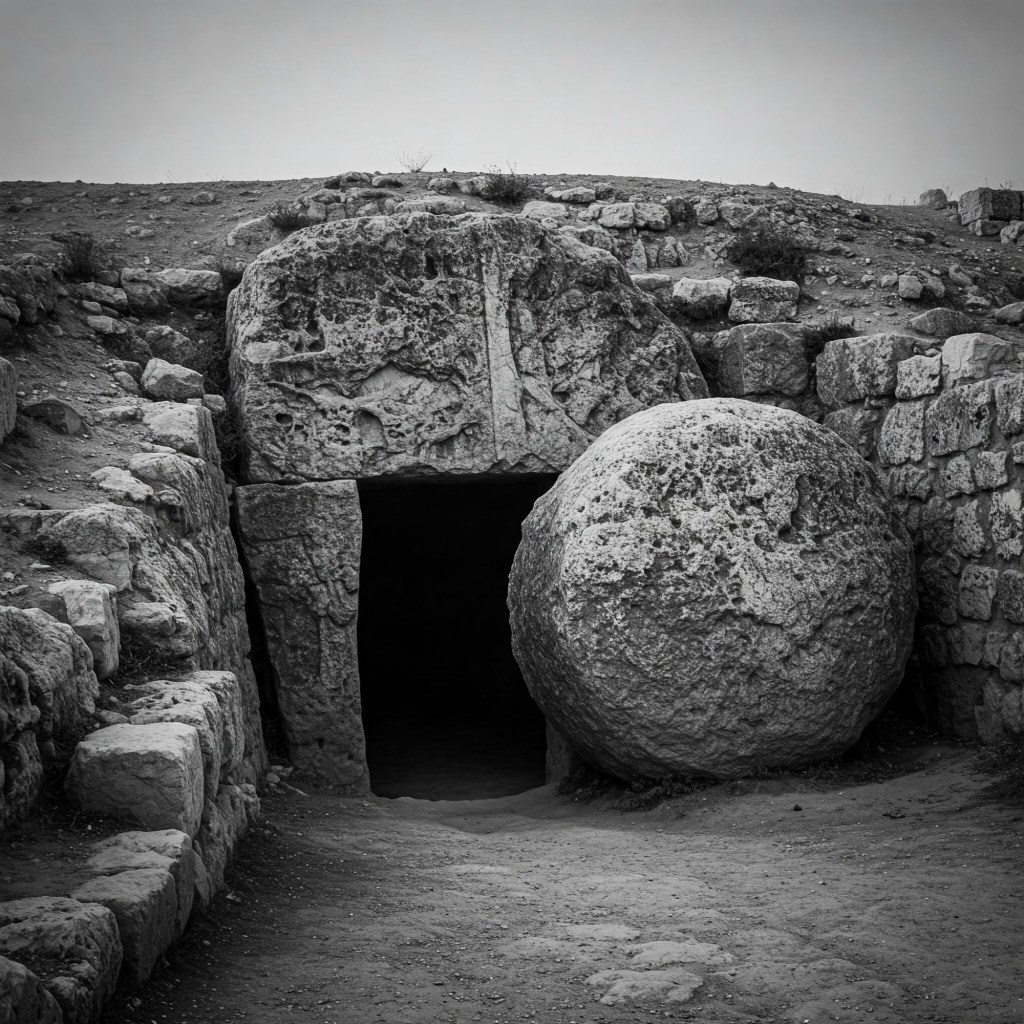
An AI generated image of the garden tomb in black-and-white set against grey sky. The entrance to the tomb is partially open, with a large stone across the right hand side of it. 

Here’s the passage in full : John 19:38–42 (ESV)

“After these things Joseph of Arimathea, who was a disciple of Jesus, but secretly for fear of the Jews, asked Pilate that he might take away the body of Jesus, and Pilate gave him permission. So he came and took away his body. Nicodemus also, who earlier had come to Jesus by night, came bringing a mixture of myrrh and aloes, about seventy-five pounds in weight. So they took the body of Jesus and bound it in linen cloths with the spices, as is the burial custom of the Jews. Now in the place where he was crucified there was a garden, and in the garden a new tomb in which no one had yet been laid. So because of the Jewish day of Preparation, since the tomb was close at hand, they laid Jesus there.”

Secret Disciples: Joseph and Nicodemus

Joseph of Arimathea, a wealthy member of the Sanhedrin, is described as a “secret disciple” of Jesus, concealing his faith due to fear of the Jews. His position in Jewish society made public allegiance to Jesus risky, potentially threatening his status and safety. Yet, in a bold act, Joseph approaches Pilate to request Jesus’ body, an action that could have exposed him to scrutiny. Similarly, Nicodemus, who previously visited Jesus at night (John 3:1–2), likely out of fear, joins Joseph in this act of devotion. He brings approximately seventy-five pounds of myrrh and aloes, an extravagant amount of spices, signaling his commitment. Their actions challenge modern Christians to examine their own faith. Many face pressure to hide their beliefs in hostile or secular environments. Rather than concealing faith, believers are called to proclaim it sensitively but unashamedly, as Jesus instructs in Matthew 5:16: “Let your light shine before others.” How can we move from secrecy to courageous witness in our daily lives?

Jewish Burial Customs in the Passage

In the first century, Jewish burial practices were rooted in respect for the deceased and adherence to purity laws. Deuteronomy 21:23 required prompt burial to avoid defilement, especially before the Sabbath. The body was typically washed, wrapped in linen cloths, and anointed with spices like myrrh and aloes to honor the deceased and mask the odour of decay. In John 19:38–42, Joseph and Nicodemus meticulously follow these customs. They wrap Jesus’ body in linen with the spices Nicodemus provides, a quantity far exceeding typical burials, reflecting deep reverence. Their care fulfills Isaiah 53:9, which prophesies the Messiah’s burial with the rich. This deliberate act underscores Jesus’ dignity, even in death.

The Garden Tomb: Location and Significance

John 19:41 describes the burial site as a new tomb in a garden, unused by anyone else. Joseph’s offering of his own tomb represents a personal sacrifice. Theologically, the tomb is a temporary resting place, foreshadowing the resurrection. Two possible locations in Jerusalem are associated with this site. The Garden Tomb, located north of the Damascus Gate, is favored by some Protestants for its serene, garden-like setting and rock-hewn tomb, fitting John’s description. Alternatively, the Church of the Holy Sepulchre, supported by early Christian tradition and archaeological evidence of first-century tombs, is widely accepted by Catholic and Orthodox traditions. If you would like my opinion, I favour the Garden Tomb location over the Holy Sepulchre .But I am no biblical archaeologist! 

Regardless of the exact site, the garden tomb invites believers to trust God’s redemptive plan, even in moments of apparent defeat.

The Disciples’ Limbo and Our Hope

For the disciples, Jesus’ death was a devastating blow. They believed Him to be the Messiah, yet witnessed His execution, leaving them in fear and confusion. Unaware of the resurrection to come, they faced a limbo of shattered hopes. Their vulnerability reflects the human struggle with uncertainty. In contrast, modern believers have the benefit of hindsight, knowing that Resurrection Sunday follows Good Friday. This perspective transforms despair into hope, as Paul writes in 1 Corinthians 15:20, describing Christ as “the firstfruits of those who have fallen asleep.” The disciples’ experience encourages Christians to hold fast to faith during trials, trusting that God’s plan unfolds according to his will. 

So what do we do? 

Joseph and Nicodemus, once secretive, acted with courage to honour Jesus in His burial. Their example challenges us to proclaim our faith boldly, even in difficult circumstances. We are called to trust in the resurrection hope, knowing that God’s victory overcomes life’s darkest moments.

The darkness of Friday has been and gone, and we find ourselves in the limbo of its aftermath. Fear not though, Sunday is coming…

Hears and Delivers

The righteous cry, and Yahweh hears, and delivers them out of all their troubles.

Psalm 34:17 (WEB)


If you are like me, when you read this verse you ask yourself “Am I righteous?” Or rather, “Am I righteous enough?” You may even start to question whether God hears your prayers, thinking you don’t qualify for the help He promises in this verse.

Righteousness however, is not about our performance nor is it something we earn.

Righteousness simply means to be in “right standing with God.” That is, to be in a good place with Him or to have a good relationship with Him. This is not something we can earn, but something we are gifted through the work of Jesus at the cross.

2 Corinthians 5:21 says:

For him who knew no sin he made to be sin on our behalf; so that in him we might become the righteousness of God.

2 Corinthians 5:21 (WEB)

We are righteous not because of anything we have or haven’t done, but because we’ve put our faith in Jesus. He exchanged His own righteousness for our sin, and now we can approach God in freedom through His blood.

So, in short, you do qualify!

If you are a follower of Christ and in relationship with Him, then you are righteous and can be assured that God does indeed hear you when you cry out. This isn’t the only verse to make such a claim, and so you can be sure that your prayers are heard.

This verse also says God delivers us from our troubles. This is a great promise, and I have no wish to limit it. I think we do need to carefully interpret it however.

If you turn on Christian TV, you might find a preacher claiming that Christians should never have another problem or that God will wave His hand over your life and all your troubles will disappear. The really unscrupulous ones may even suggest you exchange your money for such a result.

To put it plainly, that’s not biblical!

So am I saying this verse is a lie then? Not at all!

God does indeed deliver us from trouble. But that does not necessarily mean He takes it all away. Often, God will give us the strength we need to endure through a problem. We may pray that God will take it away, but He would rather we pray for the strength to endure it with a good attitude.

I am not aware of any New Testament prayer that asks God to remove all obstacles out of our way. Rather, saints like Paul prayed for inner strength, power, knowledge, peace, and more, and all to the glory of God.

Don’t misunderstand though, I am not saying God is limited or unwilling, and cannot help. The Creator of the universe is still in control, and very much looks out for the good of His children. We forget sometimes though that god’s primary concern is not our comfort, but His glory.

Whatever you are facing right now, you can trust that God not only hears your prayers, but is ready and willing to deliver you. If you’re stuck in the valley, you might want a helicopter ride out, but be prepared to push on one step at a time. God is with you!

Willing to Pay the Price? (PoW#22)

Pearl of Wisdom #22

Don’t expect what other people have, unless you’re willing to pay the price they paid to get it.

Some say we live in the age of entitlement. People have a tendency to want or even expect what other people have – without being willing to pay the price they paid to get it.

Some newly weds or homeowners expect the same standard of living as their retired parents, not realising it took their parents their entire lives working and saving to be in a position to live that way.

We want to lose weight and be fit and healthy, but don’t want to spend the hours in the gym we need to. We want the “body” but aren’t willing to let go of the chocolate!

The same can be true of churches and ministries. We see a “big church” (which is not necessarily a measure of success) and want our church to be the same. A Bible teacher draws in a crowd of hundreds, and we feel we ought to have at least the same.

What we often fail to understand is that these things all come at a cost and a sacrifice. Whether in ministry or in business or life in general, success takes time and patience. We may be watching the end result of years of hard work, expecting to have it all in a few weeks.

I encourage you to have goals and dreams, but set realistic expectations. Don’t look at others and covet what they have. Do what they did to get it. Learn from them, and strive towards your goals.

And remember, we usually only ever see the “edited highlights” of a person’s life. Instagram and Facebook are very selective windows into a person’s world.

Be blessed this week.

We are all different (POW#13)

Pearl of Wisdom #13

Not everyone does things in the same way that you do

Don’t you just love it when someone says, “I wouldn’t have done it like that…” just AFTER you finish doing a task?

You often see it in a working environment; when one employee tries to explain something to another. It seems a simple and straightforward task to the person that knows, and they just can’t understand why it’s such a mystery to the one learning.

The truth is that we are all different. What I find easy, you may find hard; and vice versa. Likewise, you may need to explain something to me several times before I get it, but someone else may grasp it on the first attempt.

Is one better than the other? No – it’s just different.

We need to understand and consciously remember that not everyone is like us. It is extremely arrogant to look down on someone else who can’t do what we can. If you look hard enough, there will certainly be things they can do that you cannot.

We must stop judging one another, and learn to work with each other. We all have different strengths and weaknesses, and God put us together so we can work together – not against each other.

Be patient with other people this week, as they will no doubt have to be patient with you!

Who’s behind door number one?

Look! I am standing at the door and knocking. If anyone listens to my voice and opens the door, I will come in to him and eat with him, and he will eat with me.

Revelation 3:20 (ISV)

In my experience, the pulpits are fairly quiet on the book of Revelation. For many, it is hard to understand and lacks practical application for us to use in the here and now. I would dispute this, but I understand why many don’t venture into this amazing book.

Revelation is full of imagery and typology, and it passes most of us by. however, there is a good reason for this… we don’t know our Old Testament well enough!

Many of the pictures or images you see in Revelation can be found in the pages of the Old Testament. Most of us are not as familiar with the Ol Testament as we might be, and therefore don’t recognise much of what Revelation is pointing to.

Revelation makes a special promise to those who would study its pages:

How blessed is the one who reads aloud and those who hear the words of this prophecy and obey what is written in it, for the time is near!

Revelation 1:3 (ISV)

So if you want to get into this book, i’d suggest you begin with the first three chapters.

The first chapter gives an overview of the book, and in fact gives a clear synopsis in verse 19 of chapter 1:

Therefore, write down what you have seen, what is, and what is going to happen after this.

Revelation 1:19 (ISV)

On the point about Revelation having a practical application, you need look no further than chapter 2 and 3. many people think the New Testament only has 21 epistles (letters from the apostles) but in fact, there are 28. Revelation chapters 2 and 3 shares an additional 7 epistles written by none other than Jesus Himself.

Our verse for today picks up in one of these epistles. You may well be familiar with Revelation 3:20, which imagines Jesus standing outside and knocking on a door – just waiting for someone to let Him in so they might eat together.

It is a famous verse that is often used to describe Jesus’ attitude towards those who have yet to commit to faith in Him. Evangelists tell people that Jesus is standing outside the door of their lives, knocking to come in.

This is a nice image and not incorrect, but that’s not the context of this verse at all.

Who’s behind door number one?

The answer is the church.

It should be astonishing, challenging and humbling to us to realise that Jesus is stood outside of a church, knocking to come in. Surely of all places to find Jesus, inside a church would be one of them? Not so apparently.

In our modern world, we have somehow come to a place where you are no longer guaranteed to find Christ in the local church. Some buildings are labelled as “churches” and yet have little or nothing to do with what the Bible defines a church to be.

Some churches are social clubs; places where people gather to meet and climb the social ladder, caring little for the Word of God or His worship. Other churches bend and adapt to every whim of society, ignoring God’s standards and just going whichever way the prevailing wind takes them.

I don’t mean to be negative. And apologies if I have come across that way. I love the church, and truly believe it to be a sleeping giant. If the church were to awake, unite and stand together, we could change this world for the better. In the Bible’s many references to the end times however, there are prophecies of apostacy and the church not being what Christ intended it to be.

Let’s read Jesus’ epistle in full, and see what we can learn from it.

To the messenger of the church in Laodicea, write: The Amen, the witness who is faithful and true, the originator of God’s creation, says this:

15 ‘I know your actions, that you are neither cold nor hot. I wish you were cold or hot. 16 Since you are lukewarm and neither hot nor cold, I am going to spit you out of my mouth. 17 You say, “I am rich. I have become wealthy. I don’t need anything.” Yet you don’t realize that you are miserable, pitiful, poor, blind, and naked. 18 Therefore, I advise you to buy from me gold purified in fire so you may be rich, white clothes to wear so your shameful nakedness won’t show, and ointment to put on your eyes so you may see. 19 I correct and discipline those whom I love, so be serious and repent! 20 Look! I am standing at the door and knocking. If anyone listens to my voice and opens the door, I will come in to him and eat with him, and he will eat with me. 21 I will give a place to sit with me on my throne to the one who overcomes, just as I have overcome and have sat down with my Father on his throne.

22 ‘Let everyone listen to what the Spirit says to the churches.’

Revelation 3:14-22 (ISV)

We’ll begin at the end – verse 22 – just to realise that what Jesus is saying specifically to the Laodicean church can also apply to us.

In verse 22, He says “Let everyone listen to what the Spirit says to the churches.” Firstly, everyone means everyone. And note the plural of “churches” at the end. This letter isn’t just for Laodicea but for all the churches listed in chapters 2 and 3, but also for all the churches – including the one you and I belong to.

Jesus is fairly scathing of the Laodicean church. And the church itself would have been totally shocked by this. They thought they were doing well, but often our perspective is somewhat different to God’s.

You may well have heard before this idea of being cold or hot, and in this case lukewarm. The challenge here is not to be like the Pharisees who Jesus had the strongest words for during His ministry. Their issue was hypocrisy. They prided themselves on being the religious leaders of the day, putting on a constant show of their “religion”. While they talked the talk, they did not walk the walk.

I believe Jesus is challenging the Laodiceans in a similar way. They claim to represent Christ in His church, and yet clearly their actions have resulted in Jesus being excluded.

Jesus would rather us represent Him truly, than to claim to be followers and act like unbelievers

An alternative view of this lukewarmness could be a mixture of grace and Law. Perhaps they were preaching grace, but restricting and forcing the church to be bound by the Law. It’s another view which you can consider.

Whatever the cause of their lukewarmness however, it had resulted in a church without Christ. That is a place we do not want to be.

I ask you to consider your own church for a moment. How does it compare to the Church at Laodicea? Is Jesus standing outside and knocking to come in?

If this challenges you, then please don’t misunderstand my point today. I am not telling you to leave your church or criticise it. No church is perfect, and if you are looking for one, you are going to be sorely disappointed.

The idea that Jesus is knocking to come in is encouraging in one sense. It means He has not given up on you. It means He still wants to join you and share with you. Leaving your church or criticising the leadership will not help. The best thing to do is open the door and invite Him in.

Reflect also on your own relationship with Christ. While these verses are clearly talking about churches, i think there’s also an application to our own personal journey with Jesus.

Do you need to invite Him in? My meaning is not in a salvation sense, but rather in fellowship. Are you a believer who has lost their way? Have the troubles of life led you to put Jesus outside? Invite Him in today, He’s right outside the door.

Don’t Let the Sun Go Down

Be ye angry, and sin not: let not the sun go down upon your wrath:

Ephesians 4:26 (KJV)

In my last blog post, I began to explore the above verse and what it means. As I said last time, I’ve usually heard this taught as a call not to go to bed on an argument. Good advice this may be, but not necessarily what Paul is getting at.

We considered how the first part – Be angry and sin not – isn’t just an instruction not to let your anger get the better of you, but could also be read as a command to be angry.

You may have read this verse a hundred times in the past, and perhaps each time you read it, your brain said “Don’t let the sun go down while you are still angry…” But what does it actually say?

It says – don’t let the sun go down on your wrath. Or to put it another way, don’t let your anger ever go out and grow dull.

I know this may seem like an odd idea, as surely the Bible teaches us to be loving and not to get angry. Can it really be a command to get and stay angry?

As we explored a little last time, anger is sometimes a right response. In the event of injustice or sin, we ought to be angry. Like God, we ought to hate sin and its effects on humanity. And while our sin may result in other people getting hurt, ultimately we are the ones who hurt the most as a result of sinfulness.

To truly love the good, we must also hate the bad. We must stand against sin in all of its forms. To do that, we need a holy anger, and one that does not go out.

Am I taking this verse out of context though? Is it correct to interpret it this way? I believe it is, but understand those who may disagree.

Context is always important when reading the Bible, and we ought never to take a single verse out of its proper context and form a doctrine out of it. Falsehood lies down that path.

Scripture should be interpreted in the light of other Scripture.

For some doctrines, we need to examine the entire Bible in order to see a complete picture. Of course we don’t have time or space to do this here, but lets look at this verse with it surrounding verses to get at least a small idea of context.

Wherefore putting away lying, speak every man truth with his neighbour: for we are members one of another. 26 Be ye angry, and sin not: let not the sun go down upon your wrath: 27 Neither give place to the devil.

Ephesians 4:25-27 (KJV)

Verse 25 is a clear instruction to put away lying, and to speak truth to each other. This can actually be quite difficult at times. “Do you like my outfit?” or “What do you think of my new hairstyle?” More importantly, when it comes to questions of advice or big decisions, “Should I take this job?” or “Do you think I should marry them?” an honest answer is not always easy to give, and often not the answer the asker really wants to hear.

So often we seek validation from others to agree with what we have already in mind to do. To give an alternative view can be tough.

Similarly, Paul could well be talking about correcting each other in a loving way. Often we leave it to the pastor or minister to address such matters, but indeed there is a role for each of us as part of a church family.

Don’t misunderstand me, I’m not giving you permission to walk up to just anyone in church and give them a lecture about how they ought to live – we must earn that right through a trusting relationship or as a loving member of church leadership.

But we must tackle sin. We must not just get by with it. So in speaking truth to one another, there may be times when we need a little righteous anger to stir us up to confront an issue. Again, don’t misunderstand me. I’m not saying we should get angry at people; rather we should be angry at sin.

Verse 27 is short and not so sweet. Don’t give the devil a foothold. Could it be that by not following the “command” to be angry, we somehow give the enemy a route into our lives?

It is a narrow path, with ditches on both sides. Err in either direction, and you’ll end up off the road!

What i mean is this. Anger which is uncontrolled or directed at people or things, can certainly give the devil a chance to wreck our lives. How many lives have been destroyed in one single moment of uncontrolled anger? How many men and women find themselves in prison for one slip of judgement allowing their temper to get the better of them?

I’m not giving anyone an excuse to be angry in an ungodly way here.

Equally though, when we reuse to be angry at sin or to have a righteous anger, we give the devil a foothold. If we co-operate with him, the enemy can destroy our lives. If you follow every temptation to do whatever you want, to commit adultery or murder or to steal or rob, your life will come to ruin.

We need to get angry at the devil

Therefore, submit yourselves to God. Resist the Devil, and he will run away from you.

James 4:7 (ISV)

James says that we must resist the devil. Often we ask God to do the resisting, but in reality it must be us who do so. We do that through prayer, our words and our actions. But notice, submission to God must come first. There is no sense in trying to resist the enemy if you are not submitting your life to Jesus.

Likewise, Jesus said:

From the days of John the Baptist until the present, the kingdom from heaven has been forcefully advancing, and violent people have been attacking it,

Matthew 11:12 (ISV)

The kingdom from heaven is forcefully advancing…

Christians ought not to be passive, weak or downtrodden. We are children of God, and the Spirit of God dwells in us. We should be advancing God’s kingdom with passion and determination. Not in our own strength, and certainly not without persecution but always pressing on.

So, Paul tells us to be angry and to never let the sun go down on our wrath. Are you advancing or just barely holding on? Do you need some righteous anger to take a stand against the enemy and resist his influence in your life?

Ask God to stir you up. Pray that He will help you to have a controlled anger that is pointed at the right things. Renew your mind in God’s Word and learn who you are in Christ. Don’t just put up with the enemy, resist him!

Don’t let the sun go down.

Be Angry

Be angry, yet do not sin.” Do not let the sun set while you are still angry,

Ephesians 4:26 (ISV)

I like the ISV Bible, but here’s that same verse from the KJV.

Be ye angry, and sin not: let not the sun go down upon your wrath:

Ephesians 4:26 (KJV)

The KJV has a certain grandeur to it which other translations can lack at times. For every day reading however, I prefer a more contemporary version than the KJV with its “thee” and “thou” wording.

In this case, I find that the KJV is one of the closest to the Greek language. Many modern translations render this verse slightly differently, and even stray into interpetting it for us the reader.

Whenever I have heard this verse taught in the past, it goes something like this:

If you get into an argument with someone, try to settle the matter before you go to bed…

This is not bad advice at all, but I’m becoming less convinced that this is really what Paul was saying here.

Some translations actually bring forth the idea that we should deal with our “heated debates” before bedtime, and again, while that may be good advice, i’m not so sure that’s what the Scripture is really all about.

Take the Amplified Bible for instance, which is one I find very helpful at times. It says this:

Be angry [at sin—at immorality, at injustice, at ungodly behavior], yet do not sin; do not let your anger [cause you shame, nor allow it to] last until the sun goes down.

Ephesians 4:26 (Amp)

The first part of the verse is very similar to the KJV – advising us not to sin while angry. It specifies the kind of things we ought to be angry about, such as injustice. The latter part of the verse advises us not to let the sun go down while we are still angry.

In some respects, this is a contradiction. The first part appears to be encouraging us to “be angry” and then tells us not to “be angry” when the sun goes down. So what’s happening here?

I think this verse is going beyond advising us not to be angry during night hours.

Let’s work through this verse logically, and study the text itself rather than our usual interpretation.

Anger is not a sin

The first thing to note is that anger is not a sin. This verse clearly indicates that we can be in a state of anger, but without falling into sin.

Jesus Himself – who was without sin – got angry. He got very angry. In fact, He was so angry that He turned over tables and even had a “weapon”.

 In the Temple he found people selling cattle, sheep, and doves, as well as moneychangers sitting at their tables.  After making a whip out of cords, he drove all of them out of the Temple, including the sheep and the cattle. He scattered the coins of the moneychangers and knocked over their tables.

Then he told those who were selling the doves, “Take these things out of here! Stop making my Father’s house a marketplace!” His disciples remembered that it was written, “Zeal for your house will consume me.”

John 2:14-17 (ISV)

So we see clearly that Jesus was angry, and yet did not sin even once. This tells us that anger alone is not a sin.

The problem comes when our anger is directed at the wrong things, or gets out of control.

As the Amplified Bible expanded this verse, it showed that the target of our anger ought to be things such as injustice or sin. That’s why we were given anger in the first place – to take action when we recognise that someone or something is unjust.

When a child is killed by a drunk driver, or an elderly person is robbed at gunpoint, it is perfectly acceptable to be angry about such things.

The issue is when we direct that anger against the slow checkout attendant or the person who didn’t see us and cut us off in traffic. Frustrating as those things may be, they are not real reasons to get angry.

The way to test is to examine our selfishness. Chances are that if we are angry because of a selfish reason (such as having to wait) then that is not a righteous anger. Righteous anger is directed at ungodliness, sin or the devil. Other unrighteous anger is usually a result of our own selfishness.

Anger is a secondary emotion. No one ever gets angry without reason, there is always something that comes first. It may be offense, humiliation or fear that triggers it.

Perhaps you have children and get angry at them at times. Ask yourself why. It may be because of fear – they did something daft and were in danger of hurting themselves. It may be that they interrupted something you were doing, and “self” didn’t like it. If my anger is kindled against my children, it is often because “I” just want to sit down, or “i’ve” had a tough day. It is rarely anything to do with them.

Be Angry

While the verse is often interpreted as “don’t sin when you get cross,” it goes even further than that. Rather than just don’t sin, it’s a command to be angry.

Actually this is a quote from Psalm 4:4 –

Be angry, yet do not sin. Think about this[b] when upon your beds, and be silent.
Interlude

Psalm 4:4 (ISV, emphasis added)

Psalm 4 is a passionate plea to prayer. David starts off crying out to God, then to man, then to God about man and finally to man about God.

Paul grabs hold of this passion and says, “Be angry, and sin not.” One of the problems in the church today is that it is afraid to stand up and call sin by its name. We compromise our position, accepting the world’s way and either ignoring or dismissing the Bible, and people outside don’t always know what the church stands for.

It’s not enough just to love the good things, we must also hate the bad.

I once heard someone say that love and hate are two separate ends of the same stick. To truly love something, you must also hate the things that come against them. I don’t know if i wholeheartedly agree with this or not, but i certainly do understand that loving good is not the same as hating evil.

When we try to love good without hating evil, we end up accepting everything and standing for nothing. We end up with watered down doctrines and a church that looks like the world instead of the Word.

So Paul’s command to be angry is not by accident. This post has already gone longer than I planned, and I haven’t yet addressed the issue of going to bed while you are still angry! Let’s pick that up next time.

For now though, perhaps you are someone with a temper and you know that you need to bring it in line. Perhaps though, you are on the opposite end, and actually need to stir yourself up and start getting angry at sin and injustice. Perhaps – slightly confusingly – you are both, and need to redirect that temper towards the right things.

Do you need to be more or less angry this week? (At appropriate things of course) Do you need to have a serious think about the things that make you angry, and the things that don’t?

Pearl of Wisdom #2

Patience is not the ability to wait, but rather the ability to wait well.

As I stepped on to the train platform, I saw an unusual number of people waiting. I immediately realised there was a delay of some kind. Looking at the boards, I saw that I had a 20-25 minute wait on my hands.

Standing at the edge of the platform, I looked up and down. Some people were huffing and puffing, others were criticising the lonely member of staff about the delay. Some read the newspaper, and others just got angry.

Every single person had to wait the exact same length of time for the train to arrive.

Waiting is not an option in such situations, but how we wait is. Patience is not about waiting, but how we conduct ourselves while we do so. How well do you wait?

Every blessing!