Understanding God’s Will in the Face of Suffering: Acts 21 and the Prophecy of Agabus

In Acts 21, we encounter a striking moment where the apostle Paul, guided by the Holy Spirit towards Jerusalem, receives a sobering prophecy about his future. This passage raises important questions about the nature of prophecy, human response to divine will, and the tension between well-meaning counsel and obedience to God’s calling.

A simple black leather belt with silver buckle resting on a white surface 

The Prophecy of Agabus (Acts 21:10-14, ESV)

“While we were staying for many days, a prophet named Agabus came down from Judea. And coming to us, he took Paul’s belt and bound his own feet and hands and said, ‘Thus says the Holy Spirit, “This is how the Jews at Jerusalem will bind the man who owns this belt and deliver him into the hands of the Gentiles.”’ When we heard this, we and the people there urged him not to go up to Jerusalem. Then Paul answered, ‘What are you doing, weeping and breaking my heart? For I am ready not only to be imprisoned but even to die in Jerusalem for the name of the Lord Jesus.’ And since he would not be persuaded, we ceased and said, ‘Let the will of the Lord be done.’”

This passage follows Paul’s earlier declaration in Acts 20:22-24 (ESV):

“And now, behold, bound by the Spirit, I am going to Jerusalem, not knowing what will happen to me there, except that the Holy Spirit testifies to me in every city that imprisonment and afflictions await me. But I do not account my life of any value nor as precious to myself, if only I may finish my course and the ministry that I received from the Lord Jesus, to testify to the gospel of the grace of God.”

1. The Nature of Agabus’ Prophecy

Agabus, a prophet from Judea, delivered a message from the Holy Spirit using symbolic action—a method reminiscent of Old Testament prophets (e.g., Ezekiel’s enacted prophecies in Ezekiel 4-5). His prophecy was predictive, not prescriptive: it revealed what would happen, not necessarily what Paul should do.

Some prophecies in Scripture are conditional, offering warnings that may be averted through repentance (e.g., Jonah’s message to Nineveh). However, Agabus’ words carried no hint of conditionality—they were a straightforward declaration of future events. This raises the question: if the prophecy was certain, why did the believers urge Paul to avoid Jerusalem?

2. The Believers’ Response: Love vs. God’s Will

The disciples, including Luke (the author of Acts), pleaded with Paul not to go. Their reaction was natural:

  • They loved Paul and did not want him to suffer.
  • They may have misinterpreted the prophecy as a warning rather than a confirmation of God’s plan.

This mirrors Peter’s reaction in Matthew 16:22 (ESV) when Jesus foretold His crucifixion:

“Peter took him aside and began to rebuke him, saying, ‘Far be it from you, Lord! This shall never happen to you.’”
Jesus’ response was sharp: “Get behind me, Satan! You are a hindrance to me. For you are not setting your mind on the things of God, but on the things of man.” (Matthew 16:23, ESV).

Similarly, the believers in Acts 21 were operating from human concern, not divine perspective. Their intentions were good, but their advice, if followed, would have diverted Paul from God’s purpose.

3. Paul’s Resolve: Embracing Suffering for Christ

Paul’s response was unwavering:

  • He was “ready not only to be imprisoned but even to die” (Acts 21:13).
  • He saw his suffering as part of his calling (Acts 20:24; Philippians 1:20-21).

His attitude reflects Jesus’ words in Luke 9:23-24 (ESV):

“If anyone would come after me, let him deny himself and take up his cross daily and follow me. For whoever would save his life will lose it, but whoever loses his life for my sake will save it.”

Paul understood that obedience to God sometimes requires embracing hardship. His journey to Jerusalem was not reckless defiance but faithful surrender.

4. Lessons for Discerning God’s Will Today

This passage offers key principles for Christians facing difficult decisions:

  • Prophecy Reveals, But Does Not Always Direct
    Agabus’ prophecy confirmed what awaited Paul, but it did not instruct him to avoid it. Likewise, God may reveal challenges ahead without necessarily calling us to evade them.
  • Well-Meaning Counsel Must Be Weighed Against God’s Word
    The believers’ pleas were heartfelt, but Paul prioritised the Spirit’s leading. Proverbs 3:5-6 (ESV) reminds us:

“Trust in the Lord with all your heart, and do not lean on your own understanding. In all your ways acknowledge him, and he will make straight your paths.”

  • Suffering May Be Part of God’s Plan
    Scripture repeatedly associates faithfulness with endurance (Romans 5:3-5; 1 Peter 4:12-13). Avoiding suffering is not always the godliest choice.

Conclusion: “Let the Will of the Lord Be Done”

The believers’ final words—“Let the will of the Lord be done” (Acts 21:14)—mark their submission to God’s higher purpose. Paul’s example challenges us to:

  • Seek God’s perspective over comfort.
  • Trust that His plans, even when painful, are purposeful.
  • Remain steadfast when well-meaning advice conflicts with divine calling.

In a world that prioritises safety and self-preservation, Paul’s resolve reminds us that the greatest fulfilment lies in surrendering to God’s will—whatever the cost.

It is always wise to listen to godly Council. The people who care about us, will naturally not want us to come to harm. We would not be sensible to simply ignore their love or advice. This is especially true on making a big decision, or one that potentially leads us down a dangerous path.

At the end of the day though, we are answerable only to God. If he is instructing us to do something, and the entire rest of the world is telling us not to, then of course we must follow him. God over man.

The most difficult part, for me at least, is discerning God’s will. Few of us will receive a clear prophecy as Paul did in today’s passage, so we must always be cautious to follow God’s will carefully. We all want a neon sign telling us which way to go, but for the most part, we are to study and understand the Bible and discern gods will from that alone.

Using appropriate wisdom and discernment, all any of us can do is try to follow God to the best of our ability. 

Misery into Hope (Micah 7:1–10)

It was a pleasure and an honour to preach at church yesterday we have been working our way through the book of Micah, and finally reached the last chapter.

The chapter opens with a rather bleak picture, but turns to the Lord in hope. You might find it helpful to read Micah 7: 1–10 before listening.

A cartoon image of a man hiding in a bush with a long butterfly net, ready to pounce 

Warm Greetings and Walking in Truth (3 John 1–4) 

In my previous post, A Mighty Message in a Little Letter, I provided an overview of the Third Epistle of John, a brief yet profound letter in the New Testament. This post marks the beginning of a new series where I will examine all 14 verses of 3 John, verse by verse, to uncover the depth of its message. Today, we focus on the first four verses, exploring the warmth of John’s greetings, the significance of spiritual and physical health, and the call to walk in truth. This study aims to provide practical insights for living out our faith, grounded in the text’s historical and theological context.

A man walking alone on a sunlit forest path, holding two books—one in each hand. He is seen from behind, heading toward a bright, misty clearing. To his left, there is a signpost with the word “TRUTH” and an arrow pointing forward in the direction he is walking. The path is surrounded by lush green foliage and tall trees, with sunlight streaming through the leaves, creating a peaceful and contemplative atmosphere. In the distance, there is a large, scroll-like object with writing on it, partially obscured by the light and trees, adding a sense of mystery and symbolism to the scene.

Verse 1: A Warm and Personal Greeting

“The elder, To my dear friend Gaius, whom I love in the truth.” (3 John 1, NIV)

John, identifying himself simply as “the elder,” opens the letter with a warm address to Gaius, a beloved friend. The phrase “whom I love in the truth” reflects not only personal affection but also a shared commitment to the gospel. The warmth of John’s greeting is striking. In an era where letters were rare and precious, receiving such a personal message from an apostle must have been profoundly encouraging. Imagine Gaius, perhaps weary from challenges in the church, opening this letter and feeling the weight of John’s care and affirmation. This sets the tone for the letter, reminding us that Christian relationships are rooted in love and truth, fostering encouragement and mutual support.

Verse 2: A Prayer for Health, with a Deeper Meaning

“Dear friend, I pray that you may enjoy good health and that all may go well with you, even as your soul is getting along well.” (3 John 2, NIV)

Verse 2 is often cited by prosperity gospel preachers as evidence that Christians should expect physical health and material success. However, a closer look reveals a more nuanced meaning. John’s prayer for Gaius’s good health and prosperity is a common epistolary greeting, akin to a standard well-wishing in ancient letters. It expresses a heartfelt desire for Gaius’s well-being but does not guarantee it as a divine promise. The key phrase, “even as your soul is getting along well,” prioritises spiritual health over physical. John acknowledges Gaius’s strong faith and implies that spiritual vitality is primary, with physical health being secondary. This counters prosperity teachings by grounding our ultimate hope in spiritual flourishing, not earthly circumstances. While God cares for our physical needs, John’s focus is on the soul’s alignment with God’s truth, which sustains us through life’s trials.

Verse 3: Walking in the Truth

“It gave me great joy when some believers came and testified about your faithfulness to the truth, telling how you continue to walk in it.” (3 John 3, NIV)

The phrase “walking in the truth” is central to this verse and the letter’s message. For John, walking in the truth is more than intellectual assent to biblical doctrine; it is a daily, practical expression of faith in our words, thoughts, and actions. It means living in alignment with the gospel, allowing its truth to shape every aspect of life. To illustrate, we can compare this to Galatians 2:11-14, where Paul confronts Peter for not “walking in line with the gospel.” Peter, under pressure, withdrew from eating with Gentiles, implying that adherence to Jewish customs was necessary for fellowship. This contradicted the gospel’s truth of unity in Christ, regardless of cultural or ethnic distinctions. Peter’s failure to walk in the truth caused division and confusion. For us, walking in the truth involves consistency between our beliefs and behaviour, ensuring our actions reflect Christ’s love, grace, and justice. It challenges us to examine whether our daily choices—how we treat others, handle conflicts, or steward resources—align with the gospel.

Verse 4: The Joy of Faithful Disciples

“I have no greater joy than to hear that my children are walking in the truth.” (3 John 4, NIV)

John concludes this opening section with a heartfelt expression of joy. The term “my children” likely refers to those John has mentored or led to faith, including Gaius. His “greatest joy” comes from knowing they are walking in the truth, faithfully living out the gospel. This verse underscores the deep satisfaction of seeing others grow in faith. As I write this blog, I feel a similar privilege and humility. Knowing that readers might be encouraged to walk in the truth through these reflections is profoundly humbling and joyful. It reminds us that our greatest legacy is not personal achievements but the impact of our faith on others, nurturing a community rooted in truth and love.

Conclusion: A Call to Faithful Living

These first four verses of 3 John set a foundation for the letter’s themes of hospitality, faithfulness, and truth. John’s warm greeting encourages us to build relationships grounded in love and gospel truth. His prayer for Gaius reminds us to prioritise spiritual health, trusting God with our physical needs. The call to walk in the truth challenges us to live consistently with the gospel, as Paul urged Peter to do. Finally, John’s joy in his disciples’ faithfulness inspires us to invest in others’ spiritual growth. As we continue this series, may we be encouraged to walk in the truth, finding joy in faithful living and community.

Reviewing House of David: A Biblical Epic with Strengths and Struggles

As a Christian, I often approach television adaptations of biblical stories with a mix of excitement and caution. The Bible is a sacred text, rich with history, theology, and divine truth, so any attempt to bring its narratives to the screen must be handled with care. Amazon Prime Video’s House of David, a new series chronicling the early life of King David, has caught my attention. Having watched roughly half of the first season, I’m eager to share my thoughts on how closely it aligns with the biblical account, its strengths as a production, and where it takes creative liberties. I hope to give you my thoughts, encouraging discernment while appreciating the show’s efforts to bring Scripture to life.

Be My AI: A wooden slingshot lying on sandy ground in a desert-like environment. The slingshot is positioned upright, casting a long shadow due to the low angle of the sun, which is either rising or setting in the background. The ground is covered with small pebbles and a few larger stones scattered around. In the distance, there are blurred silhouettes of hills or mountains under a clear sky. The lighting creates a warm, golden tone across the scene.

A Faithful Foundation with Creative Flourishes

House of David centres on the early years of David, the shepherd boy who becomes Israel’s greatest king, with the first season building towards his iconic confrontation with Goliath. The show draws primarily from 1 Samuel 13–18, faithfully depicting key moments such as Samuel’s anointing of David and David’s role as a harpist in King Saul’s court. The prophet Samuel, portrayed by Stephen Lang, is a commanding presence, embodying the gravitas of a God-ordained seer. King Saul (Ali Suliman) and other biblical figures, like Jonathan and Michal, are all present, grounding the narrative in the scriptural framework. For those familiar with David’s life as depicted in the Bible, the core story is recognisable, and the show strives to honour the essence of these events.

However, the Bible provides sparse details about David’s early life, leaving gaps that House of David fills with creative storytelling. This poetic licence is understandable—television demands a fleshed-out narrative to sustain an eight-episode season. For example, the show introduces subplots, such as a fictional romance between David and Michal that unfolds earlier than in Scripture, and explores David’s family dynamics, including a tradition suggesting he was an outcast due to his birth circumstances. While these additions add drama, they occasionally stray from the biblical text. The David of Scripture is marked by unwavering faith and courage, but the show sometimes portrays him as rebellious or uncertain, which feels inconsistent with his biblical character. As long as these embellishments don’t contradict the Bible’s core truths, I find them generally acceptable for a dramatic adaptation, though they require discernment.

I found some of the shows portrayal of David a little inconsistent at times. Even as a young man, watching the flocks, my impression from the Bible is that he had unwavering courage. The show often depicts him as quite fearful, and although he faces those fears Even tackling a lion, the show does not depict him as the man I imagine from reading the Bible. I am the 1st to admit that could be my problem, and perhaps there is some realism in a younger David learning to face his fears and develop courage as he matures. But it’s something to look out for and consider. 

Strengths: Engaging Storytelling and High Production Value

One of the standout qualities of House of David is its production quality. Filmed in Greece, the series boasts stunning cinematography, with sweeping landscapes and detailed sets that immerse viewers in the ancient Near Eastern world. The costumes and battle scenes are meticulously crafted, lending authenticity to the period. The acting is another strength—Michael Iskander’s portrayal of David captures his musicality and heart, even if the character occasionally deviates from the biblical archetype. Ali Suliman’s Saul is particularly compelling, portraying a king torn between divine calling and personal pride, a dynamic that mirrors 1 Samuel 15’s account of his disobedience.

The show’s pacing is steady, allowing relationships—such as David’s friendship with Jonathan or his tensions with Saul—to develop naturally. It explores themes of faith, obedience, and destiny, which resonate deeply with Christian viewers. The inclusion of David’s love for music, with Hebrew psalms woven into the narrative, adds a spiritually rich layer, reminding us of his role as the “sweet psalmist of Israel”.

Areas of Concern: Darkness and Supernatural Elements

House of David doesn’t shy away from the grittier aspects of the biblical world. The battle scenes, while not gratuitous, are reasonably violent, reflecting the harsh realities of the time. This aligns with the historical context but may be intense for younger viewers, so parental discretion is advised.

More concerning is the show’s emphasis on witchcraft and supernatural elements, particularly among Israel’s enemies. For instance, a subplot involving the Amalekite king Agag casting spells and references to giants as descendants of fallen angels lean heavily into fantasy. While these elements draw from biblical and postbiblical traditions, they risk sensationalising the narrative, making it feel more like a fantasy epic than a historical drama. The Bible mentions spiritual forces, but House of David amplifies these, sometimes veering into speculative territory, such as an early meeting with the Witch of Endor, which is entirely fabricated.

Clearly the Bible is a supernatural book. There are many references to God in the show, and we know from the biblical text that the enemies of Israel did worship false idols and have detestable practices which led to God‘s judgement on them. So I’m not criticising the show for supernatural elements, Merely pointing out that we ought to handle this material with care. 

A Reminder to Return to Scripture

I haven’t watched The Chosen, a series often compared to House of David for its biblical storytelling, but I assume it shares a similar approach: blending scriptural fidelity with dramatic interpretation. House of David is an engaging watch, and I’m eager to finish the season. Its success—reaching #2 on Prime Video’s most-watched list and drawing 22 million viewers in its first 17 days—shows its broad appeal. However, as Christians, we must use such adaptations as a springboard, not a substitute, for studying the Bible. Shows like this can spark interest in Scripture, but they also remind us to verify what we see against the Word of God.

In conclusion, House of David is a visually stunning, well-acted series that largely captures the spirit of David’s early life, though it takes notable creative liberties. It’s a compelling blend of faith and drama, but its darker themes and supernatural flourishes require discernment. I encourage viewers to enjoy it as historical fiction while returning to 1 Samuel to anchor their understanding in truth. Let’s use this series to deepen our engagement with the Bible, ensuring we know what is—and isn’t—biblical.

Starving for God’s Truth (Amos 8:11) 

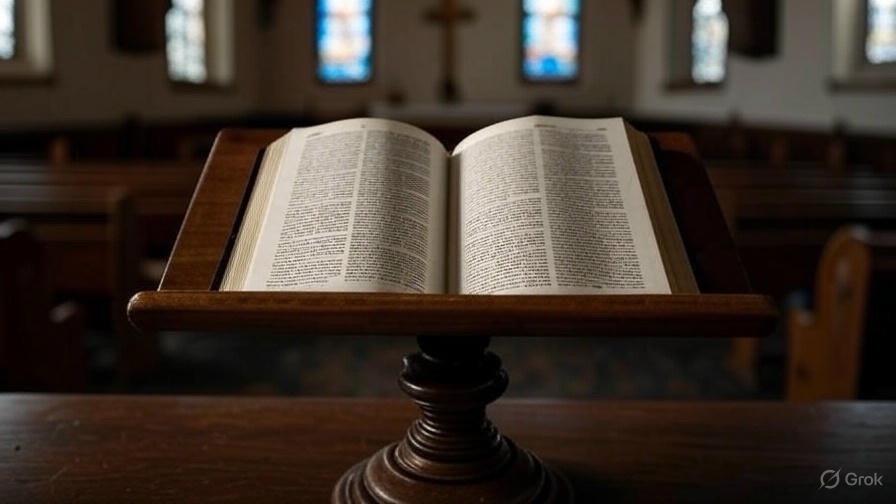
A blank Bible on a lectern indicating a famine of God‘s word 

In Amos 8:11, the prophet delivers a stark warning from God: “‘The days are coming,’ declares the Sovereign Lord, ‘when I will send a famine through the land—not a famine of food or a thirst for water, but a famine of hearing the words of the Lord.’” This Old Testament passage describes a divine judgement where God withholds His word as punishment for persistent disobedience. In our modern day, surrounded by unprecedented access to Scripture, this warning remains profoundly relevant, exposing a spiritual famine amidst apparent abundance.

In ancient Israel, God’s word through prophets was a lifeline, guiding the nation in covenant faithfulness. When the people embraced idolatry and injustice, God’s response was sometimes silence—a withdrawal of His voice. Amos 8:12 elaborates, stating that people would “stagger from sea to sea… searching for the word of the Lord, but they will not find it” (NIV). This spiritual famine was a deliberate act of judgement, leaving the nation desolate. Similarly, Hosea 4:6 declares, “My people are destroyed from lack of knowledge. Because you have rejected knowledge, I also reject you as my priests.” Here, God links spiritual ignorance to rejecting His truth, a precursor to the famine Amos foretells.

Today, such a famine seems unlikely. Smartphones and tablets provide instant access to countless Bible translations, sermons, and commentaries. A quick search yields devotionals, theological podcasts, and Christian blogs (including this one ). Yet, Amos’s warning persists. Despite this digital abundance, many churches fail to proclaim the full counsel of God’s word. Some prioritise uplifting messages over the call to repentance and faith in Christ. Others dilute the gospel, avoiding the reality of sin or the truth that “there is no other name under heaven given to mankind by which we must be saved” (Acts 4:12). This selective preaching creates a modern famine—not of Scripture’s availability, but of its faithful proclamation.

Consider the state of many churches. Is the gospel preached clearly, pointing to Christ’s atoning work and the need for repentance? Too often, sermons focus on self-help or cultural trends, neglecting the transformative power of God’s word. Hebrews 4:12 reminds us that Scripture is “living and active, sharper than any double-edged sword,” yet its edge is blunted when churches sidestep its harder truths. This echoes the judgement of Amos 8:11: God’s word is present, but its clarity and authority are withheld from those who refuse to heed it. Isaiah 55:2 questions, “Why spend money on what is not bread, and your labour on what does not satisfy?”—a challenge to those chasing spiritual substitutes over God’s truth.

This famine manifests in congregations unaware of biblical doctrines or unprepared to confront sin. It appears where the gospel is reduced to moralism, leaving souls hungry for the true “bread of life” (John 6:35). As believers, we must seek churches that faithfully proclaim God’s word in its entirety, urging repentance and pointing to Christ. We must also examine our hearts, ensuring we don’t contribute to this famine by ignoring Scripture’s call to holiness.

Amos 8:11 challenges us to hunger for God’s word, not merely its accessibility but its faithful preaching. Let’s pray for churches to boldly declare the full counsel of God, lest we wander in a self-inflicted famine, searching for truth we’ve chosen to ignore.

Transcript: Finding Hope in the midst of Turmoil -Unpacking Mica 5

For those who prefer to read rather than listen, here is a transcript of the sermon I preached yesterday on Mica five. Enjoy

Good morning everyone! It’s a pleasure to share some thoughts on a truly profound passage from the Bible today. Please forgive my notes – it’s a complex piece of scripture, and I wanted to do it justice! It has nothing to do with my age or memory, I promise!
Let’s begin with a prayer:
Father, we thank You so much for Your Word this morning. Thank You for gathering us together, Your people, to worship You. We thank You for Your majesty and Your presence among us. We thank You for this passage before us. Please help us to understand it, to learn from it, and to learn about You. We pray that what we learn today, Lord, we will apply in our lives, in Jesus’ name. Amen.
Now, who read Micah chapter 5 and fully understood it? Anyone? No? I’m not surprised! It’s quite a tricky passage, isn’t it? Even after reading many commentaries, I don’t think any single one fully agrees on its meaning. So, we’ll do our best this morning!
Layers of Meaning: Like Wallpaper in an Old House
Have you ever moved into a new house and had to decorate a room with ghastly wallpaper? You start to peel it off, only to reveal an even more hideous layer underneath. You keep going, layer after layer, until you finally expose the bare wall. I see today’s passage a little like that – lots of layers.
Micah’s prophecy moves from his present day to a future time. The clear references to Jesus and Bethlehem remind us of the coming great ruler. So, Micah is talking about his contemporary situation, but also a future time as well. It can be a little tricky to know which period he’s referring to at any given moment, but we’ll do our best.
A Quick Refresher: Understanding Micah
For those who might be new to Micah, he was a prophet around the 8th century BC, perhaps 720 BC. He spoke a lot about the Northern Kingdom of Israel and the Assyrian Empire’s threat to them. He was primarily addressing Judah, the Southern Kingdom, but often used the Northern Kingdom as a reference point. Sometimes the Bible refers to ‘Israel’ as the Northern Kingdom, sometimes as the Southern Kingdom (‘Judah’), and sometimes as the collective Israelites, the people of Israel. It can get a bit confusing, which is why some Old Testament passages are hard to follow. Do keep that in mind as you read.

  • Chapter 1: Micah focused on the people’s idolatry and their judgment for it.
  • Chapter 2: He addressed sins against the people, such as mistreating the poor and widows.
  • Chapter 3: This chapter dealt with the sins of the leaders.
  • Chapter 4: Here, the focus shifts to the ‘Mountain of the Lord’ – a hopeful, future time when all people would flow to it, perhaps referring to the coming of Jesus. It also mentions the Assyrian Empire again.
    Micah 5:1 – A Disputed Beginning
    Micah 5:1 often sparks debate about its placement. In the Hebrew Bible, it’s actually at the end of chapter 4. One commentary I read couldn’t understand why anyone would put it at the start of chapter 5. I have a theory why, though I might be completely wrong!
    We’re only looking at six verses this morning, but they are packed with powerful imagery. We must stay rooted in Micah’s immediate context: he’s speaking to people living under the looming shadow of the Assyrian Empire. While some of the prophecy certainly looks ahead, it’s easy to get lost in the imagery and forget the immediate concerns of his audience.
    Jerusalem Under Siege and Humiliation (Micah 5:1)
    Verse 1 says: “Marshal your troops, city of troops!” This refers to Jerusalem, though it’s called the ‘city of troops’ rather than ‘Jerusalem’ or ‘Daughter Zion’. It describes Jerusalem under siege, a dangerous time as the Assyrian Empire gathers.
    Then it says, “They will strike the ruler of Israel on the cheek with a rod.” This is a powerful image of humiliation. While it could be a physical blow, striking someone on the cheek with a rod was primarily about public shame. When Jesus spoke about ‘turning the other cheek’, it wasn’t about inviting further blows, but about refusing to engage in a cycle of humiliation. This is about Jerusalem, the great city of God, facing profound humiliation.
    From Humiliation to Hope: The Rise of Bethlehem (Micah 5:2)
    Then the passage shifts gears dramatically to Bethlehem: “But you, Bethlehem Ephrathah, though you are small among the clans of Judah, out of you will come for Me one who will be ruler over Israel, whose origins are from of old, from ancient times.”
    This is why I believe verses 1 and 2 belong together. You have the powerful capital city of Jerusalem, under siege and its leader humiliated, facing God’s judgement. Yet, Bethlehem, this tiny village, just a few miles from Jerusalem, the home of David, is contrasted with this mighty city. From this humble place, God calls forth a great ruler.
    Ron Hamilton and the Power of Humble Beginnings
    Have you ever heard of Ron Hamilton? He’s from Rutherglen in Scotland. Ever used daily disposable contact lenses? Well, Ron Hamilton invented them, from that small fishing village. From humble origins, a technology emerged that affects countless lives.
    In a similar way, from Bethlehem, this small town, a great ruler would be called forth by God.
    Bethlehem: The House of Bread
    Do you know what the name Bethlehem means? ‘House of Bread’. ‘Beth’ means house (think of Bethsaida, or Bethany), and ‘lechem’ means bread. So, Bethlehem is the “House of Bread”.
    It’s fascinating how this links to the Christmas story. In Matthew chapter 2, the wise men follow the star, arrive in Jerusalem, and Herod asks the teachers of the law where the Christ is to be born. They quote Micah 5:2, saying, “He will be born in Bethlehem.” And it’s from this ‘House of Bread’ that Jesus, who later declares, “I am the bread of life,” comes forth. There’s a beautiful connection here.
    A Ruler From Ancient Times
    The verse also states that this ruler’s “origins are from of old, from ancient times.” This isn’t just a regular human leader. This suggests a divine, Messianic figure, someone special. As Christians, we immediately think of Jesus. Micah looks ahead to a time when, despite Israel and Judah’s present troubles, God would call forth a ruler from ancient times, one who would be their deliverer.
    Israel Abandoned, Then Reunited (Micah 5:3)
    Verse 3 is interesting: “Therefore Israel will be abandoned until the time when she who is in labour gives birth and the rest of his brothers return to join the Israelites.”
    This idea of Israel being abandoned could be their punishment for turning their backs on God. We know the Northern Kingdom was carried away by the Assyrians, and while Judah avoided the Assyrians, they fell to the Babylonians and went into exile. This was God’s judgment.
    We see this throughout Israel’s history: periods of trouble and exile under the Assyrians, Babylonians, Persians, Greeks, and Romans. But the verse sets a time limit: “until the time when she who is in labour gives birth to a son.” This clearly refers back to Bethlehem and the idea of this ruler from ancient times. It’s a picture of Israel giving birth to the Messiah. This could signify an end to their troubles with the coming of the Messiah.
    For us, it’s hard not to connect the ‘woman in labour giving birth to a son’ with Mary giving birth to Jesus.
    The Rest of the Israelites and the Church
    The passage then speaks of “the rest of his brothers return to join the Israelites.” Some people link this to the modern nation of Israel being formed in 1948 and 1967, and the gathering of scattered Jewish people. While I understand why some make that connection, I personally don’t think it refers to the current nation of Israel.
    Looking at the news today, it’s clear that the nation of Israel is not living securely. We don’t want to lose sight of God’s covenant with Abraham, promising descendants as numerous as the stars and sand, and a specific land. But I don’t believe this passage should be interpreted as referring to the modern political entity of Israel.
    Instead, I think the idea of Jesus, the Messiah, uniting the rest of the brothers to join the Israelites, could be a reference to the Church. It could be about Gentiles coming to believe in Jesus and being united with God’s people, the Israelites, forming this new entity, the Church, where believers live for God.
    The Shepherd King and His Greatness (Micah 5:4)
    Verse 4 tells us: “He will shepherd His flock in the strength of the Lord, in the majesty of the name of the Lord His God. And they will live securely, for then His greatness will reach to the ends of the earth.”
    This idea of a ruler being a shepherd is fascinating. Again, Jesus declared, “I am the good shepherd.” So, this ruler is not only the ‘bread of life’ but also the ‘great shepherd’. He will shepherd His flock in the ‘majesty of the name of the Lord His God’. That word ‘majesty’ resonates when we worship and feel God’s powerful presence.
    His greatness “will reach to the ends of the earth.” This certainly points to Jesus. There are few places in the world today where Jesus’ name isn’t known. The Church began humbly in Jerusalem and spread to Judea, and then to the rest of the world. The Gospel is being preached everywhere, and we look forward to the day when it truly reaches every place, giving everyone the opportunity to know Jesus. This could also refer to a future time when Jesus returns and establishes His kingdom.
    Our Peace and Deliverance (Micah 5:5)
    Verse 5 is powerful: “And He will be our peace.” This immediately reminds us of the Christmas story, linked so well to Bethlehem. The first people to hear about Christ’s birth were the shepherds, and the angels proclaimed, “Peace on earth.” This coming ruler will be our peace.
    However, Micah immediately links this back to the Assyrian invasion. He says that this ruler “will raise up seven shepherds, even eight commanders.” This is a common Hebrew phrase, meaning ‘X and X plus one’, used for emphasis. You see it in Proverbs (“There are six things… yes, seven…”) or Amos (“For three sins… even four…”). It’s a Hebrew way of emphasising a complete and abundant number. So, it’s probably not literally seven or eight people, but a sufficient and abundant number of leaders. Seven often represents completeness in the Bible, and eight could symbolise abundance.
    These shepherds will “rule the land of Assyria with the sword, the land of Nimrod with the bare blade. He will deliver us from the Assyrians when they invade our land and march across our borders.” Nimrod, mentioned here, is a character from Genesis 10, often translated as a ‘great hunter before the Lord’, but actually meaning ‘against the Lord’. He’s an antagonist. This speaks of the enemies of Israel, the Assyrians and their allies. The sword here simply means a sword, not a metaphor for the Word of God, as some suggest.
    This is a message of hope: when the Assyrians come, God will raise up sufficient leadership to deliver His people from this difficult time. The simple words “He will deliver us from the Assyrians” are enough. That’s the hope they could cling to.
    What Does This Mean for Us Today?
    So, what can we take from this rich passage? There’s so much to think about, from contact lenses to the Bread of Life! But what can we do with it in our lives?
    I think the final phrase, “He will deliver us from the Assyrians,” holds the key. It means we can have hope and trust in God that He will make things right. This isn’t a prosperity gospel – I’m not saying God will fix all your problems immediately. We know that’s not true. Israel faced centuries of trouble and difficulty. God never promised a life free of pain.
    But in the midst of troubled times, God’s message was: there is hope. There is someone we can trust. There is a future to look forward to. Micah was speaking to his contemporaries, but also looking ahead to a future time when God would make everything right.
    Perhaps that won’t be on this side of eternity. But we can trust that God is our deliverer. He brings us hope, and if we trust in Him, we know we have a future in heaven, a time where we can rise above all the troubles of this life and know that He will make everything right.
    Whatever you’re in the middle of today – doubt, financial difficulty, health concerns, or simply feeling under siege – passages like this remind us that God has a plan. Even in trouble, we can trust and hope in Him, knowing that one day He will deliver us. Whether that hope is realised in this life or the next, God is a God of eternity. We need to be eternally minded, not solely earthly minded. While I wish I could tell you God will fix all your problems in this life, that’s not what we see. But we know He will fix everything in the next. These passages tell us we can trust in that hope God gives.
    I hope that’s encouraging to you this morning, and that you’ve learned a few things from this passage.
    Shall we pray?
    Father, we thank You for the Book of Micah. Thank You for the prophetic message given to the people of Israel and Judah in those days. We thank You and hope it was an encouragement to them. May we too see Your Word as a great hope for us. We thank You for hope, and that even when the enemy is at our door, when we face troubled times, Lord, we trust in You. Not that You’ll necessarily deliver us from every problem and pain in our life, but that You’ll be right there with us. You have promised never to leave us, never to forsake us. Lord, we know that even if we face troubles in this life, You have a plan, and we trust and hope in You. Help us to learn from Your people, who so often turned their backs on You, and help us not to turn our backs on You, Lord, but to follow You more heartily. May we lean on You and trust You. As we pray today, bless us as we think about Your Word, and what it means. We thank You, Lord Jesus, that You stepped down into this world, into this world of trouble and difficulty. You didn’t demand we lift ourselves up, but You left Your heavenly throne, came to earth as a baby in Bethlehem. We always think that Your Word is true and powerful. We thank You that You came to set us free. We pray we would follow You with our whole hearts. In Jesus’ name. Amen.
    Thank you.

Traits of a Biblical Man: Decision-making. The Weight of the Crown 

A businessman sitting at a wooden desk with a slingshot and blueprint plans on them. He sat in an office with large windows behind, showing a procession of animals 

In a world often defined by ambiguity and a reluctance to commit, the call for decisive leadership rings louder than ever. For Christian men, this call is not merely a secular ideal but a biblical mandate, woven into the very fabric of God’s design for humanity. From the dawn of creation to the restoration of a city, the Bible provides powerful examples of men who embraced their leadership roles by making pivotal decisions.

Let’s explore three distinct moments of decision-making from biblical narratives: Adam in Eden, David facing Goliath, and Nehemiah approaching the king. Through their choices, we uncover timeless principles for modern biblical leadership.


Adam: The Steward’s First Decree (Genesis 2:19-20)

Our journey begins in the pristine Garden of Eden, where God entrusts Adam with dominion over creation. Before the fall, in a moment of pure stewardship, God brings all the animals to Adam “to see what he would name them.” This seemingly simple act is profound. It wasn’t God who named the animals; it was Adam’s responsibility and privilege.

The Decision: Adam decided on the names for every living creature. This was not a passive observation but an active engagement with his delegated authority. Each name he uttered was a declaration of his understanding and relationship with creation, a tangible exercise of his leadership over the animal kingdom.

Role in Leadership/Decision-Making: Adam’s decision-making here highlights the essence of responsible stewardship. As the first man, he was given dominion and immediately put that authority into practice. His decision to name the animals demonstrates active participation in God’s creative order, an immediate embrace of his assigned role. For us, this speaks to the importance of taking ownership and making informed decisions in our spheres of influence, whether that’s our home, our workplace, or our community.


David: The Courage to Stand (1 Samuel 17:32-37)

Thousands of years later, on a battlefield in the Valley of Elah, fear gripped the armies of Israel. The giant Philistine, Goliath, hurled insults and challenges, yet no Israelite warrior dared to face him. It was a moment of national paralysis, until a young shepherd boy arrived with provisions.

The Decision: When David heard Goliath’s blasphemies and witnessed the fear of his countrymen, he was moved with righteous indignation. His explicit decision was to step forward and offer to fight Goliath himself. Addressing King Saul, David declared, “Let no one lose heart on account of this Philistine; your servant will go and fight him.” He didn’t just feel an urge; he articulated a clear, courageous choice to confront the seemingly insurmountable foe, grounded in his past experiences with God’s deliverance from lions and bears.

Role in Leadership/Decision-Making: David’s decision exemplifies courageous conviction. In a situation where experienced warriors were paralyzed by fear, a young man, relying on God’s power, chose to act. His leadership was not about physical stature or military rank, but about a deep-seated faith that empowered him to make a radical decision. This teaches us that true leadership often involves making unpopular or risky decisions when the status quo is failing. It demands faith to step into uncomfortable situations, trusting that God will empower us to overcome challenges that seem overwhelming.


Nehemiah: The Bold Request (Nehemiah 2:1-8)

Centuries after the initial glory of Israel, Jerusalem lay in ruins, its walls broken down, its people in disgrace. Nehemiah, a Jewish exile serving as cupbearer to King Artaxerxes in Persia, was burdened by this news. After a period of prayer and fasting, he seized a divinely appointed moment.

The Decision: When King Artaxerxes noticed Nehemiah’s sadness and asked him why, Nehemiah made the crucial decision to reveal his distress and articulate his bold request to be sent to Jerusalem to rebuild the city walls. This was a high-stakes moment; approaching a powerful king with such a personal petition carried significant risk. Nehemiah prayed briefly, then explicitly stated his desire: “If it pleases the king… send me to Judah, to the city where my ancestors are buried, so that I can rebuild it.” He didn’t just express sorrow; he presented a solution and requested the authority and resources to execute it.

Role in Leadership/Decision-Making: Nehemiah’s decision highlights strategic boldness and proactive problem-solving. He didn’t wait for someone else to take action. He leveraged his position, prepared his request, and chose the opportune moment to present it. His decision was not impulsive but born from prayer, planning, and a deep sense of purpose. This shows us that biblical decision-making often involves discerning the right timing, articulating a clear vision, and humbly yet confidently presenting a solution to those in authority, all while relying on God’s favor.


Becoming Biblical Decision-Makers in Modern Life

These biblical narratives offer more than just historical accounts; they are blueprints for godly leadership in our own lives. As Christian men, how can we emulate Adam, David, and Nehemiah in our daily decision-making?

  1. Embrace Stewardship and Initiative: Like Adam, recognize the spheres of influence God has entrusted to you – your family, your work, your church. Don’t wait for others to define your role. Proactively take ownership, make informed decisions within your delegated authority, and seek to bring order and purpose to your environment.
  2. Cultivate Courageous Conviction: Like David, be prepared to stand firm in your convictions, especially when fear or popular opinion dictates otherwise. This means discerning God’s will and acting on it, even when it feels risky or unpopular. It requires faith to confront challenges that seem insurmountable, trusting in God’s power to work through you.
  3. Develop Strategic Boldness: Like Nehemiah, approach challenges with prayerful preparation and strategic thinking. Don’t shy away from making bold requests or taking on daunting tasks if you believe it aligns with God’s purpose. Learn to discern opportune moments, articulate your vision clearly, and humbly yet confidently seek the resources and support needed to bring about positive change.

The weight of the crown, the responsibility of leadership, is not meant to crush us, but to empower us to reflect God’s own order and purpose in the world. By consciously choosing to be decisive, faithful, and proactive in our decision-making, we can honor God and lead effectively, becoming the biblical men our families, churches, and communities desperately need.

Beyond Doubt: John 20: 19–31

As ever, it was a tremendous privilege to speak at this morning’s church service. Continuing our Easter services, we were looking at the gospel of John and share below my sermon which I hope you enjoy.

A cartoon image of doubting Thomas standing in the middle of a room looking sceptical 

Glorify the Lord – Andy Brown

Bringing glory to God is, in essence, why we are here on this Earth. I suppose there are many ways in which we can glorify the Lord. In fact, I would be keen to hear your thoughts on that, so do comment below. What does it mean to you to “glorify the Lord?” How do…
— Read on andy-brown.org/2022/09/27/glorify-the-lord/

A Jealous God – Andy Brown

For the LORD your God is a consuming fire, a jealous God.Deuteronomy 4:24 (ESV) God is a consuming fire; a jealous God. What does this mean? A consuming fire is a fire which devours everything in its path. It is not contained nor containable. You may have seen the recent bush fires in Australia appearing the news.…
— Read on andy-brown.org/2020/03/27/a-jealous-god/

Say What You Mean (PoW) – Andy Brown

Pearls of Wisdom Say what you mean, and mean what you say Some say talk is cheap, but actually it can be very costly. How many relationships were ruined after someone said something in anger that they really did not mean. Words can leave deep wounds, yet we seem to respect them so little in…
— Read on andy-brown.org/2020/06/07/say-what-you-mean-pow/

Where To Draw the Line – Andy Brown

Last time, I wrote about how to defend yourself against deception. This time, I want to think about where we draw the line when it comes to Bible teachers we disagree with. What I mean is, no single teacher has everything 100% correct. And if you are looking for a theologically perfect teacher, then you…
— Read on andy-brown.org/2019/06/08/where-to-draw-the-line/