Understanding God’s Will in the Face of Suffering: Acts 21 and the Prophecy of Agabus

In Acts 21, we encounter a striking moment where the apostle Paul, guided by the Holy Spirit towards Jerusalem, receives a sobering prophecy about his future. This passage raises important questions about the nature of prophecy, human response to divine will, and the tension between well-meaning counsel and obedience to God’s calling.

A simple black leather belt with silver buckle resting on a white surface 

The Prophecy of Agabus (Acts 21:10-14, ESV)

“While we were staying for many days, a prophet named Agabus came down from Judea. And coming to us, he took Paul’s belt and bound his own feet and hands and said, ‘Thus says the Holy Spirit, “This is how the Jews at Jerusalem will bind the man who owns this belt and deliver him into the hands of the Gentiles.”’ When we heard this, we and the people there urged him not to go up to Jerusalem. Then Paul answered, ‘What are you doing, weeping and breaking my heart? For I am ready not only to be imprisoned but even to die in Jerusalem for the name of the Lord Jesus.’ And since he would not be persuaded, we ceased and said, ‘Let the will of the Lord be done.’”

This passage follows Paul’s earlier declaration in Acts 20:22-24 (ESV):

“And now, behold, bound by the Spirit, I am going to Jerusalem, not knowing what will happen to me there, except that the Holy Spirit testifies to me in every city that imprisonment and afflictions await me. But I do not account my life of any value nor as precious to myself, if only I may finish my course and the ministry that I received from the Lord Jesus, to testify to the gospel of the grace of God.”

1. The Nature of Agabus’ Prophecy

Agabus, a prophet from Judea, delivered a message from the Holy Spirit using symbolic action—a method reminiscent of Old Testament prophets (e.g., Ezekiel’s enacted prophecies in Ezekiel 4-5). His prophecy was predictive, not prescriptive: it revealed what would happen, not necessarily what Paul should do.

Some prophecies in Scripture are conditional, offering warnings that may be averted through repentance (e.g., Jonah’s message to Nineveh). However, Agabus’ words carried no hint of conditionality—they were a straightforward declaration of future events. This raises the question: if the prophecy was certain, why did the believers urge Paul to avoid Jerusalem?

2. The Believers’ Response: Love vs. God’s Will

The disciples, including Luke (the author of Acts), pleaded with Paul not to go. Their reaction was natural:

  • They loved Paul and did not want him to suffer.
  • They may have misinterpreted the prophecy as a warning rather than a confirmation of God’s plan.

This mirrors Peter’s reaction in Matthew 16:22 (ESV) when Jesus foretold His crucifixion:

“Peter took him aside and began to rebuke him, saying, ‘Far be it from you, Lord! This shall never happen to you.’”
Jesus’ response was sharp: “Get behind me, Satan! You are a hindrance to me. For you are not setting your mind on the things of God, but on the things of man.” (Matthew 16:23, ESV).

Similarly, the believers in Acts 21 were operating from human concern, not divine perspective. Their intentions were good, but their advice, if followed, would have diverted Paul from God’s purpose.

3. Paul’s Resolve: Embracing Suffering for Christ

Paul’s response was unwavering:

  • He was “ready not only to be imprisoned but even to die” (Acts 21:13).
  • He saw his suffering as part of his calling (Acts 20:24; Philippians 1:20-21).

His attitude reflects Jesus’ words in Luke 9:23-24 (ESV):

“If anyone would come after me, let him deny himself and take up his cross daily and follow me. For whoever would save his life will lose it, but whoever loses his life for my sake will save it.”

Paul understood that obedience to God sometimes requires embracing hardship. His journey to Jerusalem was not reckless defiance but faithful surrender.

4. Lessons for Discerning God’s Will Today

This passage offers key principles for Christians facing difficult decisions:

  • Prophecy Reveals, But Does Not Always Direct
    Agabus’ prophecy confirmed what awaited Paul, but it did not instruct him to avoid it. Likewise, God may reveal challenges ahead without necessarily calling us to evade them.
  • Well-Meaning Counsel Must Be Weighed Against God’s Word
    The believers’ pleas were heartfelt, but Paul prioritised the Spirit’s leading. Proverbs 3:5-6 (ESV) reminds us:

“Trust in the Lord with all your heart, and do not lean on your own understanding. In all your ways acknowledge him, and he will make straight your paths.”

  • Suffering May Be Part of God’s Plan
    Scripture repeatedly associates faithfulness with endurance (Romans 5:3-5; 1 Peter 4:12-13). Avoiding suffering is not always the godliest choice.

Conclusion: “Let the Will of the Lord Be Done”

The believers’ final words—“Let the will of the Lord be done” (Acts 21:14)—mark their submission to God’s higher purpose. Paul’s example challenges us to:

  • Seek God’s perspective over comfort.
  • Trust that His plans, even when painful, are purposeful.
  • Remain steadfast when well-meaning advice conflicts with divine calling.

In a world that prioritises safety and self-preservation, Paul’s resolve reminds us that the greatest fulfilment lies in surrendering to God’s will—whatever the cost.

It is always wise to listen to godly Council. The people who care about us, will naturally not want us to come to harm. We would not be sensible to simply ignore their love or advice. This is especially true on making a big decision, or one that potentially leads us down a dangerous path.

At the end of the day though, we are answerable only to God. If he is instructing us to do something, and the entire rest of the world is telling us not to, then of course we must follow him. God over man.

The most difficult part, for me at least, is discerning God’s will. Few of us will receive a clear prophecy as Paul did in today’s passage, so we must always be cautious to follow God’s will carefully. We all want a neon sign telling us which way to go, but for the most part, we are to study and understand the Bible and discern gods will from that alone.

Using appropriate wisdom and discernment, all any of us can do is try to follow God to the best of our ability. 

Misery into Hope (Micah 7:1–10)

It was a pleasure and an honour to preach at church yesterday we have been working our way through the book of Micah, and finally reached the last chapter.

The chapter opens with a rather bleak picture, but turns to the Lord in hope. You might find it helpful to read Micah 7: 1–10 before listening.

A cartoon image of a man hiding in a bush with a long butterfly net, ready to pounce 

Transcript: Finding Hope in the midst of Turmoil -Unpacking Mica 5

For those who prefer to read rather than listen, here is a transcript of the sermon I preached yesterday on Mica five. Enjoy

Good morning everyone! It’s a pleasure to share some thoughts on a truly profound passage from the Bible today. Please forgive my notes – it’s a complex piece of scripture, and I wanted to do it justice! It has nothing to do with my age or memory, I promise!
Let’s begin with a prayer:
Father, we thank You so much for Your Word this morning. Thank You for gathering us together, Your people, to worship You. We thank You for Your majesty and Your presence among us. We thank You for this passage before us. Please help us to understand it, to learn from it, and to learn about You. We pray that what we learn today, Lord, we will apply in our lives, in Jesus’ name. Amen.
Now, who read Micah chapter 5 and fully understood it? Anyone? No? I’m not surprised! It’s quite a tricky passage, isn’t it? Even after reading many commentaries, I don’t think any single one fully agrees on its meaning. So, we’ll do our best this morning!
Layers of Meaning: Like Wallpaper in an Old House
Have you ever moved into a new house and had to decorate a room with ghastly wallpaper? You start to peel it off, only to reveal an even more hideous layer underneath. You keep going, layer after layer, until you finally expose the bare wall. I see today’s passage a little like that – lots of layers.
Micah’s prophecy moves from his present day to a future time. The clear references to Jesus and Bethlehem remind us of the coming great ruler. So, Micah is talking about his contemporary situation, but also a future time as well. It can be a little tricky to know which period he’s referring to at any given moment, but we’ll do our best.
A Quick Refresher: Understanding Micah
For those who might be new to Micah, he was a prophet around the 8th century BC, perhaps 720 BC. He spoke a lot about the Northern Kingdom of Israel and the Assyrian Empire’s threat to them. He was primarily addressing Judah, the Southern Kingdom, but often used the Northern Kingdom as a reference point. Sometimes the Bible refers to ‘Israel’ as the Northern Kingdom, sometimes as the Southern Kingdom (‘Judah’), and sometimes as the collective Israelites, the people of Israel. It can get a bit confusing, which is why some Old Testament passages are hard to follow. Do keep that in mind as you read.

  • Chapter 1: Micah focused on the people’s idolatry and their judgment for it.
  • Chapter 2: He addressed sins against the people, such as mistreating the poor and widows.
  • Chapter 3: This chapter dealt with the sins of the leaders.
  • Chapter 4: Here, the focus shifts to the ‘Mountain of the Lord’ – a hopeful, future time when all people would flow to it, perhaps referring to the coming of Jesus. It also mentions the Assyrian Empire again.
    Micah 5:1 – A Disputed Beginning
    Micah 5:1 often sparks debate about its placement. In the Hebrew Bible, it’s actually at the end of chapter 4. One commentary I read couldn’t understand why anyone would put it at the start of chapter 5. I have a theory why, though I might be completely wrong!
    We’re only looking at six verses this morning, but they are packed with powerful imagery. We must stay rooted in Micah’s immediate context: he’s speaking to people living under the looming shadow of the Assyrian Empire. While some of the prophecy certainly looks ahead, it’s easy to get lost in the imagery and forget the immediate concerns of his audience.
    Jerusalem Under Siege and Humiliation (Micah 5:1)
    Verse 1 says: “Marshal your troops, city of troops!” This refers to Jerusalem, though it’s called the ‘city of troops’ rather than ‘Jerusalem’ or ‘Daughter Zion’. It describes Jerusalem under siege, a dangerous time as the Assyrian Empire gathers.
    Then it says, “They will strike the ruler of Israel on the cheek with a rod.” This is a powerful image of humiliation. While it could be a physical blow, striking someone on the cheek with a rod was primarily about public shame. When Jesus spoke about ‘turning the other cheek’, it wasn’t about inviting further blows, but about refusing to engage in a cycle of humiliation. This is about Jerusalem, the great city of God, facing profound humiliation.
    From Humiliation to Hope: The Rise of Bethlehem (Micah 5:2)
    Then the passage shifts gears dramatically to Bethlehem: “But you, Bethlehem Ephrathah, though you are small among the clans of Judah, out of you will come for Me one who will be ruler over Israel, whose origins are from of old, from ancient times.”
    This is why I believe verses 1 and 2 belong together. You have the powerful capital city of Jerusalem, under siege and its leader humiliated, facing God’s judgement. Yet, Bethlehem, this tiny village, just a few miles from Jerusalem, the home of David, is contrasted with this mighty city. From this humble place, God calls forth a great ruler.
    Ron Hamilton and the Power of Humble Beginnings
    Have you ever heard of Ron Hamilton? He’s from Rutherglen in Scotland. Ever used daily disposable contact lenses? Well, Ron Hamilton invented them, from that small fishing village. From humble origins, a technology emerged that affects countless lives.
    In a similar way, from Bethlehem, this small town, a great ruler would be called forth by God.
    Bethlehem: The House of Bread
    Do you know what the name Bethlehem means? ‘House of Bread’. ‘Beth’ means house (think of Bethsaida, or Bethany), and ‘lechem’ means bread. So, Bethlehem is the “House of Bread”.
    It’s fascinating how this links to the Christmas story. In Matthew chapter 2, the wise men follow the star, arrive in Jerusalem, and Herod asks the teachers of the law where the Christ is to be born. They quote Micah 5:2, saying, “He will be born in Bethlehem.” And it’s from this ‘House of Bread’ that Jesus, who later declares, “I am the bread of life,” comes forth. There’s a beautiful connection here.
    A Ruler From Ancient Times
    The verse also states that this ruler’s “origins are from of old, from ancient times.” This isn’t just a regular human leader. This suggests a divine, Messianic figure, someone special. As Christians, we immediately think of Jesus. Micah looks ahead to a time when, despite Israel and Judah’s present troubles, God would call forth a ruler from ancient times, one who would be their deliverer.
    Israel Abandoned, Then Reunited (Micah 5:3)
    Verse 3 is interesting: “Therefore Israel will be abandoned until the time when she who is in labour gives birth and the rest of his brothers return to join the Israelites.”
    This idea of Israel being abandoned could be their punishment for turning their backs on God. We know the Northern Kingdom was carried away by the Assyrians, and while Judah avoided the Assyrians, they fell to the Babylonians and went into exile. This was God’s judgment.
    We see this throughout Israel’s history: periods of trouble and exile under the Assyrians, Babylonians, Persians, Greeks, and Romans. But the verse sets a time limit: “until the time when she who is in labour gives birth to a son.” This clearly refers back to Bethlehem and the idea of this ruler from ancient times. It’s a picture of Israel giving birth to the Messiah. This could signify an end to their troubles with the coming of the Messiah.
    For us, it’s hard not to connect the ‘woman in labour giving birth to a son’ with Mary giving birth to Jesus.
    The Rest of the Israelites and the Church
    The passage then speaks of “the rest of his brothers return to join the Israelites.” Some people link this to the modern nation of Israel being formed in 1948 and 1967, and the gathering of scattered Jewish people. While I understand why some make that connection, I personally don’t think it refers to the current nation of Israel.
    Looking at the news today, it’s clear that the nation of Israel is not living securely. We don’t want to lose sight of God’s covenant with Abraham, promising descendants as numerous as the stars and sand, and a specific land. But I don’t believe this passage should be interpreted as referring to the modern political entity of Israel.
    Instead, I think the idea of Jesus, the Messiah, uniting the rest of the brothers to join the Israelites, could be a reference to the Church. It could be about Gentiles coming to believe in Jesus and being united with God’s people, the Israelites, forming this new entity, the Church, where believers live for God.
    The Shepherd King and His Greatness (Micah 5:4)
    Verse 4 tells us: “He will shepherd His flock in the strength of the Lord, in the majesty of the name of the Lord His God. And they will live securely, for then His greatness will reach to the ends of the earth.”
    This idea of a ruler being a shepherd is fascinating. Again, Jesus declared, “I am the good shepherd.” So, this ruler is not only the ‘bread of life’ but also the ‘great shepherd’. He will shepherd His flock in the ‘majesty of the name of the Lord His God’. That word ‘majesty’ resonates when we worship and feel God’s powerful presence.
    His greatness “will reach to the ends of the earth.” This certainly points to Jesus. There are few places in the world today where Jesus’ name isn’t known. The Church began humbly in Jerusalem and spread to Judea, and then to the rest of the world. The Gospel is being preached everywhere, and we look forward to the day when it truly reaches every place, giving everyone the opportunity to know Jesus. This could also refer to a future time when Jesus returns and establishes His kingdom.
    Our Peace and Deliverance (Micah 5:5)
    Verse 5 is powerful: “And He will be our peace.” This immediately reminds us of the Christmas story, linked so well to Bethlehem. The first people to hear about Christ’s birth were the shepherds, and the angels proclaimed, “Peace on earth.” This coming ruler will be our peace.
    However, Micah immediately links this back to the Assyrian invasion. He says that this ruler “will raise up seven shepherds, even eight commanders.” This is a common Hebrew phrase, meaning ‘X and X plus one’, used for emphasis. You see it in Proverbs (“There are six things… yes, seven…”) or Amos (“For three sins… even four…”). It’s a Hebrew way of emphasising a complete and abundant number. So, it’s probably not literally seven or eight people, but a sufficient and abundant number of leaders. Seven often represents completeness in the Bible, and eight could symbolise abundance.
    These shepherds will “rule the land of Assyria with the sword, the land of Nimrod with the bare blade. He will deliver us from the Assyrians when they invade our land and march across our borders.” Nimrod, mentioned here, is a character from Genesis 10, often translated as a ‘great hunter before the Lord’, but actually meaning ‘against the Lord’. He’s an antagonist. This speaks of the enemies of Israel, the Assyrians and their allies. The sword here simply means a sword, not a metaphor for the Word of God, as some suggest.
    This is a message of hope: when the Assyrians come, God will raise up sufficient leadership to deliver His people from this difficult time. The simple words “He will deliver us from the Assyrians” are enough. That’s the hope they could cling to.
    What Does This Mean for Us Today?
    So, what can we take from this rich passage? There’s so much to think about, from contact lenses to the Bread of Life! But what can we do with it in our lives?
    I think the final phrase, “He will deliver us from the Assyrians,” holds the key. It means we can have hope and trust in God that He will make things right. This isn’t a prosperity gospel – I’m not saying God will fix all your problems immediately. We know that’s not true. Israel faced centuries of trouble and difficulty. God never promised a life free of pain.
    But in the midst of troubled times, God’s message was: there is hope. There is someone we can trust. There is a future to look forward to. Micah was speaking to his contemporaries, but also looking ahead to a future time when God would make everything right.
    Perhaps that won’t be on this side of eternity. But we can trust that God is our deliverer. He brings us hope, and if we trust in Him, we know we have a future in heaven, a time where we can rise above all the troubles of this life and know that He will make everything right.
    Whatever you’re in the middle of today – doubt, financial difficulty, health concerns, or simply feeling under siege – passages like this remind us that God has a plan. Even in trouble, we can trust and hope in Him, knowing that one day He will deliver us. Whether that hope is realised in this life or the next, God is a God of eternity. We need to be eternally minded, not solely earthly minded. While I wish I could tell you God will fix all your problems in this life, that’s not what we see. But we know He will fix everything in the next. These passages tell us we can trust in that hope God gives.
    I hope that’s encouraging to you this morning, and that you’ve learned a few things from this passage.
    Shall we pray?
    Father, we thank You for the Book of Micah. Thank You for the prophetic message given to the people of Israel and Judah in those days. We thank You and hope it was an encouragement to them. May we too see Your Word as a great hope for us. We thank You for hope, and that even when the enemy is at our door, when we face troubled times, Lord, we trust in You. Not that You’ll necessarily deliver us from every problem and pain in our life, but that You’ll be right there with us. You have promised never to leave us, never to forsake us. Lord, we know that even if we face troubles in this life, You have a plan, and we trust and hope in You. Help us to learn from Your people, who so often turned their backs on You, and help us not to turn our backs on You, Lord, but to follow You more heartily. May we lean on You and trust You. As we pray today, bless us as we think about Your Word, and what it means. We thank You, Lord Jesus, that You stepped down into this world, into this world of trouble and difficulty. You didn’t demand we lift ourselves up, but You left Your heavenly throne, came to earth as a baby in Bethlehem. We always think that Your Word is true and powerful. We thank You that You came to set us free. We pray we would follow You with our whole hearts. In Jesus’ name. Amen.
    Thank you.

Finding Hope in the Midst of Turmoil: Unlocking Micah 5

As always, it was a pleasure to preach at our church this morning. Today’s passage was particularly challenging, and I must admit I found it quite hard to bring the message together. Here’s the passage, followed by the audio of what I said. Apologies for the audio quality which was not the best.

Micah 5:1-6 (NLT)
1 Mobilize! Marshal your troops!
The enemy is laying siege to Jerusalem.
They will strike Israel’s leader
in the face with a rod.
A Ruler from Bethlehem
2 But you, O Bethlehem Ephrathah,
are only a small village among all the people of Judah.
Yet a ruler of Israel,
whose origins are in the distant past,
will come from you on my behalf.
3 The people of Israel will be abandoned to their enemies
until the woman in labor gives birth.
Then at last his fellow countrymen
will return from exile to their own land.
4 And he will stand to lead his flock with the LORD’s strength,
in the majesty of the name of the LORD his God.
Then his people will live there undisturbed,
for he will be highly honored around the world.
5 And he will be the source of peace.
When the Assyrians invade our land
and break through our defenses,
we will appoint seven rulers to watch over us,
eight princes to lead us.
6 They will rule Assyria with drawn swords
and enter the gates of the land of Nimrod.
He will rescue us from the Assyrians
when they pour over the borders to invade our land.

The Cross and the Crown: Reflecting on John 19:17–24 This Good Friday

As Christians gather on this Good Friday, we pause to reflect on the sacrifice of Jesus Christ, the pivotal moment of our faith. John 19:17–24 captures the raw reality of the crucifixion, where Jesus is declared “King of the Jews” and His clothes are divided by soldiers. This passage reveals Jesus as the sovereign King of all, fulfilling ancient prophecies and completing His mission as the Savior of humanity. On this sacred day, we are called to marvel at His love and respond with heartfelt worship.

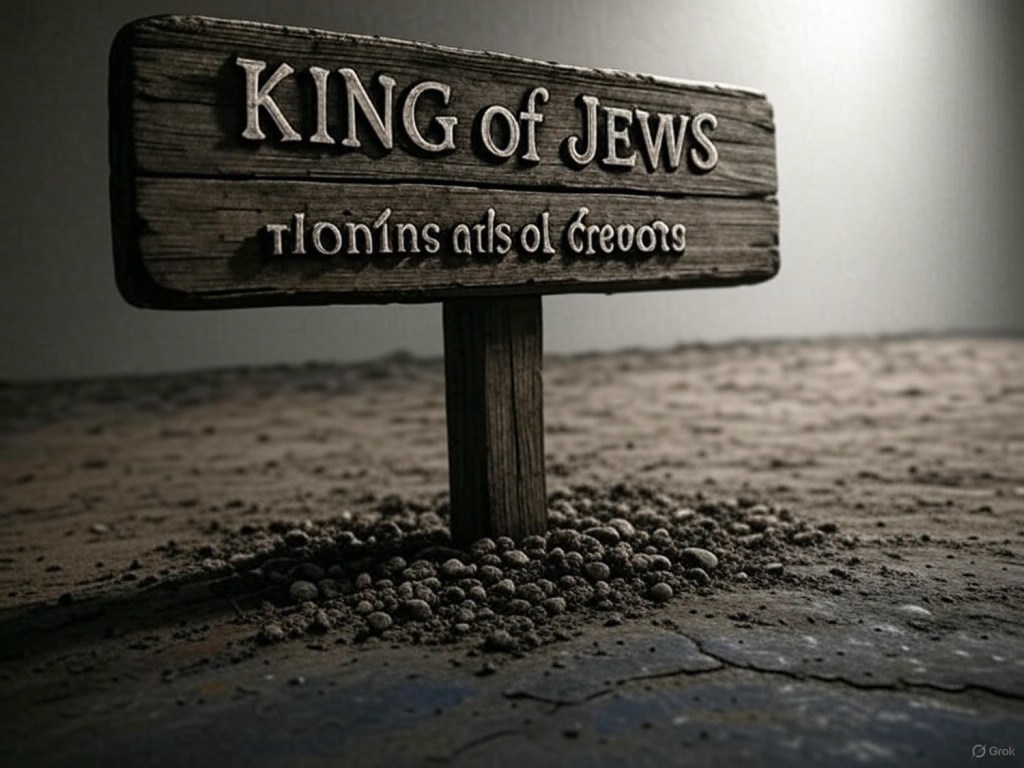
A wooden sign is planted in the ground, surrounded by small pebbles and dirt. The sign has the text “KING of JEWS” prominently displayed in large, bold letters. Below this, there is a line of text in a different script that reads ” πλοκίης αἰς οἱ ςρεοοης” which are random Greek letters for illustration . The background is a plain, slightly textured surface with a gradient of light and shadow.

Jesus: King of the Jews and King of All

John 19:17–19 recounts Jesus’ journey to the cross: “Carrying the cross by himself, he went to the place called Place of the Skull… There they nailed him to the cross… Pilate also had an inscription written and put on the cross. It read, ‘Jesus of Nazareth, the King of the Jews’” (NLT). The title “King of the Jews,” though meant as mockery by Pilate, proclaimed a profound truth. Despite opposition, Pilate refused to change the inscription (John 19:22), unwittingly affirming Jesus’ identity.

Jesus’ kingship transcends earthly boundaries. He is not only the King of the Jews but the “King of kings and Lord of lords” (Revelation 19:16, NLT). On the cross, His reign was established through sacrifice, challenging the powers of this world and offering hope to all who believe. Good Friday reminds us that Jesus’ kingship demands our allegiance. As Christians, we are called to live under His loving authority, trusting His sovereign plan even in the face of suffering.

The Soldiers and the Fulfillment of Prophecy

The scene at the cross continues in John 19:23–24: “When the soldiers had crucified Jesus, they divided his clothes among the four of them. They also took his robe, but it was seamless… So they said, ‘Rather than tearing it apart, let’s throw dice for it.’ This fulfilled the Scripture that says, ‘They divided my garments among themselves and threw dice for my clothing’” (NLT). This moment directly fulfills Psalm 22:18, written centuries earlier, proving Jesus as the promised Messiah.

This single fulfilled prophecy points to a greater truth: Jesus’ entire life and death align with God’s redemptive plan. From His birth in Bethlehem (Micah 5:2) to His suffering (Isaiah 53), Jesus fulfilled every Messianic prophecy, culminating in His sacrificial death. Good Friday marks the climax of His mission to save humanity, as He bore the weight of our sins on the cross. Even the soldiers’ callous actions, dividing His clothes, served God’s purpose, demonstrating His sovereignty over every detail. As we reflect on this, we stand in awe of Jesus’ obedience and God’s faithfulness.

Good Friday: The Weight and Wonder of the Cross

Good Friday is a day of somber reflection and profound gratitude.

Jesus’ death was the ultimate act of love, as He “gave his life to purchase freedom for everyone” (1 Timothy 2:6, NLT). John 19:17–24 anchors us in the reality of the cross—Jesus endured unimaginable pain to atone for our sins, fulfilling the Law and the prophets. His kingship, declared in the inscription, and His fulfillment of prophecy, seen in the soldiers’ actions, assure us of His victory over sin and death.

On this day, we are invited to pause and contemplate the cost of our salvation. The cross reveals both the depth of human sin and the boundless love of God. As we consider Jesus’ sacrifice, we find hope in His reign as King, knowing that His death was not the end but the beginning of eternal life for all who believe. Good Friday calls us to lift our eyes to the cross, where our Savior triumphed.

A Call to Worship

In response to Jesus’ kingship and sacrifice, our hearts turn to worship. Good Friday is a time to gather in worship services, pray, or meditate on Scripture, giving thanks for all Jesus has done. Reflect on His love, which led Him to the cross, and commit to living under His reign daily. Let this day inspire a life of worship, where every action honors Jesus as King and Savior. As Psalm 95:6 urges, “Come, let us worship and bow down. Let us kneel before the Lord our maker” (NLT).

Lord! Lord! (Matthew 7:21-23)

We look at a short yet powerful passage from the Sermon on the Mount today. Such verses should absolutely challenge us to look carefully at our lives and ensure we are truly following God and the Gospel.

We read:

21 “Not everyone who calls out to me, ‘Lord! Lord!’ will enter the Kingdom of Heaven. Only those who actually do the will of my Father in heaven will enter. 22 On judgment day many will say to me, ‘Lord! Lord! We prophesied in your name and cast out demons in your name and performed many miracles in your name.’ 23 But I will reply, ‘I never knew you. Get away from me, you who break God’s laws.’

Matthew 7:21-23 NLT

To be clear, these are words of Jesus Himself. As with everything the Lord said, we ought not to take it lightly.

Jesus tells us plainly that not everyone who calls Him Lord will enter the Kingdom of Heaven. In other translations, I believe it says not everyone who says to me Lord, Lord will be saved. This is vitally important, and tells us something about what it truly means to be saved. Many people call themselves Christians, and many would say that Jesus is Lord, but is He – really?

Jesus says that only those who do the will of the Father will actually enter the Kingdom of Heaven. Does this fly in the face of the Gospel of grace? It sounds like salvation by works doesn’t it? Calling on the name of the Lord is suddenly not enough, but we must do certain things too to “earn” salvation, right?

I think not.

There is a distinct difference between acknowledging Jesus as Lord and living so, and simply paying lip-service and saying the words. I may have said this before, but it is a good example… I may be a fully paid up member of the local gym, carrying my membership card and even wearing the T-shirt, but if I never go and lift weights, I may as well not bother.

In a similar way, we can go to church, sing the songs, carry a Bible around and more, and yet if our lives do not reflect holiness and obedience, we must ask ourselves if we have truly surrendered our lives to God.

#Salvation is more than just saying words, it is living a life of #obedience #Bible #Jesus #Christianity

When we encounter Jesus, it ought to change us. When we make Him our Lord, that means putting Him in full charge of our lives and not just tagging Him on to our current lifestyle. True submission requires obedience. There can be no other way. It is a silly example, but I cannot claim to be a man of peace if I am frequently getting into fist-fights in the local pub. Likewise, I cannot claim to be a Christian while completely ignoring God’s instructions.

Obeying God’s will, as Jesus sets out above, is not a means to salvation, but a result of it.

Obeying #God is not a means of #salvation, but a result of it #Bible #Jesus

The true Gospel is indeed a Gospel of grace, not something we earn through obedience. God’s grace is freely given, and we need not nor cannot do anything to work for it. However, once freely received, the resulting change in our hearts should be reflected in our lives. Once saved, we joyfully obey the will of the Father in response to His grace. Grace comes first, and the fruit of obedience follows.

Verses 22 and 23 send a shiver down my spine. On that final day when we all stand before God, not all who think they are saved actually are. Imagine that for a moment, imagine being one of those who are told by Jesus, “I don’t know you!” What a terrible thing.

I do not want that to be me, and neither do I want that to be you.

The defence of these people (which is really no defence at all), is that they have 1) prophesied in Jesus’ name, 2) cast out demons and 3) performed many miracles. These are not small things in and of themselves. What this tells me is that not every miracle worker knows Christ, or rather, is known by Christ. Not every prophet, nor everyone who delivers others from demons, is part of God’s kingdom.

So how can we tell?

This is not straightforward to answer in a short blog post. Clearly, the Bible does encourage the use of such spiritual gifts such as prophecy or the working of miracles. Yet my suspicion is that is less about the activity itself i.e. casting out demons, but the motive behind it. Of these three examples, all are very public things. I wonder if it is all too easy to start claiming the credit for a miracle, a prophecy or a demon-deliverance. These are gifts of the Spirit, but there is no mention made of the fruit.

22 But the Holy Spirit produces this kind of fruit in our lives: love, joy, peace, patience, kindness, goodness, faithfulness, 23 gentleness, and self-control. There is no law against these things!

Galatians 5:22-23 NLT

Many seek the gifts of the Spirit, without seeking the fruit. Jesus said you will know them by their “fruit,” not by their “gifts.” (see earlier on in this very chapter – Matthew 7:15-20)

So what do we take from this?

Firstly, we do need to acknowledge Jesus as Lord. He is in charge, and we must recognise His rightful place in our lives. We must not seek Him as Saviour without also accepting Him as Lord.

If, indeed, He is our Lord, then we must do what He tells us. We will not get that perfectly right all of the time, but in response to the grace we have been given, we take His commands seriously. The better we come to know Him, the more we will want to do this.

We obey, not to earn His love, but in response to it.

When we do obey, it must also be for the right motives. We do not do it to be popular or to seek fame and fortune, but instead we do it for His glory.

As a blogger, I too need to be cautious with this. Do I write to bless people, or do I write to seek their favour? Judging by how often I check my stats, I need to check my motives! How about you?

These are challenging words from Christ, and I encourage you to pray over them in the coming days. I want you to know Christ, and I want Him to know you. When you stand before Him one day, I want you to have full assurance of your salvation. God’s grace is sufficient, and so let each of us respond to it in obedience. Amen

Just as He said He would

Happy Easter!

It was my privilege to share for a few minutes this morning at our early morning sunrise service on this Resurrection Sunday.

I share below a recording of the message which I hope you enjoy.

May you be eternally blessed this Easter weekend!

A message from Andy on Easter Sunday morningA message from Andy on Easter Sunday morning

Is the Old Testament Relevant Today? (Best of 2021)

As part of my Course in Christian Studies, I have completed an assignment about why I think the Old Testament is relevant to 21st Century readers. I thought I would share it with you today. Is the Old Testament Relevant Today? CCS Assignment 1 Imagine you have a Christian friend who cannot see the point…
— Read on andy-brown.org/2021/01/09/is-the-old-testament-relevant-today/

Joseph and Jesus (Joseph #8)

I have now written and published a series of posts on Genesis 37, which covers the early part of the story of Joseph. I know it is a familiar story to many, and I hope that you have found my thoughts helpful.

Let me summarise chapter 37 for you now:

There once was a son, beloved by his father, and he made some very bold claims about himself. He was hated by his brothers, so much so that they bound him and beat him. They wanted to kill him and left him for dead. They thought they had gotten rid of him for good for the price of a few silver coins. They did not realise that one day, he would return to rule over them.

Who am I talking about here? Joseph? Or Jesus? With some careful wording, the above seems to apply rather well to both the son of Jacob and the Son of God.

Joseph is a “type” of Christ, and by type, I mean something akin to a prototype. In the Hebrew Scriptures, prophecy is less about predicting the future, and more about  establishing a pattern. Joseph is a pattern for Christ.

Let’s walk back through Genesis 37 and see if we can spot the similarities between Joseph and Jesus.

  • Joseph was hated by his brothers. Jesus was largely rejected by the people of Israel. (Gen 37:4)
  • Joseph was beloved by his father, as was Jesus beloved by His Father (Gen 37:4)
  • Joseph’s brothers hated him for telling them the truth (his dreams). Jesus was hated by the religious leaders of the day for telling them the truth. (Gen 37:5)
  • Joseph told his brothers that they would one day bow down to him. Jesus said that one day we all will bow down to Him (Gen 37:6-7)
  • Joseph’s father sent him to his brothers. Jesus was sent by the Father to the people of Israel (Gen 37:13)
  • Joseph’s brothers plotted to kill him; Jesus’ fellow Israelites plotted to kill Him. (Gen 37:18)
  • They threw Joseph in a pit, and Jesus was put in a tomb hewn from rock. (Gen 37:19)
  • They stripped Joseph of his tunic, and the same was done to Jesus (Gen 37:23)
  • Joseph was sold for twenty pieces of silver; Jesus was sold for thirty pieces. (Gen 37:28)
  • Reuben returned to Joseph’s pit and found it empty. Likewise, the women found Jesus’ tomb empty on the third day (Gen 37:29)
  • Joseph’s brothers killed a male goat to hide their sin. Jesus became a sacrifice for us all, and His blood covered our sin (Gen 37:31)

Some of these, alone, may seem just trivial or coincidental. But when you look at the list as whole, you must admit there is certainly something here.

Is Joseph a perfect, prophetic representation of Jesus? No, not exactly of course. However, there are signs here and patterns set out which we must not gloss over. This passage alone is surely not enough to convince anyone of Jesus’ future coming, but take it alongside the many other Messianic prophecies of the Old Testament, and a picture forms.

I am not suggesting you bend Scripture to make it say whatever you wish. IF you look however, you will soon see that Jesus is ever present in His Word. The old Testament is a shadow of things to come, and that shadow is that of Christ Himself.

Genesis 37 is not the only place in Joseph’s story where we see Christ. As we continue on through his story, I will try to point them out to you. If you spot one that I miss, do let me know!

Rest assured; the Bible is true! It is the only truth we can rely on! I have not just bet my life on it, but my whole eternity as well. How about you?

Peter Preaches… Again

In yesterday’s post – Miracle at the Gates – we spent some time thinking about the miracle performed by Peter and John at the entrance to the temple. This miracle created a lot of attention, and Peter did not hesitate to speak to those gathered. Today we will have a look at what he had to say. Notice this is the second time Peter preaches, hence the title. You can read about the first time he spoke (at Pentecost) in my post – Peter Preaches.

You can find Peter’s words in Acts 3:12-26, and as it’s quite a lengthy passage, I won’t quote it all here. Hit the link above if you want to read the full text, and I’ll quote parts of it throughout the post.

Open With a Question

Peter begins his sermon by asking the crowd a few questions. It can be a good way to start a message, as it gets us thinking about the subject at hand.

When Peter saw it, he responded to the people, “You men of Israel, why do you marvel at this man? Why do you fasten your eyes on us, as though by our own power or godliness we had made him walk?

Acts 3:12 (WEB)

Peter gets straight to it, asking why they are so interested in what has happened. He is challenging their surprise, as if this man becoming well is a perfectly normal thing to have happened. And indeed, when in the presence and power of Christ, the supernatural becomes the natural.

Peter asks the group why they “fasten their eyes” on them, which is the same phrase used in verse 4 when peter looked on the man prior to the healing.

He is crystal clear with the people that this man was not healed by his or John’s power or godliness, and therefore the crowd’s interest should not be on them, but on the source of that power. And that is…?

The Answer

Verse 13 begins “The God of Abraham, Isaac, and Jacob, the God of our fathers, has glorified his Servant Jesus,” and points very clearly to the God and Father of our Lord Jesus Christ. Peter names the Jewish forefathers, Abraham, Isaac and Jacob leaving the people in no doubt about Who has performed this amazing feat of healing.

Peter pulls no punches as he tells them that they are responsible for killing the prince of Life. Pilate offered them a chance to release Christ, but they chose a murderer instead, denying and rejecting the Messiah.

By faith in his name, his name has made this man strong, whom you see and know. Yes, the faith which is through him has given him this perfect soundness in the presence of you all.

Acts 3:16 (WEB)

Verse 16 implies it is both faith in the Name of Jesus, and the very Name itself which has given this man “perfect soundness” of body. What miracles can be brought about by the Name of Christ! We must never underestimate that Name, nor use it in vain. Power is released as we utter the Name of Jesus, and is the reason we pray in that Name alone.

What Shall We Do?

Verses 17 and 18 tell us that Peter acknowledged their ignorance of what they had done. They knew not who Jesus really was, and neither did their leaders. Yet the prophets had foretold that the Christ would have to suffer and die, and so Christ fulfilled their words.

Peter goes on to tell the people what they now need to do.

Repent therefore, and turn again, that your sins may be blotted out, so that there may come times of refreshing from the presence of the Lord,

Acts 3:19 (WEB)

To repent, as Peter says, is to turn – to turn away from sin and wrongdoing, and to turn to God. We must all do this. Few churches seem to remind their congregants of the need to repent these days. Yet, each one of us, must turn from our sin and turn to Christ. In doing so, our sins will be blotted out – crossed out of the book if you prefer – never to be mentioned again.

Peter tells not just his audience, but us as well, of the terrible consequences of not turning to Christ in verse 23.

And it shall be that every soul who does not listen to that prophet shall be destroyed from the people.’

Acts 3:23 (ESV)

We must take this warning seriously. There will come a time when it is too late to turn back, and their is no better time than now to give your life to Christ. He is the only way to Heaven and their are no shortcuts. Surrender to Him right here and now, ask Him to forgive you and to be in charge of your life from here on out. It will be the best decision you ever make!

Closing Words

Peter closes his sermon by telling the people that Christ will remain in Heaven until the time comes to restore all things. When that day comes, He will return and put all things right! This was spoken of by the prophets of old, and Peter points out several Scriptures to them.

He reminds them of the covenant God made with Abraham, and that it would never be forgotten. God is not slow in keeping His promises, nor will He ever break a single one of them.

Peter finishes in verse 26 with the following words, and I think it is a great place to finish our post today also.

Praise God our Father who sent His Son to us to bless us, and to turn us from our wickedness!

God, having raised up his servant, sent him to you first, to bless you by turning every one of you from your wickedness.”

Acts 3:26 (ESV)

Three Days

For us, Easter Saturday sits between the devastating day of the cross on Good Friday, and the joy of the resurrection to come on Easter Day. I prefer the name “Resurrection Sunday” but perhaps that’s a discussion for another time!

For the friends of Jesus two thousand years ago, many of them were not ready or waiting for the resurrection at all. This day would have been a day of loss and grief for them. All of their hopes and dreams had been smashed. They had expected Jesus to evict the Romans and set Himself up as King. Quite the opposite had happened! Their Messiah had been lost. 

Would they have started to doubt themselves? Would they have been asking one another – was this really the Christ after all? They had seen so many miracles and wonder works, yet they had not expected Him to die like a common criminal. 

It may seem somewhat baffling to us that the disciples had not heard the words Jesus had spoken. In advance of these things, He had told them that it would happen. And even beyond His words, the Scriptures foretold it all. But I think we can forgive them for not seeing that in the prophecies of the Old Testament. 

From that time on Jesus began to explain to his disciples that he must go to Jerusalem and suffer many things at the hands of the elders, the chief priests and the teachers of the law, and that he must be killed and on the third day be raised to life.

Matthew 16:21 (NIVUK)


For what I received I passed on to you as of first importance[a]: that Christ died for our sins according to the Scriptures, 4 that he was buried, that he was raised on the third day according to the Scriptures, 5 and that he appeared to Cephas,[b] and then to the Twelve.

1 Corinthians 15:3-5 (NIVUK)

The verse above from the Gospel of Matthew shows that Jesus taught His disciples that He would die, and three days later rise to new life. Likewise, Paul (in hindsight of course) shares the same thing. Paul says however “according to the Scripture.” So the Old Testament must have predicted this in advance.

But where?

When reading Old Testament prophecies, we must understand that often they do not merely say “The Son of God will come, and His name will be Jesus, and after dying He will come back to life after three days…” That would be convenient for Bible scholars of course, but we must not forget the Old Testament was written by many people over hundreds of years. Despite this, it really is astonishingly coherent, and clearly shows the hand of the divine behind it. 

The first place I want to point to is the lie – or rather death – of Jonah the prophet. Sometimes called “The Reluctant Prophet,” because he ran in the total opposite direction to where God was sending him, Jonah is a fascinating character. 

You probably know his story from Sunday School, if you ever went, and may well be familiar with his being swallowed by a large fish or whale. 

Now the Lord provided a huge fish to swallow Jonah, and Jonah was in the belly of the fish three days and three nights.

Jonah 1:17 (NIVUK)

We see here that Jonah spent three days and three nights in the belly of the fish. Reading on to Jonah 2, I think it is clear that Jonah actually died in the sea or sea creature. He talks about the abode of the dead, or “the pit” so it seems likely he did actually die. If not though, the point remains. 

Bible prophecy is often pattern and not prediction. that means it establishes a pattern of events which will occur again in the future. Jonah’s three days and three nights of “death” are a pointer towards Christ’s own experience of three days in the grave. 

Similarly, Abraham’s sacrificing of Isaac is another picture. I’ve spoken before about this passage from Genesis 22, and personally believe it is a prophecy acted out by Abraham of what God would one day do with His own Son Jesus. 

We read in Genesis 22 that from the time when God gave the command for Isaac to be sacrificed, to the time Abraham arrived at Mount Moriah was precisely three days. 

Early the next morning Abraham got up and loaded his donkey. He took with him two of his servants and his son Isaac. When he had cut enough wood for the burnt offering, he set out for the place God had told him about. 4 On the third day Abraham looked up and saw the place in the distance.

Genesis 22:3-4 (NIVUK)

In the Jewish mind, and so in Abraham’s mind, Isaac was essentially dead from the moment God had given the command. It was a three day journey, as we read above, until the events unfolded and Issac was returned to Abraham. So another son lost to “death” for three days. 

There is more we could explore, but it would and should take an entire lifetime to examine the Old Testament and unveil the prophecies which spoke of Christ’s death and resurrection centuries in advance. 

Many will tell you that you can’t prove God exists, or there is no evidence that the Bible is true, it’s just a personal matter of faith. Not true. A comprehensive study of God’s Word will show you that there is incontrovertible evidence of biblical truth. The more you study it, the more you will realise it is not only true, but the only real truth we can rely upon. 

Jesus died for you. Three days later He rose from the dead. Many witnesses saw it. You don’t have the luxury to ignore it or deny it. So what will you do with this truth today? 

Stones that shout for joy

Today is Palm Sunday, and the day where we remember Jesus entering Jerusalem on a donkey. It is called Palm Sunday because of the crowds who lay palm branches and their own coats on the ground for Jesus to ride on as He entered the city. Think of this as a sort of “red carpet!”

In the village where we live, a usual Palm Sunday would see a group from the church walking from the town hall through to the church – led by a locally sourced donkey! It is quite a sight to be seen, and the children love it.

This year, due to the COVID-19 situation, this won’t be going ahead. Instead, many churches around the country and the world will celebrate online via live streaming. I hope, if nothing else, this reminds us how fortunate we are to be able to meet in person.

Jesus’ Triumphal Entry into Jerusalem is recorded in Luke’s Gospel.

After Jesus had said this, he went on ahead, going up to Jerusalem. 29 As he approached Bethphage and Bethany at the hill called the Mount of Olives, he sent two of his disciples, saying to them, 30 ‘Go to the village ahead of you, and as you enter it, you will find a colt tied there, which no one has ever ridden. Untie it and bring it here. 31 If anyone asks you, “Why are you untying it?” say, “The Lord needs it.”’

32 Those who were sent ahead went and found it just as he had told them. 33 As they were untying the colt, its owners asked them, ‘Why are you untying the colt?’

34 They replied, ‘The Lord needs it.’

35 They brought it to Jesus, threw their cloaks on the colt and put Jesus on it. 36 As he went along, people spread their cloaks on the road.

37 When he came near the place where the road goes down the Mount of Olives, the whole crowd of disciples began joyfully to praise God in loud voices for all the miracles they had seen:

38 ‘Blessed is the king who comes in the name of the Lord!’

‘Peace in heaven and glory in the highest!’

39 Some of the Pharisees in the crowd said to Jesus, ‘Teacher, rebuke your disciples!’

40 ‘I tell you,’ he replied, ‘if they keep quiet, the stones will cry out.’

Luke 19:28-40 (NIVUK)

As mentioned above, our church are not able to meet this Palm Sunday. Our family had agreed to lead the prayers that day, so made a little video instead. My daughters danced in the background, waving homemade palm branches while I talked a little about Jesus’ entry into the city.

I pointed out that if we are ever in danger of missing an important point from the Gospels, then often the Pharisees come to our aid. In the video at least, I’m not sure I fully explained why – so will try to do a better job here!

As Jesus enters the city, the crowds begin to praise Him. They cut branches from the trees and lay out their jackets for Him to ride over. Verse 38 records the words they began to shout: “Blessed is the king who comes in the name of the Lord!” This is a direct quote from Psalm 118.

When the crowds do this, the Pharisees immediately stand to attention and tell Jesus to rebuke His disciples. Why? Because they knew, as well as Jesus did, that Psalm 118 and these words in particular are Messianic. They know that the crowds are acknowledging Jesus as the King who was to come.

The Pharisees do not want anyone to recognise this. They don’t believe it themselves, and essentially consider it blasphemy. They are saying, “Jesus! These people are proclaiming you as the Messiah! Stop them!”

How does Jesus respond? By telling them that if the people refused to cry out, then the very stones themselves would begin to praise.

Palm Sunday is the fulfilment of a very specific prophecy from the Old Testament book of Daniel. In that, the angel Gabriel declares the exact day in which the Messiah would be presented to Jerusalem as King, and that day was this Palm Sunday when Jesus rode into the city. You can hear more about this in my message – Prophecy and Palm Branches which I will put at the bottom of this post. You can hear more of my talks in the Audio section.

While I was in Jerusalem a few years ago, I was fortunate enough to be able to walk the road that Jesus went down that first Palm Sunday. As we walked, I picked up a small stone from the ground which I have kept as a keepsake. Of course the stone itself was not there the day Jesus was, although that would have been nice, but it is a little reminder to me. If I do not praise God, then maybe that little stone might cry out.

When you are next out, doing your daily exercise, or the next time you take a turn around the garden, why don’t you also pick up a stone. You can put it somewhere that you’ll see it, and every time you do, take a moment to praise and thank God for His Son. Otherwise that stone might shout for joy instead of you!

Jesus rode that donkey into Jerusalem knowing full well where it would lead. Less than a week later, He would be nailed to a wooden cross and bearing the punishment for us all. That crowd which praised Him on the way in, would soon change their tune and shout “Crucify him!”

Remember why Jesus did it. It was for you and for me. I see Palm Sunday as the peak at the top of a roller-coaster – that moment where all seems to freeze before it races downwards the other side. Jesus is being rightly praised, but would soon plummet into the shame of a sinner’s death – undeserved. He did it for you.

Praise the God and Father of our Lord Jesus Christ this Holy week.


Palm Branches and Prophecy