A Determined Desire: Choosing a Life of Integrity (Psalm 101:2)


In our last post, we saw how David’s journey into a life of integrity began not with a list of rules, but with a song. His heart was captivated by God’s unfailing love and perfect justice, and that worship became the fuel for everything that followed. Now, in verse two, we see that worship naturally translates into a personal, practical commitment. The song in his heart leads to a solemn promise on his lips.

Let’s read the verse: “I will be careful to live a blameless life— when will you come to help me? I will lead a life of integrity in my own home.” (Psalm 101:2, NLT).

This is where the rubber meets the road. David moves from praising God’s character to defining his own conduct. But notice how he does it. This isn’t a proud boast; it’s a humble, dependent vow.

The What: A “Blameless” Life

David declares he will be “careful to live a blameless life.” The word “blameless” can sound intimidating, as if it means a perfect, sinless life. But in the Bible, to be blameless doesn’t mean to be flawless. It means to be wholehearted, integrated, and sincere. It’s about having a heart that is fully committed to God, which leads to a life that is consistent and trustworthy.

Think of it like a building that is “plumb” – its walls are straight and true because they are aligned with a fixed standard. For David, that standard was God’s law. To be blameless is to intentionally align your life with God’s ways. The fact that he says he will “be careful” shows this won’t happen by accident. It requires attention, intention, and diligence. It’s a conscious choice to walk a particular path.

The Where: The Importance of “My Own Home”

Then David gets even more specific: “I will lead a life of integrity in my own home.” This is a powerful and revealing statement. It’s one thing to act a certain way in public, at church, or when people are watching. It’s another thing entirely to live with integrity in the privacy of your own four walls.

Our home is the place where we are most truly ourselves. It’s where our guard comes down. If our faith doesn’t work there, it isn’t real. David is committing to the same character in private that he displays in public. He promises to be the same person with his family, his servants, and his private thoughts as he is when standing before the nation. This is the ultimate test of integrity. Are we kind, patient, and faithful when the only audience is God and those who know us best?

The How: A Cry for Help

Sandwiched right in the middle of this bold promise is a vulnerable plea: “when will you come to help me?” This is the key to the whole verse. David knows he cannot do this in his own strength. His resolve is coupled with a deep dependence on God.

This prayer shows that the desire to live a blameless life is itself a gift from God. It is the Holy Spirit who stirs our hearts to want holiness. By crying out for help, David acknowledges that from start to finish, a life of integrity is a work of God’s grace in us. The Apostle Paul understood this same principle when he wrote, “For God is working in you, giving you the desire and the power to do what pleases him” (Philippians 2:13, NLT). Our job is to cooperate with that work, to say “I will” while simultaneously praying, “Lord, please help me to will.”

What This Means For Us Today

So, how do we apply this determined yet dependent vow to our own lives?

First, we can choose to be intentional. Living a life of integrity doesn’t happen by default. We must decide, as David did, to “be careful.” This might mean setting healthy boundaries for ourselves, being mindful of our entertainment choices, or pausing before we speak in frustration. It’s about actively pursuing wholeness, rather than just passively hoping for it.

Second, we can start at home. Let’s ask ourselves some challenging questions: Is my character consistent behind closed doors? Am I more loving and patient with strangers than I am with my own family? David’s vow challenges us to make our home the primary place where we practice our faith, offering grace, speaking truth, and serving one another.

Finally, we can combine our resolve with reliance. We can make our own bold promises to God, but we must always do so with a prayer on our lips. When we feel the temptation to cut corners, to be harsh in private, or to let our standards slip, we can echo David’s cry: “Lord, I want to be faithful here—please, come and help me right now.” Our determination is the track, but God’s grace is the engine that carries us forward.

David’s worship led to a want for holiness. Next, we will see how this internal commitment begins to shape his outward actions, starting with what he allows before his eyes.

Understanding God’s Will in the Face of Suffering: Acts 21 and the Prophecy of Agabus

In Acts 21, we encounter a striking moment where the apostle Paul, guided by the Holy Spirit towards Jerusalem, receives a sobering prophecy about his future. This passage raises important questions about the nature of prophecy, human response to divine will, and the tension between well-meaning counsel and obedience to God’s calling.

A simple black leather belt with silver buckle resting on a white surface 

The Prophecy of Agabus (Acts 21:10-14, ESV)

“While we were staying for many days, a prophet named Agabus came down from Judea. And coming to us, he took Paul’s belt and bound his own feet and hands and said, ‘Thus says the Holy Spirit, “This is how the Jews at Jerusalem will bind the man who owns this belt and deliver him into the hands of the Gentiles.”’ When we heard this, we and the people there urged him not to go up to Jerusalem. Then Paul answered, ‘What are you doing, weeping and breaking my heart? For I am ready not only to be imprisoned but even to die in Jerusalem for the name of the Lord Jesus.’ And since he would not be persuaded, we ceased and said, ‘Let the will of the Lord be done.’”

This passage follows Paul’s earlier declaration in Acts 20:22-24 (ESV):

“And now, behold, bound by the Spirit, I am going to Jerusalem, not knowing what will happen to me there, except that the Holy Spirit testifies to me in every city that imprisonment and afflictions await me. But I do not account my life of any value nor as precious to myself, if only I may finish my course and the ministry that I received from the Lord Jesus, to testify to the gospel of the grace of God.”

1. The Nature of Agabus’ Prophecy

Agabus, a prophet from Judea, delivered a message from the Holy Spirit using symbolic action—a method reminiscent of Old Testament prophets (e.g., Ezekiel’s enacted prophecies in Ezekiel 4-5). His prophecy was predictive, not prescriptive: it revealed what would happen, not necessarily what Paul should do.

Some prophecies in Scripture are conditional, offering warnings that may be averted through repentance (e.g., Jonah’s message to Nineveh). However, Agabus’ words carried no hint of conditionality—they were a straightforward declaration of future events. This raises the question: if the prophecy was certain, why did the believers urge Paul to avoid Jerusalem?

2. The Believers’ Response: Love vs. God’s Will

The disciples, including Luke (the author of Acts), pleaded with Paul not to go. Their reaction was natural:

  • They loved Paul and did not want him to suffer.
  • They may have misinterpreted the prophecy as a warning rather than a confirmation of God’s plan.

This mirrors Peter’s reaction in Matthew 16:22 (ESV) when Jesus foretold His crucifixion:

“Peter took him aside and began to rebuke him, saying, ‘Far be it from you, Lord! This shall never happen to you.’”
Jesus’ response was sharp: “Get behind me, Satan! You are a hindrance to me. For you are not setting your mind on the things of God, but on the things of man.” (Matthew 16:23, ESV).

Similarly, the believers in Acts 21 were operating from human concern, not divine perspective. Their intentions were good, but their advice, if followed, would have diverted Paul from God’s purpose.

3. Paul’s Resolve: Embracing Suffering for Christ

Paul’s response was unwavering:

  • He was “ready not only to be imprisoned but even to die” (Acts 21:13).
  • He saw his suffering as part of his calling (Acts 20:24; Philippians 1:20-21).

His attitude reflects Jesus’ words in Luke 9:23-24 (ESV):

“If anyone would come after me, let him deny himself and take up his cross daily and follow me. For whoever would save his life will lose it, but whoever loses his life for my sake will save it.”

Paul understood that obedience to God sometimes requires embracing hardship. His journey to Jerusalem was not reckless defiance but faithful surrender.

4. Lessons for Discerning God’s Will Today

This passage offers key principles for Christians facing difficult decisions:

  • Prophecy Reveals, But Does Not Always Direct
    Agabus’ prophecy confirmed what awaited Paul, but it did not instruct him to avoid it. Likewise, God may reveal challenges ahead without necessarily calling us to evade them.
  • Well-Meaning Counsel Must Be Weighed Against God’s Word
    The believers’ pleas were heartfelt, but Paul prioritised the Spirit’s leading. Proverbs 3:5-6 (ESV) reminds us:

“Trust in the Lord with all your heart, and do not lean on your own understanding. In all your ways acknowledge him, and he will make straight your paths.”

  • Suffering May Be Part of God’s Plan
    Scripture repeatedly associates faithfulness with endurance (Romans 5:3-5; 1 Peter 4:12-13). Avoiding suffering is not always the godliest choice.

Conclusion: “Let the Will of the Lord Be Done”

The believers’ final words—“Let the will of the Lord be done” (Acts 21:14)—mark their submission to God’s higher purpose. Paul’s example challenges us to:

  • Seek God’s perspective over comfort.
  • Trust that His plans, even when painful, are purposeful.
  • Remain steadfast when well-meaning advice conflicts with divine calling.

In a world that prioritises safety and self-preservation, Paul’s resolve reminds us that the greatest fulfilment lies in surrendering to God’s will—whatever the cost.

It is always wise to listen to godly Council. The people who care about us, will naturally not want us to come to harm. We would not be sensible to simply ignore their love or advice. This is especially true on making a big decision, or one that potentially leads us down a dangerous path.

At the end of the day though, we are answerable only to God. If he is instructing us to do something, and the entire rest of the world is telling us not to, then of course we must follow him. God over man.

The most difficult part, for me at least, is discerning God’s will. Few of us will receive a clear prophecy as Paul did in today’s passage, so we must always be cautious to follow God’s will carefully. We all want a neon sign telling us which way to go, but for the most part, we are to study and understand the Bible and discern gods will from that alone.

Using appropriate wisdom and discernment, all any of us can do is try to follow God to the best of our ability. 

Wise Sons, Foolish Children, and Worrying Parents (Proverbs 10:1)

“A wise son brings joy to his father, but a foolish son brings grief to his mother.”

Two parents sat on a large sofa cradling a newborn baby, looking very happy 

This proverb from the book of Proverbs cuts right to the chase about how a child’s actions profoundly affect their parents. When it speaks of a “wise” son, it’s not just about academic cleverness or quick wit. It refers to someone who consistently makes good choices, acts with integrity, and shows sound judgment in life. This kind of child brings immense happiness and a deep sense of pride to their father. Their thoughtful and responsible decisions reflect well on their upbringing, leading to positive outcomes that fill their parents with contentment.

Conversely, a “foolish” son is someone who acts impulsively, makes poor decisions, or disregards good counsel. Their actions often lead to negative consequences, causing distress, worry, and significant sadness, particularly for their mother. This isn’t about a lack of love, but the heavy emotional burden of witnessing a child stray from a path of well-being and purpose. It’s a challenging experience for any parent to see their child struggle due to misguided choices.

This ancient saying holds remarkable relevance in our modern lives. It serves as a potent reminder that our choices and behaviours have a tangible impact on those who care for us most deeply – our parents. It prompts us to consider: are our actions bringing joy or grief to those who have invested so much in our lives? It encourages us to cultivate wisdom – to seek understanding, exercise good judgment, and act with integrity in all we do.

For parents, this proverb also subtly underscores the profound and enduring nature of their role. Once you become a parent, you never stop being one. We parents often carry a deep-seated concern about how our children will turn out, a worry that can last a lifetime. This verse highlights that we have a tremendous influence in shaping our children’s character during their formative years. The values we instil, the guidance we provide, and the environment we create all contribute significantly to the development of their wisdom and moral compass.

However, as children grow up, they inevitably take responsibility for their own actions. While parental influence is vast, the ultimate choices made by adult children are their own. The proverb acknowledges this journey from parental guidance to individual accountability. Ultimately, Proverbs 10:1 offers a timeless principle: living wisely leads to a flourishing life, not just for the individual, but for their wider family circle, fostering a legacy of joy rather than sorrow.

The ultimate wisdom we hope our children cultivate is the wisdom to follow Christ.

Whether you are a parent or a child, or somewhere in between, make wise choices today which you will be happy with for a lifetime.

Traits of a Biblical Man: The Enduring Spirit 

Have you ever felt like giving up? I know I have. Recently, at work, I was having a tough time. It felt like I wasn’t making any progress in my career. Day-to-day tasks felt dull and unchallenging, and I was hungry for bigger and better things. The temptation to throw in the towel was strong. But, I pressed on, emphasised excellence in my work, and eventually, I got a breakthrough with a promotion.

Biblical perseverance isn’t just stubbornness, but a steadfast commitment rooted in faith and trust in God, even amidst trials. It’s crucial for spiritual growth, fulfilling God’s calling, and enduring hardship for Christ’s sake. Biblical men are called to be resilient, and this post will explore this vital trait, drawing inspiration from key figures, so we can apply these lessons to our walk with Christ.


Cartoon-style elderly man with a long white beard and bushy eyebrows, wearing a blue robe and sandals, standing outdoors in a mountainous landscape. He is smiling broadly and winking, while holding a massive barbell with large weights above his head in a triumphant pose. The sky is bright blue with fluffy clouds, and green trees and rocky mountains surround him, giving the scene a lively and energetic atmosphere.

The Apostle Paul: Pressing On Towards the Goal

Consider the life of the Apostle Paul. After his dramatic conversion, he embarked on immense missionary journeys, facing a vast array of suffering. Shipwrecks, beatings, imprisonment, and constant opposition marked his path. Yet, he never wavered.

Philippians 3:14 encapsulates his spirit: “I press on toward the goal for the prize of the upward call of God in Christ Jesus.” “Pressing on” speaks of effort, determination, and forward momentum despite obstacles. Paul’s “goal” was his spiritual life and calling, and his “prize” was the reward of faithfulness.

He faced countless trials, but his focus remained fixed. He understood that true biblical perseverance is about keeping one’s eyes on the ultimate prize – Christ – regardless of earthly circumstances. Paul’s life demonstrates this powerfully.


Caleb: Unwavering Faith and Steadfastness

Caleb, one of the twelve spies sent into Canaan, offers another compelling example. Unlike the other ten, who were fearful, Caleb remained confident in God’s promise.

Numbers 13 and 14 recount how the spies assessed the land and the people’s subsequent fear and rebellion. Caleb, however, trusted God, even when facing overwhelming odds and popular dissent.

His perseverance led to him inheriting the land promised to him (Joshua 14:6-15), even forty-five years later. At 85, he was still strong and zealous, a testament to a life lived with unwavering faith. Caleb’s story illustrates that perseverance is not just about enduring hardship, but also about holding fast to God’s promises and acting on faith, even when others falter.


Joseph: A Picture of Enduring Hope

Joseph’s life is a powerful picture of enduring hope. From being the favoured son to being betrayed by his brothers, his journey was filled with adversity.

He faced enslavement in Egypt, false accusations, and imprisonment. Even in prison, he waited patiently, hoping the cupbearer would remember him, trusting God’s plan even when circumstances seemed bleak.

Joseph maintained integrity in Potiphar’s house. He exercised patience and hope during prolonged suffering. Ultimately, his reconciliation with his brothers and his understanding of God’s sovereign hand (Genesis 50:20) reveal the depth of his perseverance. Joseph’s life shows that perseverance is about maintaining faith and hope through extended periods of injustice and suffering, knowing that God is working all things for good.


Application: Cultivating a Resilient Spirit

How can we cultivate this resilient spirit in our own lives?

  • Rooted in God’s Word: Daily scripture reading and meditation are foundational. The Bible provides divine wisdom, comfort, and reminders of God’s unchanging character and promises. When we immerse ourselves in His Word, we strengthen our faith and build a robust spiritual foundation that can withstand the storms of life. It’s where we find the strength to keep going when our own resources are depleted.
  • Prayer: Seeking God’s strength and guidance in challenging times is indispensable. Prayer is our direct line to the Almighty, allowing us to articulate our struggles, express our doubts, and lay our burdens before Him. It’s through prayer that we receive peace that surpasses understanding, divine intervention, and renewed spiritual energy to face another day. It reminds us that we are not alone in our battles.
  • Community: Leaning on brothers in Christ for support and encouragement is vital. We are not designed to walk this path in isolation. A strong Christian community offers accountability, practical help, and empathetic understanding. Beyond general fellowship, we can cultivate what some call a “foxhole” – a tight-knit group of men you can call on any time, day or night, to stand with you in a time of trial. This kind of deep, trusted brotherhood is essential. Be a part of a group of men like that; actively seek out and build such a group. More importantly, be the kind of man who will consistently be there for his brothers in their time of need. This level of committed support prevents the isolation that can erode our resolve to persevere.
  • Focus on the Long-Term: Shifting our perspective from immediate gratification to eternal rewards is crucial for endurance. The temporary discomforts and trials of this life become bearable when viewed against the backdrop of eternity. Remembering the ultimate prize – an eternal dwelling with Christ – provides profound motivation to press on, knowing that our present sufferings are incomparable to the glory that awaits us.
  • Embrace Discomfort: Viewing trials as opportunities for growth and spiritual refinement changes our entire outlook. Instead of seeing difficulties as setbacks, we can embrace them as tools in God’s hand to shape our character, deepen our faith, and increase our reliance on Him. Just as gold is refined by fire, our perseverance is forged in the crucible of adversity, making us stronger and more Christ-like.
  • Trust in God’s Sovereignty: Remembering that God has a plan even when we don’t understand it brings profound peace. When we trust that God is in control, even amidst chaos and uncertainty, we are freed from the burden of needing to orchestrate every outcome ourselves. This confidence in His overarching purpose allows us to surrender our anxieties and continue forward with assurance, knowing that He is working all things for our good and His glory.

Biblical perseverance equips men to face life’s battles with resilience, not giving up on their faith, families, or callings. The Christian man is a “keeps-on-keeping-on” man.

None of the men we have considered today had it easy. They endured long periods of trial, and while we all hope and long for a victorious ending, not all get that in this life. While we have no doubt that God will make everything right in the end, we also remember examples of men who remained faithful and yet were martyred or forgotten. This is hard to take sometimes, but for biblical men, our goal is not our own fame or fortune but the glory of God. He must increase, and we must decrease. 


Conclusion

Perseverance is vital for biblical men. The examples of Paul, Caleb, and Joseph demonstrate its power. Embrace perseverance as a core trait of your Christian walk, trusting that God will empower you to “press on” and “keep on keeping on” for His glory. Reflect on areas in your life where you need to cultivate greater perseverance.

Love in Action: Living out Jesus‘s Commands

Introduction: The Call to Obey God’s Commandments

What does it mean to love God in a world filled with challenges? The Bible provides a clear answer: loving God is inseparable from obeying His commands. In 1 John 5:2–3 (NIV), we read, “This is how we know that we love the children of God: by loving God and carrying out his commands. In fact, this is love for God: to keep his commands. And his commands are not burdensome.” The apostle John emphasises that obedience is the tangible expression of our love for God. Far from being oppressive, God’s commands are designed to lead us into abundant life.

This post begins a series exploring how we can live out our love for God by obeying the commands of Jesus. Today, we focus on three specific commands: loving our neighbour, forgiving others, and making disciples. Each command offers practical ways to reflect God’s love in our daily lives. By examining their meaning and application, we can take steps toward a deeper, more obedient faith.

A group of seven people, including both older adults and younger adults, standing together outdoors on a sunny day. They are smiling and appear to be enjoying each other’s company. Several of them are holding bags filled with fresh produce, such as leafy greens and other vegetables. The group is casually dressed, and they are standing on a paved street with yellow buildings and green trees in the background. In the distance, a church steeple is visible. The overall mood is cheerful and communal, suggesting they may have just come from a market or community event.

Examining Three Commands of Jesus

Command 1: Love Your Neighbour as Yourself (Mark 12:31)

Jesus declares in Mark 12:31 (NIV), “The second is this: ‘Love your neighbour as yourself.’ There is no commandment greater than these.” Paired with loving God, this command forms the foundation of Christian ethics. It calls us to treat others with the same care, respect, and selflessness we desire for ourselves.

Loving our neighbour does not mean accepting or endorsing sinfulness. True love seeks the ultimate good of others, which may involve graciously challenging sinful behaviour and sharing the Gospel. This command is radically inclusive, extending to friends, strangers, and even those who oppose us. It reflects God’s heart for all people, urging us to see others through His eyes.

Practically, we can obey this command by serving those around us—perhaps helping a struggling neighbour with practical needs or listening empathetically to a friend. Loving our neighbour might also mean gently pointing someone toward God’s truth through the Gospel, offering hope and redemption. For example, consider a church member who invited a colleague to a Bible study, patiently answering their questions about faith. Such actions embody Christ’s love. Reflect on your daily interactions: are they marked by this selfless, Gospel-centred love?

Command 2: Forgive Others (Matthew 6:14–15)

In Matthew 6:14–15 (NIV), Jesus teaches, “For if you forgive other people when they sin against you, your heavenly Father will also forgive you. But if you do not forgive others their sins, your Father will not forgive your sins.” Spoken in the context of the Lord’s Prayer, this command underscores forgiveness as a cornerstone of Christian life.

Forgiveness means releasing resentment and extending grace, mirroring the forgiveness God offers us. It is not always easy—deep hurts, such as betrayal or injustice, can feel insurmountable. Yet Jesus calls us to forgive, relying on God’s strength to heal our wounds. Forgiveness does not excuse sin but frees us from bitterness and aligns us with God’s heart.

To apply this command, start by praying for those who have hurt you, asking God to soften your heart. Journaling can help process emotions, while seeking reconciliation—where appropriate—can restore relationships. For instance, forgiving a family member who apologised after a dispute can rebuild trust. Forgiveness is often a process, not a one-time act. Begin with small steps, trusting God to guide you toward healing and peace.

Command 3: Make Disciples (Matthew 28:19–20)

Jesus’s final charge, known as the Great Commission, is found in Matthew 28:19–20 (NIV): “Therefore go and make disciples of all nations, baptising them in the name of the Father and of the Son and of the Holy Spirit, and teaching them to obey everything I have commanded you.” This command calls every believer to share the Gospel and nurture others in faith.

Making disciples involves sharing the good news of Jesus, mentoring new believers, and living as an example of His teachings. This command connects directly to loving our neighbour: there is no greater act of love than sharing God’s love through the Gospel, offering others the hope of eternal life. While the scope is global, discipleship begins in our immediate communities—with friends, family, or colleagues.

Practically, you can obey by sharing your faith with a friend, joining a small group to grow together, or mentoring a new believer. For deeper insight into the Great Commission, I recommend my book, From Doubt to Disciples, which explores how to live out this command with confidence. Grab a copy to discover practical steps for disciple-making. By modelling Christ’s love, your faith can become contagious, inspiring others to follow Him.

Conclusion: Living Out Love Through Obedience

The commands to love our neighbour, forgive others, and make disciples are powerful expressions of loving God, as outlined in 1 John 5:2–3. Loving our neighbour includes sharing the Gospel, not affirming sin, ensuring our love points to God’s truth. Forgiving others reflects God’s grace, freeing us to live in peace. Making disciples, the ultimate act of neighbourly love, spreads God’s hope to others. These commands, though challenging, are not burdensome—they lead to a life aligned with God’s purpose.

Start small: choose one command to focus on this week. Perhaps offer a kind word to a neighbour, forgive a lingering hurt, or share your faith with a friend. God’s grace empowers us to grow in obedience, transforming our lives and communities. This post is the first in a series exploring Jesus’s commands. Future posts will examine others, such as “Do not judge” or “Follow me,” to deepen our journey.

Jesus said if you love me, you will obey me… How much will you love him this week?

Transcript: Finding Hope in the midst of Turmoil -Unpacking Mica 5

For those who prefer to read rather than listen, here is a transcript of the sermon I preached yesterday on Mica five. Enjoy

Good morning everyone! It’s a pleasure to share some thoughts on a truly profound passage from the Bible today. Please forgive my notes – it’s a complex piece of scripture, and I wanted to do it justice! It has nothing to do with my age or memory, I promise!
Let’s begin with a prayer:
Father, we thank You so much for Your Word this morning. Thank You for gathering us together, Your people, to worship You. We thank You for Your majesty and Your presence among us. We thank You for this passage before us. Please help us to understand it, to learn from it, and to learn about You. We pray that what we learn today, Lord, we will apply in our lives, in Jesus’ name. Amen.
Now, who read Micah chapter 5 and fully understood it? Anyone? No? I’m not surprised! It’s quite a tricky passage, isn’t it? Even after reading many commentaries, I don’t think any single one fully agrees on its meaning. So, we’ll do our best this morning!
Layers of Meaning: Like Wallpaper in an Old House
Have you ever moved into a new house and had to decorate a room with ghastly wallpaper? You start to peel it off, only to reveal an even more hideous layer underneath. You keep going, layer after layer, until you finally expose the bare wall. I see today’s passage a little like that – lots of layers.
Micah’s prophecy moves from his present day to a future time. The clear references to Jesus and Bethlehem remind us of the coming great ruler. So, Micah is talking about his contemporary situation, but also a future time as well. It can be a little tricky to know which period he’s referring to at any given moment, but we’ll do our best.
A Quick Refresher: Understanding Micah
For those who might be new to Micah, he was a prophet around the 8th century BC, perhaps 720 BC. He spoke a lot about the Northern Kingdom of Israel and the Assyrian Empire’s threat to them. He was primarily addressing Judah, the Southern Kingdom, but often used the Northern Kingdom as a reference point. Sometimes the Bible refers to ‘Israel’ as the Northern Kingdom, sometimes as the Southern Kingdom (‘Judah’), and sometimes as the collective Israelites, the people of Israel. It can get a bit confusing, which is why some Old Testament passages are hard to follow. Do keep that in mind as you read.

  • Chapter 1: Micah focused on the people’s idolatry and their judgment for it.
  • Chapter 2: He addressed sins against the people, such as mistreating the poor and widows.
  • Chapter 3: This chapter dealt with the sins of the leaders.
  • Chapter 4: Here, the focus shifts to the ‘Mountain of the Lord’ – a hopeful, future time when all people would flow to it, perhaps referring to the coming of Jesus. It also mentions the Assyrian Empire again.
    Micah 5:1 – A Disputed Beginning
    Micah 5:1 often sparks debate about its placement. In the Hebrew Bible, it’s actually at the end of chapter 4. One commentary I read couldn’t understand why anyone would put it at the start of chapter 5. I have a theory why, though I might be completely wrong!
    We’re only looking at six verses this morning, but they are packed with powerful imagery. We must stay rooted in Micah’s immediate context: he’s speaking to people living under the looming shadow of the Assyrian Empire. While some of the prophecy certainly looks ahead, it’s easy to get lost in the imagery and forget the immediate concerns of his audience.
    Jerusalem Under Siege and Humiliation (Micah 5:1)
    Verse 1 says: “Marshal your troops, city of troops!” This refers to Jerusalem, though it’s called the ‘city of troops’ rather than ‘Jerusalem’ or ‘Daughter Zion’. It describes Jerusalem under siege, a dangerous time as the Assyrian Empire gathers.
    Then it says, “They will strike the ruler of Israel on the cheek with a rod.” This is a powerful image of humiliation. While it could be a physical blow, striking someone on the cheek with a rod was primarily about public shame. When Jesus spoke about ‘turning the other cheek’, it wasn’t about inviting further blows, but about refusing to engage in a cycle of humiliation. This is about Jerusalem, the great city of God, facing profound humiliation.
    From Humiliation to Hope: The Rise of Bethlehem (Micah 5:2)
    Then the passage shifts gears dramatically to Bethlehem: “But you, Bethlehem Ephrathah, though you are small among the clans of Judah, out of you will come for Me one who will be ruler over Israel, whose origins are from of old, from ancient times.”
    This is why I believe verses 1 and 2 belong together. You have the powerful capital city of Jerusalem, under siege and its leader humiliated, facing God’s judgement. Yet, Bethlehem, this tiny village, just a few miles from Jerusalem, the home of David, is contrasted with this mighty city. From this humble place, God calls forth a great ruler.
    Ron Hamilton and the Power of Humble Beginnings
    Have you ever heard of Ron Hamilton? He’s from Rutherglen in Scotland. Ever used daily disposable contact lenses? Well, Ron Hamilton invented them, from that small fishing village. From humble origins, a technology emerged that affects countless lives.
    In a similar way, from Bethlehem, this small town, a great ruler would be called forth by God.
    Bethlehem: The House of Bread
    Do you know what the name Bethlehem means? ‘House of Bread’. ‘Beth’ means house (think of Bethsaida, or Bethany), and ‘lechem’ means bread. So, Bethlehem is the “House of Bread”.
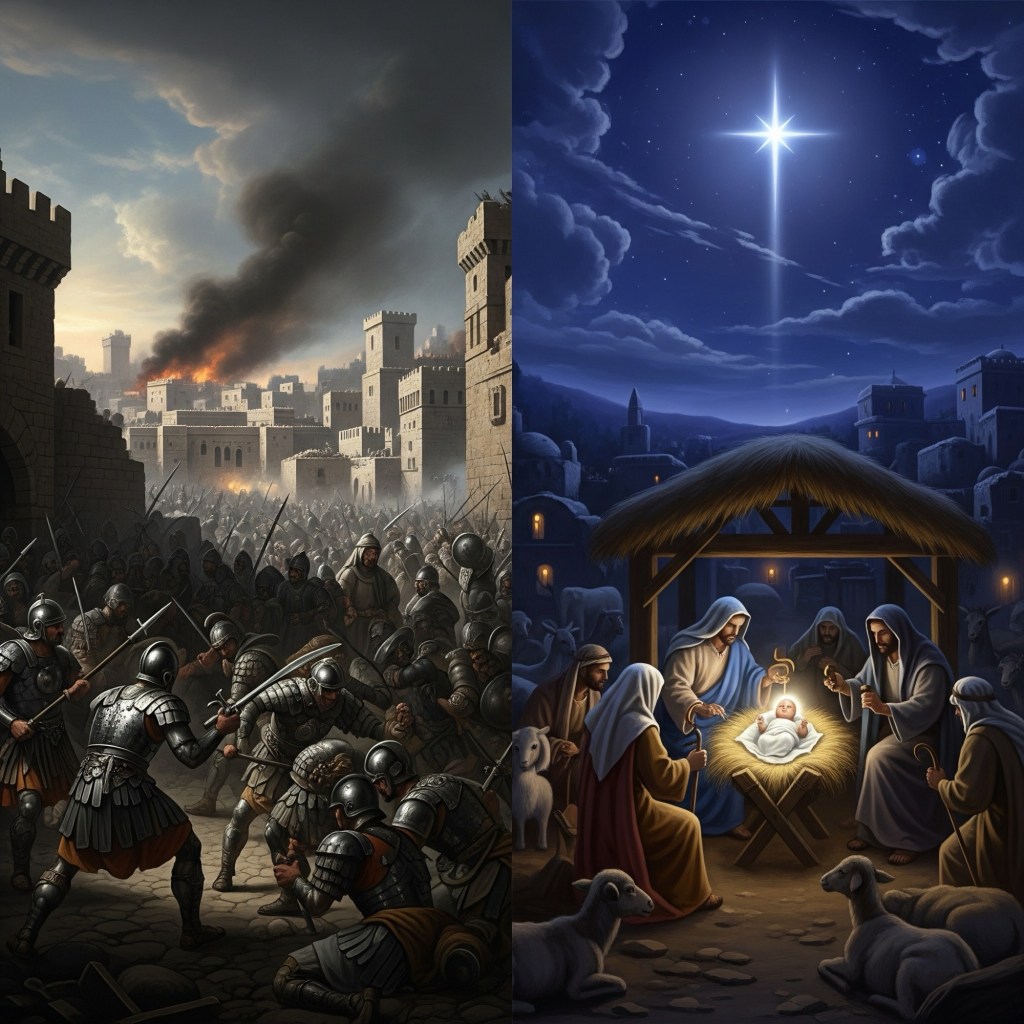
    It’s fascinating how this links to the Christmas story. In Matthew chapter 2, the wise men follow the star, arrive in Jerusalem, and Herod asks the teachers of the law where the Christ is to be born. They quote Micah 5:2, saying, “He will be born in Bethlehem.” And it’s from this ‘House of Bread’ that Jesus, who later declares, “I am the bread of life,” comes forth. There’s a beautiful connection here.
    A Ruler From Ancient Times
    The verse also states that this ruler’s “origins are from of old, from ancient times.” This isn’t just a regular human leader. This suggests a divine, Messianic figure, someone special. As Christians, we immediately think of Jesus. Micah looks ahead to a time when, despite Israel and Judah’s present troubles, God would call forth a ruler from ancient times, one who would be their deliverer.
    Israel Abandoned, Then Reunited (Micah 5:3)
    Verse 3 is interesting: “Therefore Israel will be abandoned until the time when she who is in labour gives birth and the rest of his brothers return to join the Israelites.”
    This idea of Israel being abandoned could be their punishment for turning their backs on God. We know the Northern Kingdom was carried away by the Assyrians, and while Judah avoided the Assyrians, they fell to the Babylonians and went into exile. This was God’s judgment.
    We see this throughout Israel’s history: periods of trouble and exile under the Assyrians, Babylonians, Persians, Greeks, and Romans. But the verse sets a time limit: “until the time when she who is in labour gives birth to a son.” This clearly refers back to Bethlehem and the idea of this ruler from ancient times. It’s a picture of Israel giving birth to the Messiah. This could signify an end to their troubles with the coming of the Messiah.
    For us, it’s hard not to connect the ‘woman in labour giving birth to a son’ with Mary giving birth to Jesus.
    The Rest of the Israelites and the Church
    The passage then speaks of “the rest of his brothers return to join the Israelites.” Some people link this to the modern nation of Israel being formed in 1948 and 1967, and the gathering of scattered Jewish people. While I understand why some make that connection, I personally don’t think it refers to the current nation of Israel.
    Looking at the news today, it’s clear that the nation of Israel is not living securely. We don’t want to lose sight of God’s covenant with Abraham, promising descendants as numerous as the stars and sand, and a specific land. But I don’t believe this passage should be interpreted as referring to the modern political entity of Israel.
    Instead, I think the idea of Jesus, the Messiah, uniting the rest of the brothers to join the Israelites, could be a reference to the Church. It could be about Gentiles coming to believe in Jesus and being united with God’s people, the Israelites, forming this new entity, the Church, where believers live for God.
    The Shepherd King and His Greatness (Micah 5:4)
    Verse 4 tells us: “He will shepherd His flock in the strength of the Lord, in the majesty of the name of the Lord His God. And they will live securely, for then His greatness will reach to the ends of the earth.”
    This idea of a ruler being a shepherd is fascinating. Again, Jesus declared, “I am the good shepherd.” So, this ruler is not only the ‘bread of life’ but also the ‘great shepherd’. He will shepherd His flock in the ‘majesty of the name of the Lord His God’. That word ‘majesty’ resonates when we worship and feel God’s powerful presence.
    His greatness “will reach to the ends of the earth.” This certainly points to Jesus. There are few places in the world today where Jesus’ name isn’t known. The Church began humbly in Jerusalem and spread to Judea, and then to the rest of the world. The Gospel is being preached everywhere, and we look forward to the day when it truly reaches every place, giving everyone the opportunity to know Jesus. This could also refer to a future time when Jesus returns and establishes His kingdom.
    Our Peace and Deliverance (Micah 5:5)
    Verse 5 is powerful: “And He will be our peace.” This immediately reminds us of the Christmas story, linked so well to Bethlehem. The first people to hear about Christ’s birth were the shepherds, and the angels proclaimed, “Peace on earth.” This coming ruler will be our peace.
    However, Micah immediately links this back to the Assyrian invasion. He says that this ruler “will raise up seven shepherds, even eight commanders.” This is a common Hebrew phrase, meaning ‘X and X plus one’, used for emphasis. You see it in Proverbs (“There are six things… yes, seven…”) or Amos (“For three sins… even four…”). It’s a Hebrew way of emphasising a complete and abundant number. So, it’s probably not literally seven or eight people, but a sufficient and abundant number of leaders. Seven often represents completeness in the Bible, and eight could symbolise abundance.
    These shepherds will “rule the land of Assyria with the sword, the land of Nimrod with the bare blade. He will deliver us from the Assyrians when they invade our land and march across our borders.” Nimrod, mentioned here, is a character from Genesis 10, often translated as a ‘great hunter before the Lord’, but actually meaning ‘against the Lord’. He’s an antagonist. This speaks of the enemies of Israel, the Assyrians and their allies. The sword here simply means a sword, not a metaphor for the Word of God, as some suggest.
    This is a message of hope: when the Assyrians come, God will raise up sufficient leadership to deliver His people from this difficult time. The simple words “He will deliver us from the Assyrians” are enough. That’s the hope they could cling to.
    What Does This Mean for Us Today?
    So, what can we take from this rich passage? There’s so much to think about, from contact lenses to the Bread of Life! But what can we do with it in our lives?
    I think the final phrase, “He will deliver us from the Assyrians,” holds the key. It means we can have hope and trust in God that He will make things right. This isn’t a prosperity gospel – I’m not saying God will fix all your problems immediately. We know that’s not true. Israel faced centuries of trouble and difficulty. God never promised a life free of pain.
    But in the midst of troubled times, God’s message was: there is hope. There is someone we can trust. There is a future to look forward to. Micah was speaking to his contemporaries, but also looking ahead to a future time when God would make everything right.
    Perhaps that won’t be on this side of eternity. But we can trust that God is our deliverer. He brings us hope, and if we trust in Him, we know we have a future in heaven, a time where we can rise above all the troubles of this life and know that He will make everything right.
    Whatever you’re in the middle of today – doubt, financial difficulty, health concerns, or simply feeling under siege – passages like this remind us that God has a plan. Even in trouble, we can trust and hope in Him, knowing that one day He will deliver us. Whether that hope is realised in this life or the next, God is a God of eternity. We need to be eternally minded, not solely earthly minded. While I wish I could tell you God will fix all your problems in this life, that’s not what we see. But we know He will fix everything in the next. These passages tell us we can trust in that hope God gives.
    I hope that’s encouraging to you this morning, and that you’ve learned a few things from this passage.
    Shall we pray?
    Father, we thank You for the Book of Micah. Thank You for the prophetic message given to the people of Israel and Judah in those days. We thank You and hope it was an encouragement to them. May we too see Your Word as a great hope for us. We thank You for hope, and that even when the enemy is at our door, when we face troubled times, Lord, we trust in You. Not that You’ll necessarily deliver us from every problem and pain in our life, but that You’ll be right there with us. You have promised never to leave us, never to forsake us. Lord, we know that even if we face troubles in this life, You have a plan, and we trust and hope in You. Help us to learn from Your people, who so often turned their backs on You, and help us not to turn our backs on You, Lord, but to follow You more heartily. May we lean on You and trust You. As we pray today, bless us as we think about Your Word, and what it means. We thank You, Lord Jesus, that You stepped down into this world, into this world of trouble and difficulty. You didn’t demand we lift ourselves up, but You left Your heavenly throne, came to earth as a baby in Bethlehem. We always think that Your Word is true and powerful. We thank You that You came to set us free. We pray we would follow You with our whole hearts. In Jesus’ name. Amen.
    Thank you.

Finding Hope in the Midst of Turmoil: Unlocking Micah 5

As always, it was a pleasure to preach at our church this morning. Today’s passage was particularly challenging, and I must admit I found it quite hard to bring the message together. Here’s the passage, followed by the audio of what I said. Apologies for the audio quality which was not the best.

Micah 5:1-6 (NLT)
1 Mobilize! Marshal your troops!
The enemy is laying siege to Jerusalem.
They will strike Israel’s leader
in the face with a rod.
A Ruler from Bethlehem
2 But you, O Bethlehem Ephrathah,
are only a small village among all the people of Judah.
Yet a ruler of Israel,
whose origins are in the distant past,
will come from you on my behalf.
3 The people of Israel will be abandoned to their enemies
until the woman in labor gives birth.
Then at last his fellow countrymen
will return from exile to their own land.
4 And he will stand to lead his flock with the LORD’s strength,
in the majesty of the name of the LORD his God.
Then his people will live there undisturbed,
for he will be highly honored around the world.
5 And he will be the source of peace.
When the Assyrians invade our land
and break through our defenses,
we will appoint seven rulers to watch over us,
eight princes to lead us.
6 They will rule Assyria with drawn swords
and enter the gates of the land of Nimrod.
He will rescue us from the Assyrians
when they pour over the borders to invade our land.

Traits of a Biblical Man: Decision-making. The Weight of the Crown 

A businessman sitting at a wooden desk with a slingshot and blueprint plans on them. He sat in an office with large windows behind, showing a procession of animals 

In a world often defined by ambiguity and a reluctance to commit, the call for decisive leadership rings louder than ever. For Christian men, this call is not merely a secular ideal but a biblical mandate, woven into the very fabric of God’s design for humanity. From the dawn of creation to the restoration of a city, the Bible provides powerful examples of men who embraced their leadership roles by making pivotal decisions.

Let’s explore three distinct moments of decision-making from biblical narratives: Adam in Eden, David facing Goliath, and Nehemiah approaching the king. Through their choices, we uncover timeless principles for modern biblical leadership.


Adam: The Steward’s First Decree (Genesis 2:19-20)

Our journey begins in the pristine Garden of Eden, where God entrusts Adam with dominion over creation. Before the fall, in a moment of pure stewardship, God brings all the animals to Adam “to see what he would name them.” This seemingly simple act is profound. It wasn’t God who named the animals; it was Adam’s responsibility and privilege.

The Decision: Adam decided on the names for every living creature. This was not a passive observation but an active engagement with his delegated authority. Each name he uttered was a declaration of his understanding and relationship with creation, a tangible exercise of his leadership over the animal kingdom.

Role in Leadership/Decision-Making: Adam’s decision-making here highlights the essence of responsible stewardship. As the first man, he was given dominion and immediately put that authority into practice. His decision to name the animals demonstrates active participation in God’s creative order, an immediate embrace of his assigned role. For us, this speaks to the importance of taking ownership and making informed decisions in our spheres of influence, whether that’s our home, our workplace, or our community.


David: The Courage to Stand (1 Samuel 17:32-37)

Thousands of years later, on a battlefield in the Valley of Elah, fear gripped the armies of Israel. The giant Philistine, Goliath, hurled insults and challenges, yet no Israelite warrior dared to face him. It was a moment of national paralysis, until a young shepherd boy arrived with provisions.

The Decision: When David heard Goliath’s blasphemies and witnessed the fear of his countrymen, he was moved with righteous indignation. His explicit decision was to step forward and offer to fight Goliath himself. Addressing King Saul, David declared, “Let no one lose heart on account of this Philistine; your servant will go and fight him.” He didn’t just feel an urge; he articulated a clear, courageous choice to confront the seemingly insurmountable foe, grounded in his past experiences with God’s deliverance from lions and bears.

Role in Leadership/Decision-Making: David’s decision exemplifies courageous conviction. In a situation where experienced warriors were paralyzed by fear, a young man, relying on God’s power, chose to act. His leadership was not about physical stature or military rank, but about a deep-seated faith that empowered him to make a radical decision. This teaches us that true leadership often involves making unpopular or risky decisions when the status quo is failing. It demands faith to step into uncomfortable situations, trusting that God will empower us to overcome challenges that seem overwhelming.


Nehemiah: The Bold Request (Nehemiah 2:1-8)

Centuries after the initial glory of Israel, Jerusalem lay in ruins, its walls broken down, its people in disgrace. Nehemiah, a Jewish exile serving as cupbearer to King Artaxerxes in Persia, was burdened by this news. After a period of prayer and fasting, he seized a divinely appointed moment.

The Decision: When King Artaxerxes noticed Nehemiah’s sadness and asked him why, Nehemiah made the crucial decision to reveal his distress and articulate his bold request to be sent to Jerusalem to rebuild the city walls. This was a high-stakes moment; approaching a powerful king with such a personal petition carried significant risk. Nehemiah prayed briefly, then explicitly stated his desire: “If it pleases the king… send me to Judah, to the city where my ancestors are buried, so that I can rebuild it.” He didn’t just express sorrow; he presented a solution and requested the authority and resources to execute it.

Role in Leadership/Decision-Making: Nehemiah’s decision highlights strategic boldness and proactive problem-solving. He didn’t wait for someone else to take action. He leveraged his position, prepared his request, and chose the opportune moment to present it. His decision was not impulsive but born from prayer, planning, and a deep sense of purpose. This shows us that biblical decision-making often involves discerning the right timing, articulating a clear vision, and humbly yet confidently presenting a solution to those in authority, all while relying on God’s favor.


Becoming Biblical Decision-Makers in Modern Life

These biblical narratives offer more than just historical accounts; they are blueprints for godly leadership in our own lives. As Christian men, how can we emulate Adam, David, and Nehemiah in our daily decision-making?

  1. Embrace Stewardship and Initiative: Like Adam, recognize the spheres of influence God has entrusted to you – your family, your work, your church. Don’t wait for others to define your role. Proactively take ownership, make informed decisions within your delegated authority, and seek to bring order and purpose to your environment.
  2. Cultivate Courageous Conviction: Like David, be prepared to stand firm in your convictions, especially when fear or popular opinion dictates otherwise. This means discerning God’s will and acting on it, even when it feels risky or unpopular. It requires faith to confront challenges that seem insurmountable, trusting in God’s power to work through you.
  3. Develop Strategic Boldness: Like Nehemiah, approach challenges with prayerful preparation and strategic thinking. Don’t shy away from making bold requests or taking on daunting tasks if you believe it aligns with God’s purpose. Learn to discern opportune moments, articulate your vision clearly, and humbly yet confidently seek the resources and support needed to bring about positive change.

The weight of the crown, the responsibility of leadership, is not meant to crush us, but to empower us to reflect God’s own order and purpose in the world. By consciously choosing to be decisive, faithful, and proactive in our decision-making, we can honor God and lead effectively, becoming the biblical men our families, churches, and communities desperately need.

The Word of God: A Lamp Unto Our Feet (Psalm 119:105)

Psalm 119:105 states, “Your word is a lamp to my feet and a light to my path.” This verse underscores the importance of studying and following God’s Word, while also suggesting that its guidance often illuminates only the next few steps of our journey, not the entire path. Imagine a traveller navigating a dark forest with a modest torch. The beam reveals just enough to avoid a stumble or choose a trail, but the path’s end remains hidden. This is how God’s Word functions: a guide for the immediate step, requiring faith for the destination.

A lit lamp 

The forest analogy highlights Scripture’s role. The traveller’s torch lights the ground ahead, but not the journey’s end. Similarly, we crave certainty about our future—careers, relationships, or spiritual growth—but God’s Word is a lamp, not a floodlight. It provides clarity for the present, urging us to act faithfully while trusting God for what lies beyond. Studying Scripture equips us to discern the next right step. For example, Micah 6:8—“act justly, love mercy, walk humbly with your God”—guides moral choices, while Philippians 4:6-7 offers peace through prayer. Immersing ourselves in the Bible keeps the lamp fuelled, preventing us from stumbling in life’s uncertainties.

The lamp’s limited glow also teaches faith. The traveller presses on, trusting the torch for each step. Likewise, God’s Word may not reveal our ultimate purpose, but it shows enough to move forward. Proverbs 3:5-6 reinforces this: “Trust in the Lord with all your heart, and do not lean on your own understanding. In all your ways acknowledge Him, and He will make your paths straight.” Obeying the next step—applying for a job, reconciling a relationship, or resisting temptation—aligns us with God’s plan, even if the full path is unclear.

This perspective frees us from overthinking. We often wait for a grand revelation, when God asks only for obedience in the obvious next step. Matthew 5:23-24 urges reconciliation; James 4:7 calls us to resist temptation. The lamp shines on these choices, and our task is to act, trusting God for the rest. Over time, as we obey, the straight path promised in Proverbs emerges, leading to unexpected opportunities or deeper fulfilment.

Ultimately, we need not map the entire journey. God, the master cartographer, knows the way. Our role is to keep His Word close, study it diligently, and follow its light one step at a time. Open your Bible, seek God’s wisdom, and obey the next step. Trust Him, as Proverbs advises, and let Him make your path straight. The forest may be dark, but with God’s Word as your lamp, you’ll never walk alone.

Pure Media: The Magazine 

As some of you will know, I present a weekly show on Pure 24/7 Radio. It’s a 90s music show and you can catch it on UK time from 6 pm on a Thursday evening.

What you might not know, is that the wonderful people behind Pure 24/7 Radio also produce a magazine… Pure media: the magazine.

It really is a wonderful magazine! Very high-quality, interesting articles and entirely free if you read it online! If you prefer to have a copy in your hands, then you can order printed versions from the shop. Here’s the link… Pure media magazine shop

Why am I telling you this? Well, the May edition has just landed and it features yours truly talking about my faith and my journey of site loss. I do encourage you to check it out where you can not only read more about my story, but enjoy the other wonderful features in the magazine.

If you enjoy it, tell a friend or even buy an extra copy to share with someone in your church or family.

Find out more by searching for them on Facebook or ex, or just visiting the website above. 

Finding balance and looking ahead-a quick update from me! 

I’m so sorry for not writing much lately. Life has taken a busy turn with a new job and a pretty demanding role. It’s kept me on my toes, and I’ve missed connecting with you all through these posts. The days seem to blur together with meetings, deadlines, and trying to keep up with everything. I’ve always loved sitting down to share thoughts on faith, life, and what God’s been teaching me, so this quieter spell on the blog has felt strange. Thanks for sticking with me through it—I’m hoping to find a better rhythm soon, though it might take a bit of juggling.

A cartoon character with a radio headphones on, a magazine in one hand and a laptop in the other. In the background you can see a busy commuter train and tall buildings 

In a few weeks, I’ve got the privilege of preaching at church on Micah chapter 4, and I’m really looking forward to it. It’s a powerful passage about God’s promise of hope and restoration, packed with vivid imagery and big ideas. Here’s a taste from the early part: “Now it shall come to pass in the latter days That the mountain of the Lord’s house Shall be established on the top of the mountains, And shall be exalted above the hills; And peoples shall flow to it. Many nations shall come and say, ‘Come, and let us go up to the mountain of the Lord, To the house of the God of Jacob; He will teach us His ways, And we shall walk in His paths.'” What a picture of unity and peace—a time when people from all over will come together to seek God and live in His ways. There’s so much in there to unpack, and what’s fascinating is how many different ways folks interpret it. Some see it as a literal future event, with a physical temple and nations streaming to Jerusalem. Others take it more symbolically, pointing to the church or even Christ’s ultimate reign. I’m excited to dig into those perspectives, wrestle with the text, and see where the Spirit leads. It’s a chance to explore what this hope means for us today—how we hold onto it amid our own challenges. Keep praying for God’s kingdom to come as I prepare!

On another note, don’t forget you can catch me every Thursday evening from 6 pm UK time on Pure 24/7 Radio for the 90s show. It’s a blast spinning those tunes—think Oasis, Spice Girls, and maybe a bit of Take That—and chatting about life and faith. There’s something special about music that takes you back, isn’t there? It’s a chance to unwind, reflect, and connect with listeners who share a love for the era. Tune in at pure247radio.org—I’d love to have you along for the ride. The team at Pure 24/7 does an amazing job, and it’s a privilege to be part of their lineup. Whether you’re driving home, cooking dinner, or just chilling out, it’s a great way to spend a couple of hours.

While you’re at it, check out Pure Media’s magazine. It’s a free monthly download packed with inspiring articles that I think you’ll enjoy. Grab it here: puremediafamily.com/magazine. They cover all sorts—faith, family, culture—and it’s a brilliant resource to keep you encouraged. One piece that stood out recently was an article on finding joy in tough seasons. It featured a story about a family navigating loss with faith and resilience, woven with practical tips and Scripture. It hit home for me, especially with the busyness I’ve been feeling, and I reckon it’d resonate with many of you too. The magazine’s got a knack for blending real-life experiences with hope, so it’s well worth a look.

I won’t promise I’ll be back writing loads soon—this job’s keeping me busy, and I’m still figuring out how to carve out time for everything. But I’ll definitely try. These posts are a way to process what’s on my heart and share it with you, and I don’t want that to slip away completely. Thanks for your support—it means a lot to know you’re reading, even when I’ve been quieter. You’re all in my prayers, and I’m grateful for this little community we’ve got here. Keep seeking Him, and maybe I’ll catch you on the radio or in the comments sometime soon!

The Isolation Test – Andy Brown

This post was originally written during the height of lockdown in the UK. However, I hope you still find it useful today. Enjoy! 

Every Christian can act like one when they are home alone. But when we are trapped in the same four walls with our close family, not able to go out as we wish, it can be a lot harder to be a good witness for Christ. How are you coping with the Isolation Test?I’m not quite…
— Read on andy-brown.org/2020/04/23/the-isolation-test/