
On Maundy Thursday, we pause during Holy Week to reflect on the Last Supper, a sacred moment when Jesus shared a final meal with His disciples, instituted Holy Communion, and revealed Judas’ betrayal. This day, named from the Latin mandatum meaning “commandment,” centers on Jesus’ call to love one another (John 13:34). As we explore the events leading to this meal, the exposure of Judas’ intentions, and the origin of Communion, we deepen our understanding of Christ’s sacrifice and our calling as His followers. Grounded in Scripture, this reflection reminds us of the love and service at the heart of our faith.
The Road to the Last Supper
Holy Week unfolds with events that prepare us for the Last Supper. On Palm Sunday, we recall Jesus’ triumphal entry into Jerusalem, greeted by crowds waving palm branches (Matthew 21:1-11). In the days following, He cleanses the temple (Matthew 21:12-13) and teaches parables, confronting religious leaders (Mark 11:27-12:44). These actions intensify opposition, as the chief priests and scribes plot to kill Him (Mark 14:1-2). Amid this tension, Jesus prepares for the Passover, the Jewish feast commemorating God’s deliverance of Israel from Egypt (Exodus 12:1-14).
Jesus instructs His disciples to arrange the meal in an upper room in Jerusalem (Luke 22:7-13). This setting, intimate and solemn, underscores the weight of the moment. Jesus knows His hour is near (John 13:1), and we should sense the gravity as He gathers with those He loves. The Passover meal becomes the backdrop for a new act of redemption, one that we commemorate to this day.
The Last Supper and Judas’ Betrayal
During the Last Supper, Jesus reveals a painful truth: one of His disciples will betray Him. John 13:21-30 captures this moment vividly:
“After he had said this, Jesus was troubled in spirit and testified, ‘Very truly I tell you, one of you is going to betray me.’ … When he had dipped the piece of bread, he gave it to Judas, the son of Simon Iscariot. As soon as Judas took the bread, Satan entered into him. So Jesus told him, ‘What you are about to do, do quickly.’ … As soon as Judas had taken the bread, he went out. And it was night.” (John 13:21, 26-27, 30, NIV)
Matthew’s account adds further clarity:
“And while they were eating, he said, ‘Truly I tell you, one of you will betray me.’ … Judas, the one who would betray him, said, ‘Surely you don’t mean me, Rabbi?’ Jesus answered, ‘You have said so.’” (Matthew 26:21, 25, NIV)
Jesus’ identification of Judas fulfills Old Testament prophecy, such as Psalm 41:9, which speaks of a trusted friend lifting his heel against another. By sharing bread with Judas, a gesture of fellowship, Jesus underscores the depth of the betrayal.
Judas does not leave of his own accord, but is called out in front of them all. It shows that the timing of these events were God ordained, and not planned by sinful humanity. Jesus was in full control. 
The Institution of Holy Communion
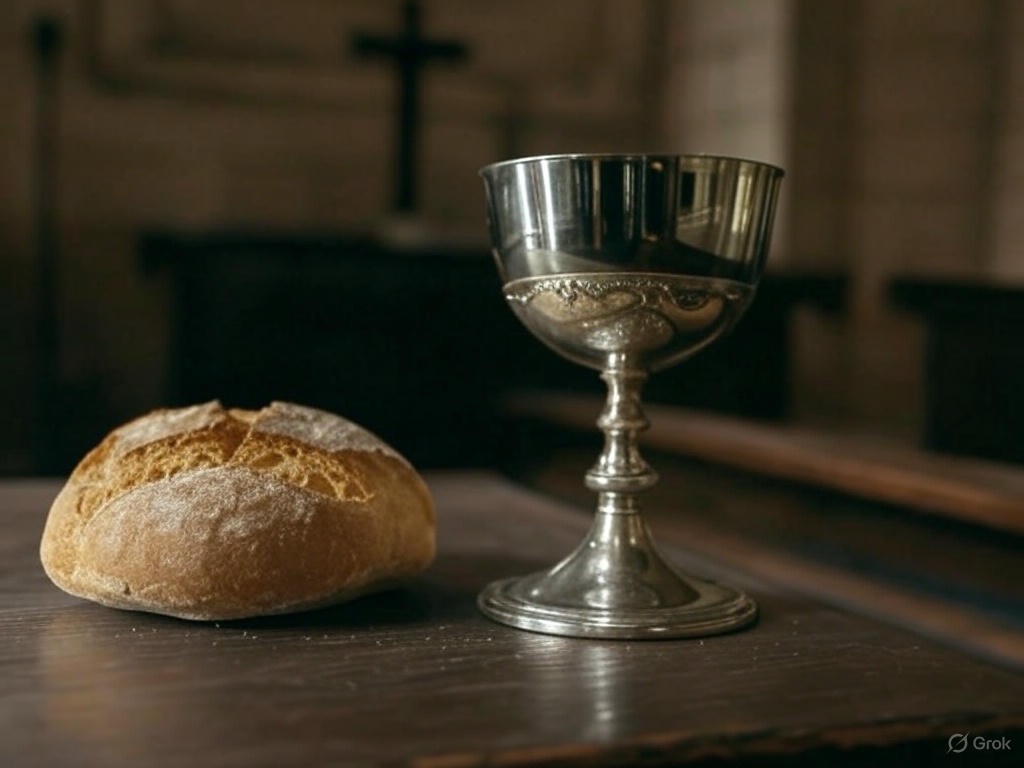
At the same meal, Jesus establishes Holy Communion, transforming the Passover elements into symbols of His sacrifice. Luke 22:19-20 records His words:
“And he took bread, gave thanks and broke it, and gave it to them, saying, ‘This is my body given for you; do this in remembrance of me.’ In the same way, after the supper he took the cup, saying, ‘This cup is the new covenant in my blood, which is poured out for you.’” (Luke 22:19-20, NIV)
Paul later affirms this practice, writing in 1 Corinthians 11:23-25:
“For I received from the Lord what I also passed on to you: The Lord Jesus, on the night he was betrayed, took bread, and when he had given thanks, he broke it and said, ‘This is my body, which is for you; do this in remembrance of me.’ In the same way, after supper he took the cup, saying, ‘This cup is the new covenant in my blood; do this, whenever you drink it, in remembrance of me.’”
Here, Jesus reinterprets the bread and wine. The bread represents His body, broken for our salvation; the wine signifies His blood, sealing the new covenant promised in Jeremiah 31:31-34. This act institutes Communion as a sacred rite, one we should observe to remember Christ’s sacrifice, experience His presence, and unite as His body. From the early church (Acts 2:42) to today, Communion remains central to our worship, a tangible reminder of God’s grace.
Moreover, the Last Supper foreshadows the cross. The bread and wine point to Good Friday, when Jesus’ body is broken and His blood is shed. As we participate in Communion, we proclaim His death until He returns (1 Corinthians 11:26). Maundy Thursday thus bridges the joy of Palm Sunday and the sorrow of Good Friday, preparing us for the glory of Easter.
A Time for Reflection
As we observe Maundy Thursday, we are called to reflect on Christ’s love, the cost of our redemption, and the pain of betrayal. The Last Supper invites us to the table, where we encounter Jesus’ sacrifice and receive His grace through Communion. We ought to examine our hearts, asking how we can love and serve as He did. Whether through attending a Maundy Thursday service or quietly meditating on these Scriptures, let us draw near to Jesus, who gave everything for us.
This day reminds us that even in the face of betrayal, Jesus chose love. May we, too, choose love, honoring Him in our worship and our lives.
- Counting the Cost of Comfort (Matthew 8:19-20)
- A Determined Desire: Choosing a Life of Integrity (Psalm 101:2)
- A Heart Captivated: The Foundation of a Godly Life (Psalm 101:1)
- The Richness Within: Christ, Chorus and Christian Community (Colossians 3:16)
- The Sovereign’s Vow (Introduction to Psalm 101) 
 Andy Brown