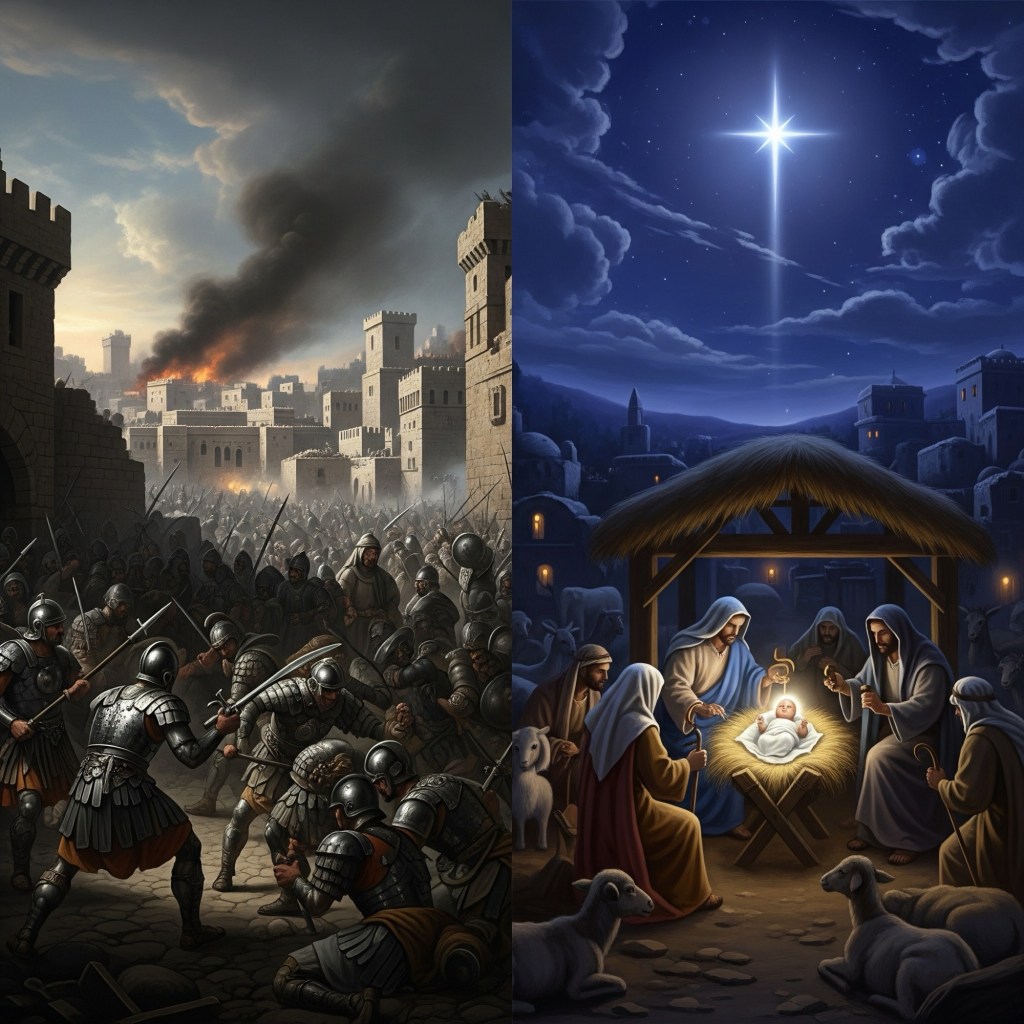
Understanding God’s Will in the Face of Suffering: Acts 21 and the Prophecy of Agabus

In Acts 21, we encounter a striking moment where the apostle Paul, guided by the Holy Spirit towards Jerusalem, receives a sobering prophecy about his future. This passage raises important questions about the nature of prophecy, human response to divine will, and the tension between well-meaning counsel and obedience to God’s calling.

A simple black leather belt with silver buckle resting on a white surface 

The Prophecy of Agabus (Acts 21:10-14, ESV)

“While we were staying for many days, a prophet named Agabus came down from Judea. And coming to us, he took Paul’s belt and bound his own feet and hands and said, ‘Thus says the Holy Spirit, “This is how the Jews at Jerusalem will bind the man who owns this belt and deliver him into the hands of the Gentiles.”’ When we heard this, we and the people there urged him not to go up to Jerusalem. Then Paul answered, ‘What are you doing, weeping and breaking my heart? For I am ready not only to be imprisoned but even to die in Jerusalem for the name of the Lord Jesus.’ And since he would not be persuaded, we ceased and said, ‘Let the will of the Lord be done.’”

This passage follows Paul’s earlier declaration in Acts 20:22-24 (ESV):

“And now, behold, bound by the Spirit, I am going to Jerusalem, not knowing what will happen to me there, except that the Holy Spirit testifies to me in every city that imprisonment and afflictions await me. But I do not account my life of any value nor as precious to myself, if only I may finish my course and the ministry that I received from the Lord Jesus, to testify to the gospel of the grace of God.”

1. The Nature of Agabus’ Prophecy

Agabus, a prophet from Judea, delivered a message from the Holy Spirit using symbolic action—a method reminiscent of Old Testament prophets (e.g., Ezekiel’s enacted prophecies in Ezekiel 4-5). His prophecy was predictive, not prescriptive: it revealed what would happen, not necessarily what Paul should do.

Some prophecies in Scripture are conditional, offering warnings that may be averted through repentance (e.g., Jonah’s message to Nineveh). However, Agabus’ words carried no hint of conditionality—they were a straightforward declaration of future events. This raises the question: if the prophecy was certain, why did the believers urge Paul to avoid Jerusalem?

2. The Believers’ Response: Love vs. God’s Will

The disciples, including Luke (the author of Acts), pleaded with Paul not to go. Their reaction was natural:

  • They loved Paul and did not want him to suffer.
  • They may have misinterpreted the prophecy as a warning rather than a confirmation of God’s plan.

This mirrors Peter’s reaction in Matthew 16:22 (ESV) when Jesus foretold His crucifixion:

“Peter took him aside and began to rebuke him, saying, ‘Far be it from you, Lord! This shall never happen to you.’”
Jesus’ response was sharp: “Get behind me, Satan! You are a hindrance to me. For you are not setting your mind on the things of God, but on the things of man.” (Matthew 16:23, ESV).

Similarly, the believers in Acts 21 were operating from human concern, not divine perspective. Their intentions were good, but their advice, if followed, would have diverted Paul from God’s purpose.

3. Paul’s Resolve: Embracing Suffering for Christ

Paul’s response was unwavering:

  • He was “ready not only to be imprisoned but even to die” (Acts 21:13).
  • He saw his suffering as part of his calling (Acts 20:24; Philippians 1:20-21).

His attitude reflects Jesus’ words in Luke 9:23-24 (ESV):

“If anyone would come after me, let him deny himself and take up his cross daily and follow me. For whoever would save his life will lose it, but whoever loses his life for my sake will save it.”

Paul understood that obedience to God sometimes requires embracing hardship. His journey to Jerusalem was not reckless defiance but faithful surrender.

4. Lessons for Discerning God’s Will Today

This passage offers key principles for Christians facing difficult decisions:

  • Prophecy Reveals, But Does Not Always Direct
    Agabus’ prophecy confirmed what awaited Paul, but it did not instruct him to avoid it. Likewise, God may reveal challenges ahead without necessarily calling us to evade them.
  • Well-Meaning Counsel Must Be Weighed Against God’s Word
    The believers’ pleas were heartfelt, but Paul prioritised the Spirit’s leading. Proverbs 3:5-6 (ESV) reminds us:

“Trust in the Lord with all your heart, and do not lean on your own understanding. In all your ways acknowledge him, and he will make straight your paths.”

  • Suffering May Be Part of God’s Plan
    Scripture repeatedly associates faithfulness with endurance (Romans 5:3-5; 1 Peter 4:12-13). Avoiding suffering is not always the godliest choice.

Conclusion: “Let the Will of the Lord Be Done”

The believers’ final words—“Let the will of the Lord be done” (Acts 21:14)—mark their submission to God’s higher purpose. Paul’s example challenges us to:

  • Seek God’s perspective over comfort.
  • Trust that His plans, even when painful, are purposeful.
  • Remain steadfast when well-meaning advice conflicts with divine calling.

In a world that prioritises safety and self-preservation, Paul’s resolve reminds us that the greatest fulfilment lies in surrendering to God’s will—whatever the cost.

It is always wise to listen to godly Council. The people who care about us, will naturally not want us to come to harm. We would not be sensible to simply ignore their love or advice. This is especially true on making a big decision, or one that potentially leads us down a dangerous path.

At the end of the day though, we are answerable only to God. If he is instructing us to do something, and the entire rest of the world is telling us not to, then of course we must follow him. God over man.

The most difficult part, for me at least, is discerning God’s will. Few of us will receive a clear prophecy as Paul did in today’s passage, so we must always be cautious to follow God’s will carefully. We all want a neon sign telling us which way to go, but for the most part, we are to study and understand the Bible and discern gods will from that alone.

Using appropriate wisdom and discernment, all any of us can do is try to follow God to the best of our ability. 

The Eerie Stillness of Revelation 7:1: Exploring the Four Winds

This morning, as I delved into my daily Bible reading, I came across Revelation 7:1, a verse that paints a striking image: four angels standing at the corners of the earth, holding back the four winds so that no breeze stirs the land, sea, or trees. The thought of a world without wind—a silent, motionless earth—struck me as profoundly unsettling. It evokes an eerie calm, a stillness that feels almost otherworldly. This vivid imagery prompted me to explore the interpretations of this verse, particularly whether the “winds” might symbolise the Holy Spirit, as wind often does in Scripture, or if they carry a more literal or destructive meaning. Below, I unpack the possible meanings of this passage, drawing on theological insights and reflecting on its implications.

The Imagery of a Windless World

Revelation 7:1 reads: “After this I saw four angels standing at the four corners of the earth, holding back the four winds of the earth to prevent any wind from blowing on the land or on the sea or on any tree” (NIV). Taken literally, this cessation of wind would disrupt natural processes—weather patterns, ocean currents, and ecological balance—creating a world frozen in suspense. The absence of wind, as I imagined it, conjures a haunting silence, a planet holding its breath before a divine act. This literal interpretation aligns with the apocalyptic tone of Revelation, where natural phenomena often signal God’s intervention. Many scholars, particularly those with a dispensationalist perspective, view this as a literal event in an end-times timeline, where God halts creation to prepare for significant events, such as the sealing of the 144,000 (Revelation 7:2-8).

Symbolic Meanings: Winds of Judgment or Spirit?

Beyond the literal, the “four winds” carry rich symbolic potential. In biblical literature, wind often represents divine forces or judgment. In Jeremiah 49:36 and Daniel 7:2, winds symbolise chaos or destructive powers, suggesting that the angels in Revelation 7:1 are restraining forces of calamity until God’s faithful are protected. This is the dominant interpretation among evangelical scholars, such as John Walvoord and G.K. Beale, who see the winds as agents of divine wrath, held back to allow mercy for the elect.

However, another interpretation, less common but compelling, connects the winds to the Holy Spirit. In John 3:8, Jesus likens the Spirit to wind, unpredictable and life-giving, and in Acts 2:2, the Spirit’s arrival at Pentecost is described as a “mighty rushing wind.” Could the restraint of the winds in Revelation 7:1 symbolise a temporary withdrawal of the Holy Spirit’s influence? This reading suggests a period when divine grace is limited, allowing human sinfulness or satanic forces to escalate before God’s final judgment. Such an idea resonates with 2 Thessalonians 2:6-7, where a “restrainer” holds back lawlessness until removed. If the winds represent the Spirit, their absence would indeed create a spiritual desolation, amplifying the eerie calm I felt when pondering the verse.

Theological and Cultural Perspectives

Theological commentaries offer diverse insights. Robert Mounce describes the windless state as a cosmic pause, a moment of divine preparation before judgment unfolds. Early church fathers like Victorinus leaned toward allegorical readings, though they rarely tied this verse explicitly to the Holy Spirit. Online discussions, particularly on platforms like X, reflect similar diversity. Some users focus on the literal imagery, noting the unsettling silence of a windless world, while others see the winds as symbolic of chaos or divine judgment. The Holy Spirit interpretation, while rare, appears in mystical or pneumatological readings, suggesting a time when God’s active presence is withheld.

Reflecting on the Implications

The imagery of Revelation 7:1, whether literal or symbolic, is profoundly evocative. A literal reading paints a world in suspense, its natural rhythms halted, creating a stillness that feels both awe-inspiring and unsettling. The symbolic view of the winds as destructive forces underscores God’s mercy, delaying judgment to protect the faithful. The Holy Spirit interpretation, though less common, offers a poignant picture: a world without the Spirit’s life-giving presence, left to face the consequences of its rebellion. This reading deepens the verse’s emotional weight, suggesting a spiritual void that mirrors the physical silence I imagined.

Conclusion: A Multilayered Vision

Revelation 7:1 invites us to wrestle with its layers of meaning. The literal stillness of a windless earth captures the imagination, while the symbolic possibilities—whether destructive winds or the restrained Spirit—point to God’s sovereignty and mercy. For me, the idea of the Holy Spirit being withheld resonates deeply, highlighting the urgency of the sealing of God’s servants. Yet, the context of Revelation 7 suggests the winds are more likely forces of chaos, restrained to protect the faithful. Regardless of interpretation, the verse’s eerie calm serves as a powerful reminder of a world awaiting God’s ultimate plan. As I reflect on this passage, I’m left with a sense of awe at its mystery and an invitation to explore further the rich symbolism of Revelation.

Transcript: Finding Hope in the midst of Turmoil -Unpacking Mica 5

For those who prefer to read rather than listen, here is a transcript of the sermon I preached yesterday on Mica five. Enjoy

Good morning everyone! It’s a pleasure to share some thoughts on a truly profound passage from the Bible today. Please forgive my notes – it’s a complex piece of scripture, and I wanted to do it justice! It has nothing to do with my age or memory, I promise!
Let’s begin with a prayer:
Father, we thank You so much for Your Word this morning. Thank You for gathering us together, Your people, to worship You. We thank You for Your majesty and Your presence among us. We thank You for this passage before us. Please help us to understand it, to learn from it, and to learn about You. We pray that what we learn today, Lord, we will apply in our lives, in Jesus’ name. Amen.
Now, who read Micah chapter 5 and fully understood it? Anyone? No? I’m not surprised! It’s quite a tricky passage, isn’t it? Even after reading many commentaries, I don’t think any single one fully agrees on its meaning. So, we’ll do our best this morning!
Layers of Meaning: Like Wallpaper in an Old House
Have you ever moved into a new house and had to decorate a room with ghastly wallpaper? You start to peel it off, only to reveal an even more hideous layer underneath. You keep going, layer after layer, until you finally expose the bare wall. I see today’s passage a little like that – lots of layers.
Micah’s prophecy moves from his present day to a future time. The clear references to Jesus and Bethlehem remind us of the coming great ruler. So, Micah is talking about his contemporary situation, but also a future time as well. It can be a little tricky to know which period he’s referring to at any given moment, but we’ll do our best.
A Quick Refresher: Understanding Micah
For those who might be new to Micah, he was a prophet around the 8th century BC, perhaps 720 BC. He spoke a lot about the Northern Kingdom of Israel and the Assyrian Empire’s threat to them. He was primarily addressing Judah, the Southern Kingdom, but often used the Northern Kingdom as a reference point. Sometimes the Bible refers to ‘Israel’ as the Northern Kingdom, sometimes as the Southern Kingdom (‘Judah’), and sometimes as the collective Israelites, the people of Israel. It can get a bit confusing, which is why some Old Testament passages are hard to follow. Do keep that in mind as you read.

  • Chapter 1: Micah focused on the people’s idolatry and their judgment for it.
  • Chapter 2: He addressed sins against the people, such as mistreating the poor and widows.
  • Chapter 3: This chapter dealt with the sins of the leaders.
  • Chapter 4: Here, the focus shifts to the ‘Mountain of the Lord’ – a hopeful, future time when all people would flow to it, perhaps referring to the coming of Jesus. It also mentions the Assyrian Empire again.
    Micah 5:1 – A Disputed Beginning
    Micah 5:1 often sparks debate about its placement. In the Hebrew Bible, it’s actually at the end of chapter 4. One commentary I read couldn’t understand why anyone would put it at the start of chapter 5. I have a theory why, though I might be completely wrong!
    We’re only looking at six verses this morning, but they are packed with powerful imagery. We must stay rooted in Micah’s immediate context: he’s speaking to people living under the looming shadow of the Assyrian Empire. While some of the prophecy certainly looks ahead, it’s easy to get lost in the imagery and forget the immediate concerns of his audience.
    Jerusalem Under Siege and Humiliation (Micah 5:1)
    Verse 1 says: “Marshal your troops, city of troops!” This refers to Jerusalem, though it’s called the ‘city of troops’ rather than ‘Jerusalem’ or ‘Daughter Zion’. It describes Jerusalem under siege, a dangerous time as the Assyrian Empire gathers.
    Then it says, “They will strike the ruler of Israel on the cheek with a rod.” This is a powerful image of humiliation. While it could be a physical blow, striking someone on the cheek with a rod was primarily about public shame. When Jesus spoke about ‘turning the other cheek’, it wasn’t about inviting further blows, but about refusing to engage in a cycle of humiliation. This is about Jerusalem, the great city of God, facing profound humiliation.
    From Humiliation to Hope: The Rise of Bethlehem (Micah 5:2)
    Then the passage shifts gears dramatically to Bethlehem: “But you, Bethlehem Ephrathah, though you are small among the clans of Judah, out of you will come for Me one who will be ruler over Israel, whose origins are from of old, from ancient times.”
    This is why I believe verses 1 and 2 belong together. You have the powerful capital city of Jerusalem, under siege and its leader humiliated, facing God’s judgement. Yet, Bethlehem, this tiny village, just a few miles from Jerusalem, the home of David, is contrasted with this mighty city. From this humble place, God calls forth a great ruler.
    Ron Hamilton and the Power of Humble Beginnings
    Have you ever heard of Ron Hamilton? He’s from Rutherglen in Scotland. Ever used daily disposable contact lenses? Well, Ron Hamilton invented them, from that small fishing village. From humble origins, a technology emerged that affects countless lives.
    In a similar way, from Bethlehem, this small town, a great ruler would be called forth by God.
    Bethlehem: The House of Bread
    Do you know what the name Bethlehem means? ‘House of Bread’. ‘Beth’ means house (think of Bethsaida, or Bethany), and ‘lechem’ means bread. So, Bethlehem is the “House of Bread”.
    It’s fascinating how this links to the Christmas story. In Matthew chapter 2, the wise men follow the star, arrive in Jerusalem, and Herod asks the teachers of the law where the Christ is to be born. They quote Micah 5:2, saying, “He will be born in Bethlehem.” And it’s from this ‘House of Bread’ that Jesus, who later declares, “I am the bread of life,” comes forth. There’s a beautiful connection here.
    A Ruler From Ancient Times
    The verse also states that this ruler’s “origins are from of old, from ancient times.” This isn’t just a regular human leader. This suggests a divine, Messianic figure, someone special. As Christians, we immediately think of Jesus. Micah looks ahead to a time when, despite Israel and Judah’s present troubles, God would call forth a ruler from ancient times, one who would be their deliverer.
    Israel Abandoned, Then Reunited (Micah 5:3)
    Verse 3 is interesting: “Therefore Israel will be abandoned until the time when she who is in labour gives birth and the rest of his brothers return to join the Israelites.”
    This idea of Israel being abandoned could be their punishment for turning their backs on God. We know the Northern Kingdom was carried away by the Assyrians, and while Judah avoided the Assyrians, they fell to the Babylonians and went into exile. This was God’s judgment.
    We see this throughout Israel’s history: periods of trouble and exile under the Assyrians, Babylonians, Persians, Greeks, and Romans. But the verse sets a time limit: “until the time when she who is in labour gives birth to a son.” This clearly refers back to Bethlehem and the idea of this ruler from ancient times. It’s a picture of Israel giving birth to the Messiah. This could signify an end to their troubles with the coming of the Messiah.
    For us, it’s hard not to connect the ‘woman in labour giving birth to a son’ with Mary giving birth to Jesus.
    The Rest of the Israelites and the Church
    The passage then speaks of “the rest of his brothers return to join the Israelites.” Some people link this to the modern nation of Israel being formed in 1948 and 1967, and the gathering of scattered Jewish people. While I understand why some make that connection, I personally don’t think it refers to the current nation of Israel.
    Looking at the news today, it’s clear that the nation of Israel is not living securely. We don’t want to lose sight of God’s covenant with Abraham, promising descendants as numerous as the stars and sand, and a specific land. But I don’t believe this passage should be interpreted as referring to the modern political entity of Israel.
    Instead, I think the idea of Jesus, the Messiah, uniting the rest of the brothers to join the Israelites, could be a reference to the Church. It could be about Gentiles coming to believe in Jesus and being united with God’s people, the Israelites, forming this new entity, the Church, where believers live for God.
    The Shepherd King and His Greatness (Micah 5:4)
    Verse 4 tells us: “He will shepherd His flock in the strength of the Lord, in the majesty of the name of the Lord His God. And they will live securely, for then His greatness will reach to the ends of the earth.”
    This idea of a ruler being a shepherd is fascinating. Again, Jesus declared, “I am the good shepherd.” So, this ruler is not only the ‘bread of life’ but also the ‘great shepherd’. He will shepherd His flock in the ‘majesty of the name of the Lord His God’. That word ‘majesty’ resonates when we worship and feel God’s powerful presence.
    His greatness “will reach to the ends of the earth.” This certainly points to Jesus. There are few places in the world today where Jesus’ name isn’t known. The Church began humbly in Jerusalem and spread to Judea, and then to the rest of the world. The Gospel is being preached everywhere, and we look forward to the day when it truly reaches every place, giving everyone the opportunity to know Jesus. This could also refer to a future time when Jesus returns and establishes His kingdom.
    Our Peace and Deliverance (Micah 5:5)
    Verse 5 is powerful: “And He will be our peace.” This immediately reminds us of the Christmas story, linked so well to Bethlehem. The first people to hear about Christ’s birth were the shepherds, and the angels proclaimed, “Peace on earth.” This coming ruler will be our peace.
    However, Micah immediately links this back to the Assyrian invasion. He says that this ruler “will raise up seven shepherds, even eight commanders.” This is a common Hebrew phrase, meaning ‘X and X plus one’, used for emphasis. You see it in Proverbs (“There are six things… yes, seven…”) or Amos (“For three sins… even four…”). It’s a Hebrew way of emphasising a complete and abundant number. So, it’s probably not literally seven or eight people, but a sufficient and abundant number of leaders. Seven often represents completeness in the Bible, and eight could symbolise abundance.
    These shepherds will “rule the land of Assyria with the sword, the land of Nimrod with the bare blade. He will deliver us from the Assyrians when they invade our land and march across our borders.” Nimrod, mentioned here, is a character from Genesis 10, often translated as a ‘great hunter before the Lord’, but actually meaning ‘against the Lord’. He’s an antagonist. This speaks of the enemies of Israel, the Assyrians and their allies. The sword here simply means a sword, not a metaphor for the Word of God, as some suggest.
    This is a message of hope: when the Assyrians come, God will raise up sufficient leadership to deliver His people from this difficult time. The simple words “He will deliver us from the Assyrians” are enough. That’s the hope they could cling to.
    What Does This Mean for Us Today?
    So, what can we take from this rich passage? There’s so much to think about, from contact lenses to the Bread of Life! But what can we do with it in our lives?
    I think the final phrase, “He will deliver us from the Assyrians,” holds the key. It means we can have hope and trust in God that He will make things right. This isn’t a prosperity gospel – I’m not saying God will fix all your problems immediately. We know that’s not true. Israel faced centuries of trouble and difficulty. God never promised a life free of pain.
    But in the midst of troubled times, God’s message was: there is hope. There is someone we can trust. There is a future to look forward to. Micah was speaking to his contemporaries, but also looking ahead to a future time when God would make everything right.
    Perhaps that won’t be on this side of eternity. But we can trust that God is our deliverer. He brings us hope, and if we trust in Him, we know we have a future in heaven, a time where we can rise above all the troubles of this life and know that He will make everything right.
    Whatever you’re in the middle of today – doubt, financial difficulty, health concerns, or simply feeling under siege – passages like this remind us that God has a plan. Even in trouble, we can trust and hope in Him, knowing that one day He will deliver us. Whether that hope is realised in this life or the next, God is a God of eternity. We need to be eternally minded, not solely earthly minded. While I wish I could tell you God will fix all your problems in this life, that’s not what we see. But we know He will fix everything in the next. These passages tell us we can trust in that hope God gives.
    I hope that’s encouraging to you this morning, and that you’ve learned a few things from this passage.
    Shall we pray?
    Father, we thank You for the Book of Micah. Thank You for the prophetic message given to the people of Israel and Judah in those days. We thank You and hope it was an encouragement to them. May we too see Your Word as a great hope for us. We thank You for hope, and that even when the enemy is at our door, when we face troubled times, Lord, we trust in You. Not that You’ll necessarily deliver us from every problem and pain in our life, but that You’ll be right there with us. You have promised never to leave us, never to forsake us. Lord, we know that even if we face troubles in this life, You have a plan, and we trust and hope in You. Help us to learn from Your people, who so often turned their backs on You, and help us not to turn our backs on You, Lord, but to follow You more heartily. May we lean on You and trust You. As we pray today, bless us as we think about Your Word, and what it means. We thank You, Lord Jesus, that You stepped down into this world, into this world of trouble and difficulty. You didn’t demand we lift ourselves up, but You left Your heavenly throne, came to earth as a baby in Bethlehem. We always think that Your Word is true and powerful. We thank You that You came to set us free. We pray we would follow You with our whole hearts. In Jesus’ name. Amen.
    Thank you.

Finding Hope in the Midst of Turmoil: Unlocking Micah 5

As always, it was a pleasure to preach at our church this morning. Today’s passage was particularly challenging, and I must admit I found it quite hard to bring the message together. Here’s the passage, followed by the audio of what I said. Apologies for the audio quality which was not the best.

Micah 5:1-6 (NLT)
1 Mobilize! Marshal your troops!
The enemy is laying siege to Jerusalem.
They will strike Israel’s leader
in the face with a rod.
A Ruler from Bethlehem
2 But you, O Bethlehem Ephrathah,
are only a small village among all the people of Judah.
Yet a ruler of Israel,
whose origins are in the distant past,
will come from you on my behalf.
3 The people of Israel will be abandoned to their enemies
until the woman in labor gives birth.
Then at last his fellow countrymen
will return from exile to their own land.
4 And he will stand to lead his flock with the LORD’s strength,
in the majesty of the name of the LORD his God.
Then his people will live there undisturbed,
for he will be highly honored around the world.
5 And he will be the source of peace.
When the Assyrians invade our land
and break through our defenses,
we will appoint seven rulers to watch over us,
eight princes to lead us.
6 They will rule Assyria with drawn swords
and enter the gates of the land of Nimrod.
He will rescue us from the Assyrians
when they pour over the borders to invade our land.

The Word of God: A Lamp Unto Our Feet (Psalm 119:105)

Psalm 119:105 states, “Your word is a lamp to my feet and a light to my path.” This verse underscores the importance of studying and following God’s Word, while also suggesting that its guidance often illuminates only the next few steps of our journey, not the entire path. Imagine a traveller navigating a dark forest with a modest torch. The beam reveals just enough to avoid a stumble or choose a trail, but the path’s end remains hidden. This is how God’s Word functions: a guide for the immediate step, requiring faith for the destination.

A lit lamp 

The forest analogy highlights Scripture’s role. The traveller’s torch lights the ground ahead, but not the journey’s end. Similarly, we crave certainty about our future—careers, relationships, or spiritual growth—but God’s Word is a lamp, not a floodlight. It provides clarity for the present, urging us to act faithfully while trusting God for what lies beyond. Studying Scripture equips us to discern the next right step. For example, Micah 6:8—“act justly, love mercy, walk humbly with your God”—guides moral choices, while Philippians 4:6-7 offers peace through prayer. Immersing ourselves in the Bible keeps the lamp fuelled, preventing us from stumbling in life’s uncertainties.

The lamp’s limited glow also teaches faith. The traveller presses on, trusting the torch for each step. Likewise, God’s Word may not reveal our ultimate purpose, but it shows enough to move forward. Proverbs 3:5-6 reinforces this: “Trust in the Lord with all your heart, and do not lean on your own understanding. In all your ways acknowledge Him, and He will make your paths straight.” Obeying the next step—applying for a job, reconciling a relationship, or resisting temptation—aligns us with God’s plan, even if the full path is unclear.

This perspective frees us from overthinking. We often wait for a grand revelation, when God asks only for obedience in the obvious next step. Matthew 5:23-24 urges reconciliation; James 4:7 calls us to resist temptation. The lamp shines on these choices, and our task is to act, trusting God for the rest. Over time, as we obey, the straight path promised in Proverbs emerges, leading to unexpected opportunities or deeper fulfilment.

Ultimately, we need not map the entire journey. God, the master cartographer, knows the way. Our role is to keep His Word close, study it diligently, and follow its light one step at a time. Open your Bible, seek God’s wisdom, and obey the next step. Trust Him, as Proverbs advises, and let Him make your path straight. The forest may be dark, but with God’s Word as your lamp, you’ll never walk alone.

The Holiness of God and the Lesson of Uzzah: A Reflection on 1 Chronicles 13

When we read the account of Uzzah in 1 Chronicles 13, we encounter a moment that can feel shocking, even unsettling. Uzzah, in a seemingly instinctive act, reaches out to steady the Ark of the Covenant as it wobbles, only to be struck down by God. At first glance, this seems harsh, perhaps even unfair. Why would God respond so severely to a man trying to protect something sacred? Yet, as we unpack this passage, we uncover profound truths about God’s holiness, the seriousness of worship, and the chasm between humanity and God—a chasm bridged only by Jesus Christ.

An AI generated image of oxen pulling a wooden cart with the ark of the covenant resting upon it 

In 1 Chronicles 13, King David is leading a joyful procession to bring the Ark of the Covenant to Jerusalem. The ark, a symbol of God’s presence, is being transported on a cart. As the oxen stumble, Uzzah reaches out to steady the ark, and God’s anger results in his immediate death. The text records, “And when they came to the threshing floor of Chidon, Uzzah put out his hand to take hold of the ark, for the oxen stumbled. And the anger of the Lord was kindled against Uzzah, and he struck him down because he put out his hand to the ark, and he died there before God” (1 Chronicles 13:9-10, ESV). To our modern sensibilities, Uzzah’s action seems reasonable, even commendable. He was trying to prevent the ark from falling to the ground. Yet, the severity of God’s response reveals a deeper spiritual reality: God’s holiness is not to be underestimated.

God’s holiness is perfect, unblemished, and utterly distinct from humanity. The ark was not merely a sacred object; it was the earthly representation of God’s presence, and God had given clear instructions for its handling (Numbers 4:15). Only the Levites were to carry the ark, using poles on their shoulders, and no one was to touch it directly. By placing the ark on a cart—a method borrowed from the Philistines (1 Samuel 6:7)—and allowing Uzzah, who was not a Levite, to touch it, the Israelites were disregarding God’s commands. Theologian R.C. Sproul offers a striking perspective: the muddy ground, untouched by human sin, was less offensive to God’s holiness than human hands tainted by sin. Uzzah’s act, though well-intentioned, violated the sanctity of God’s presence.

This leads us to our first key lesson: we cannot underestimate God’s holiness or the depth of our sinfulness. In our contemporary world, it’s easy to approach God casually, as if He were a friend or equal. Yet, God’s holiness sets Him infinitely apart. Isaiah 6:3 declares, “Holy, holy, holy is the Lord Almighty,” and in His presence, even the prophet Isaiah cried out, “Woe to me! I am ruined!” (Isaiah 6:5). Our sin creates a profound separation from God, and no amount of good intentions can bridge that gap. Uzzah’s story reminds us that God’s standards are not ours. His holiness demands reverence, and our sinfulness falls far short.

The second lesson from this passage is that how we worship and approach God matters deeply. The Israelites’ failure to follow God’s instructions for transporting the ark was not a minor oversight; it reflected a lack of seriousness about God’s word. Worship is not a free-for-all where anything goes. God has revealed how He desires to be worshipped, and while we live in an era of grace through Christ, this does not mean we approach God flippantly. Jesus Himself said, “God is spirit, and his worshippers must worship in the Spirit and in truth” (John 4:24). Our worship should be heartfelt, but it must also align with God’s truth as revealed in Scripture.

Uzzah’s story, though sobering, points us to the hope we have in Jesus Christ. The separation between God’s holiness and our sinfulness, so starkly illustrated in 1 Chronicles 13, finds its resolution at the cross. Jesus, the sinless Son of God, lived the holy life we could not and died in our place, taking the penalty for our sin. Through His death and resurrection, we receive His righteousness as a gift (2 Corinthians 5:21). Because of Christ, we can now “approach God’s throne of grace with confidence” (Hebrews 4:16). Where Uzzah faced death for touching the ark, we, through Jesus, are invited to draw near to God as His children.

As we reflect on Uzzah’s story, let us be humbled by God’s holiness and convicted to approach Him with reverence. Let us also rejoice in the gospel, which bridges the unbridgeable. May our worship be shaped by God’s word and empowered by His Spirit, and may we live in the confidence that Christ has made a way for us to stand in God’s holy presence.


Don’t forget, Andy‘s brand-new book has recently been published on Amazon! from Doubt to Disciples: Unlocking the Great Commission. Head over to the books section to find out more- Books


Transcription of Beyond Doubt: John 20: 19-31 

For those who prefer to read rather than listen, please see below an edited transcript of my sermon which I shared with you yesterday. 

Peace, Power, and Purpose: Meeting the Risen Lord

Good morning. It’s wonderful to share some thoughts with you today. I was due to speak a little while ago but was unwell, so I’m really pleased to be here now.

Thinking back, I believe I spoke around Easter last year too.
Last year, we looked at the resurrection story through the book of Luke, focusing on the road to Emmaus. This year, we’ve been considering it through John’s Gospel, and today’s passage (John 20:19-31) actually overlaps a little with the end of that Emmaus story, describing events later on that same Resurrection Sunday evening. The disciples from Emmaus may well have been in the very room we read about today. What we know for sure is that Thomas wasn’t with them. We’ll explore more about Thomas, also known as Didymus (the twin), in a few minutes.

There’s a lot in this passage, perhaps more than we can fully unpack in one go, but I hope we can learn a great deal from this powerful story.

In the Locked Room

The passage begins on the evening of that first Easter Sunday. The disciples were gathered together, having been through the tumultuous events of Holy Week. They had witnessed Jesus’ actions in the temple, seen him wash their feet, and then watched him be arrested, illegally tried, crucified, and die.

That very day, they’d also heard the astonishing reports from the women at the tomb – that Jesus’ body was gone. John tells us he and Peter had run to the tomb themselves and confirmed it was empty. Some had even reported seeing the Lord.

Now, huddled together in a locked room, they were terrified. They were afraid of the Jewish leaders who had been willing to kill their leader and wouldn’t hesitate to kill them too. So they were locked away, probably praying, certainly fearful.

Suddenly, Jesus appears among them. He comes and stands right there. There’s some discussion about whether this was a truly supernatural appearance, like a sudden ‘poof’, or if perhaps Jesus simply used a key to enter the locked room. The text itself simply says he “appeared among them”.
However, regardless of how he entered, the event itself is undeniably supernatural. Just a day or two before, this man was dead, crucified. They had seen him die. And now he stands before them, alive. If that isn’t supernatural, I’m not sure what is.

He shows them his hands and his side, displaying the wounds. There is no mistake; this is Jesus, resurrected from the dead.


Peace Be With You


Three times in this passage, Jesus says to the disciples, “Peace be with you.” Considering their backdrop of being locked away and terrified, Jesus appearing and offering this peace is incredibly comforting and reassuring.

They had been unsure about who he was, much like the disciples on the road to Emmaus initially didn’t fully recognise him. By showing them the wounds, Jesus demonstrated his identity. Just as perhaps the Emmaus disciples recognised him as he broke bread (maybe seeing his hands then), Jesus confirms he is the one who was crucified. This is no hoax, no trick.

The Three Things Jesus Said

In that room that night, Jesus says or does three significant things. Let’s look at each one:

“As the Father has sent me, I am sending you.” These words echo the sentiment of the Great Commission, although that event occurred later on a mountain in Galilee (Matthew 28). Here, Jesus is already giving his disciples their mission. He is sending them out into the world. This wasn’t just for the original twelve (or eleven, as it was then); it is for us too. We are not called just to gather inside the church walls, as wonderful as that is, but also to go out and tell everyone about Jesus. As one church worker I heard put it, Jesus didn’t say “Get your programme together and invite them in.” He said, “Go.” We are to go and meet people where they are, in our communities, and tell them about Jesus.

He breathes on them and says, “Receive the Holy Spirit.” This might seem strange to us today, but it’s deeply symbolic. It reminds us of Genesis, where God formed Adam from dust and breathed the breath of life into him. The Old Testament word ‘Ruach’ can mean wind, breath, or spirit. Here, Jesus is breathing life and the Spirit into them. This wasn’t the full outpouring of the Spirit at Pentecost (which we will celebrate in a few weeks), but rather a promise, a ‘down payment’ if you like, of the Spirit that would empower them fully after Jesus’ ascension. Jesus gives them the Spirit because this great mission he’s sending them on is not something they can do in their own strength or wisdom. It’s not about how clever or good we are at talking; it’s about the power and presence of the Spirit working through us and in the hearts of those who hear.

He says, “If you forgive anyone’s sins, their sins are forgiven; if you do not forgive them, they are not forgiven.” This is perhaps the most challenging verse in the passage, and there isn’t necessarily one single, easy interpretation.

Some have suggested this refers to church discipline, where the church has the authority to ‘forgive’ or ‘withhold forgiveness’ in a disciplinary sense. However, the context here isn’t really about church discipline.

Others see it as a specific, apostolic gift given only to this particular group of disciples, not extending to others or future believers. But I struggle with this too.

Consider the story of the paralysed man brought to Jesus (Mark 2:1-12). When they lowered him through the roof, Jesus didn’t immediately heal him; he said, “Son, your sins are forgiven.” The religious leaders were outraged, rightly observing, “Who can forgive sins but God alone?” Jesus then proved his authority to forgive sins by healing the man, demonstrating the invisible (forgiveness) through the visible (healing). They were correct: ultimate forgiveness of sins against God is God’s prerogative alone. While we forgive one another personally, we don’t have the authority to grant divine forgiveness on God’s behalf.

Also, think about Thomas not being present that night. If this was a special apostolic gift to forgive sins, it would be unfortunate for him to have missed out!
I believe the most consistent interpretation is that this verse refers to the declaration of forgiveness. As the disciples (and we) go out and preach the Good News, when people respond to Christ, believe in him, and follow him, we can confidently declare that their sins have been forgiven by God. Conversely, when people reject Christ, we can declare that they remain unforgiven, because forgiveness is found only in Jesus. It’s a power to announce the reality of a person’s standing before God based on their response to the gospel, rather than the ability to dispense or withhold forgiveness ourselves.

Doubting Thomas

The passage moves on to Thomas. John specifically notes that Thomas, also known as Didymus, was not with them when Jesus first appeared. We don’t know why – maybe he was running an errand! When the others excitedly told him, “We have seen the Lord!”, Thomas’s response was firm: “Unless I see the nail marks in his hands and put my finger where the nails were, and put my hand into his side, I will not believe.”


Because of this, he is often labelled “Doubting Thomas.” But perhaps that’s a little unfair. This is the same Thomas who, earlier in John’s Gospel (John 11), when Jesus decided to go to Jerusalem knowing it meant his death, bravely said to the other disciples, “Let us also go, that we may die with him.” Those are not the words of someone uncommitted!


Thomas didn’t want to rely on second-hand accounts. He needed to see, touch, feel, and know for himself that this extraordinary, unbelievable claim – that Jesus was alive after crucifixion – was true. He needed tangible proof. His demand highlights the reality of Jesus’ crucifixion and wounding. (Incidentally, this verse also definitively counters recent claims by some scholars that Jesus wasn’t nailed to the cross; Thomas’s demand for the “nail marks” and Old Testament prophecy about him being “pierced” are clear biblical evidence).


My Lord and My God


Eight days later (a week later, if you count inclusively), the disciples were together again, and this time Thomas was with them. Once more, Jesus appears among them, presumably in a similar manner. Again, he says, “Peace be with you.”


Then, he turns directly to Thomas. “Put your finger here; see my hands. Reach out your hand and put it into my side. Stop doubting and believe.”


The text doesn’t explicitly say whether Thomas actually touched him. What it does say is his immediate response: “My Lord and my God!”


What an incredible confession! It’s a step beyond Peter’s earlier confession of Jesus as the Christ, the Messiah. Here, Thomas recognises, after everything they had witnessed, that Jesus is indeed God in human form.


Jesus’ resurrected body, perhaps, had supernatural capabilities – appearing in a locked room, for instance. But importantly, it also carried the wounds inflicted on his earthly body. Those scars remained. One day, we too will have new, perfect bodies in heaven, free from pain and decay. But there will be one person in heaven who carries scars – Jesus. Those wounds will serve as an eternal reminder of the immense sacrifice he made for us. They are badges of honour that we will worship for all eternity.


“My Lord and my God,” Thomas declared.


Why John Wrote


John concludes this passage by stating, “Jesus performed many other signs in the presence of his disciples, which are not recorded in this book. But these are written that you may believe that Jesus is the Messiah, the Son of God, and that by believing you may have life in his name.” (John 20:30-31)


John is crystal clear about his purpose. He didn’t record every single thing Jesus did, but he carefully selected specific events and teachings for two reasons:

So that you might know that Jesus is the Messiah, the long-awaited one prophesied in the Old Testament.

So that by believing in him, by putting your trust in this Messiah, you might have eternal life.
This directly ties back to the commission Jesus gave his disciples: “As the Father has sent me, I am sending you.” John wrote his Gospel so that people might know who Jesus is and believe. Likewise, the disciples were sent out to tell the world who Jesus is so that others might believe and have eternal life.


In the same way, you and I today have that same mission. We are sent out to tell everyone about Jesus, so they too might believe he is the Messiah and have eternal life. So they too might join Thomas in saying, “My Lord and my God.”
Can We Say It?


“My Lord and my God.” These are not words to be said lightly. Where is Jesus in the tapestry of your life – your work, your home, your family, your leisure? Is he just somewhere in the picture, or is he at the very top? Is he your primary focus, your absolute priority in all things? Is he both your Lord and your God?


If he is truly both of those things, then nothing else can be more important. This doesn’t mean the other things in life are unimportant – our work, family, and how we spend our time all matter. But Jesus must be our ultimate priority.


The challenge for each of us today is: Can we honestly and truthfully say, alongside Thomas, “My Lord and my God”?


We don’t have the benefit of seeing Jesus physically with our own eyes today. Thomas saw Jesus and believed. But Jesus said to him, “Because you have seen me, you have believed; blessed are those who have not seen and yet have believed.”


That’s us. We haven’t seen Jesus physically, not like Thomas did. Yet, we believe. And Jesus calls us blessed because of that belief.


That seems a wonderful place to end. We are blessed because we know Jesus, and we believe in him even without seeing him. As we go out from here, let us carry the message of Jesus, encouraging others to say, “My Lord and my God,” and ensuring that we can honestly and truthfully say it ourselves, meaning it with our lives.


Amen.


Let’s pray.
Heavenly Father, we thank you for your word and its truth. Lord Jesus, we know Thomas came to you with doubts, and you graciously encouraged him. Lord, if we have doubts today, we pray that you would also encourage us. We thank you that you bless us even though we haven’t seen you physically; we know you are real. We pray, Lord, that we will keep you in your rightful place in our lives, first and foremost above everything else. We pray today that we can say, “My Lord and my God,” and truly mean those words, living out that commitment authentically. We pray that we would receive your Holy Spirit, empowering us to go out and take the good news of the gospel into our communities, our homes, our streets, our workplaces – into the lives of everyone we encounter. Help us to tell them not only that Jesus is the Messiah, but that by believing in and trusting him, they might inherit eternal life. Help us to go and make disciples. Help us to tell people how wonderful you are. In Jesus’ name, Amen.


Beyond Doubt: John 20: 19–31

As ever, it was a tremendous privilege to speak at this morning’s church service. Continuing our Easter services, we were looking at the gospel of John and share below my sermon which I hope you enjoy.

A cartoon image of doubting Thomas standing in the middle of a room looking sceptical 

Where To Draw the Line – Andy Brown

Last time, I wrote about how to defend yourself against deception. This time, I want to think about where we draw the line when it comes to Bible teachers we disagree with. What I mean is, no single teacher has everything 100% correct. And if you are looking for a theologically perfect teacher, then you…
— Read on andy-brown.org/2019/06/08/where-to-draw-the-line/

900 years (audio)

As always, it was a great honour to speak at my church service yesterday morning. This time, in particular, was special as the church celebrated its 900th anniversary!

A paint by numbers of the church building, contributed to by the entire church family

I share below a recording of the message, based on Luke 4.

Apologies that the sound quality is not the best, but I hope you’re still able to hear what I say clearly.

Enjoy and God bless, and here’s to the next 900 years!

My witnesses (audio)

Several weeks ago, my church held its annual meeting – APCM. I was hoping to speak at the service beforehand, but unfortunately was unwell. In preparation for the service, I was able to record the version of my sermon which I share below.

I hope you enjoy and are blessed by this.

Many Miracles – Andy Brown

Today we tackle a fairly short but astonishing passage from Acts chapter 5. It again highlights to us the kind of life that these early believers lived and it is only natural to compare their experiences to our own. Many miracles and wonders were being performed among the people by the apostles. All the believers…
— Read on andy-brown.org/2020/06/19/many-miracles/