Maundy Thursday and the Last Supper

On Maundy Thursday, we pause during Holy Week to reflect on the Last Supper, a sacred moment when Jesus shared a final meal with His disciples, instituted Holy Communion, and revealed Judas’ betrayal. This day, named from the Latin mandatum meaning “commandment,” centers on Jesus’ call to love one another (John 13:34). As we explore the events leading to this meal, the exposure of Judas’ intentions, and the origin of Communion, we deepen our understanding of Christ’s sacrifice and our calling as His followers. Grounded in Scripture, this reflection reminds us of the love and service at the heart of our faith.
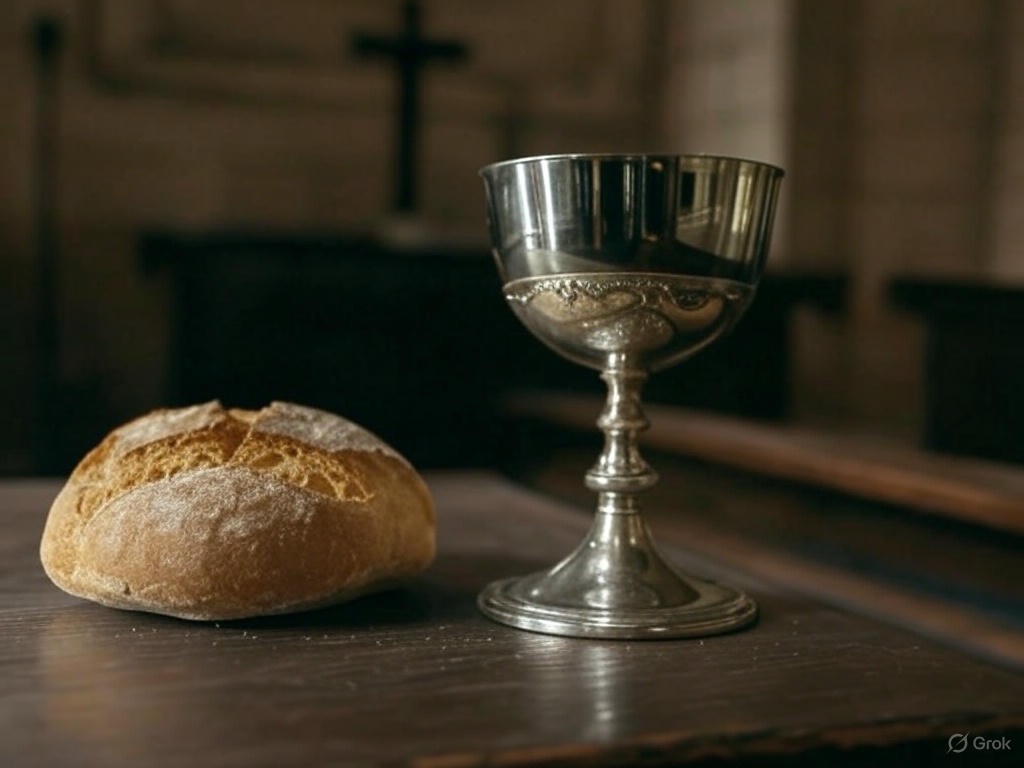
A close-up of a loaf of bread and a silver chalice depicting holy communion 

The Road to the Last Supper

Holy Week unfolds with events that prepare us for the Last Supper. On Palm Sunday, we recall Jesus’ triumphal entry into Jerusalem, greeted by crowds waving palm branches (Matthew 21:1-11). In the days following, He cleanses the temple (Matthew 21:12-13) and teaches parables, confronting religious leaders (Mark 11:27-12:44). These actions intensify opposition, as the chief priests and scribes plot to kill Him (Mark 14:1-2). Amid this tension, Jesus prepares for the Passover, the Jewish feast commemorating God’s deliverance of Israel from Egypt (Exodus 12:1-14).

Jesus instructs His disciples to arrange the meal in an upper room in Jerusalem (Luke 22:7-13). This setting, intimate and solemn, underscores the weight of the moment. Jesus knows His hour is near (John 13:1), and we should sense the gravity as He gathers with those He loves. The Passover meal becomes the backdrop for a new act of redemption, one that we commemorate to this day.

The Last Supper and Judas’ Betrayal

During the Last Supper, Jesus reveals a painful truth: one of His disciples will betray Him. John 13:21-30 captures this moment vividly:

“After he had said this, Jesus was troubled in spirit and testified, ‘Very truly I tell you, one of you is going to betray me.’ … When he had dipped the piece of bread, he gave it to Judas, the son of Simon Iscariot. As soon as Judas took the bread, Satan entered into him. So Jesus told him, ‘What you are about to do, do quickly.’ … As soon as Judas had taken the bread, he went out. And it was night.” (John 13:21, 26-27, 30, NIV)

Matthew’s account adds further clarity:

“And while they were eating, he said, ‘Truly I tell you, one of you will betray me.’ … Judas, the one who would betray him, said, ‘Surely you don’t mean me, Rabbi?’ Jesus answered, ‘You have said so.’” (Matthew 26:21, 25, NIV)

Jesus’ identification of Judas fulfills Old Testament prophecy, such as Psalm 41:9, which speaks of a trusted friend lifting his heel against another. By sharing bread with Judas, a gesture of fellowship, Jesus underscores the depth of the betrayal.

Judas does not leave of his own accord, but is called out in front of them all. It shows that the timing of these events were God ordained, and not planned by sinful humanity. Jesus was in full control. 

The Institution of Holy Communion

At the same meal, Jesus establishes Holy Communion, transforming the Passover elements into symbols of His sacrifice. Luke 22:19-20 records His words:

“And he took bread, gave thanks and broke it, and gave it to them, saying, ‘This is my body given for you; do this in remembrance of me.’ In the same way, after the supper he took the cup, saying, ‘This cup is the new covenant in my blood, which is poured out for you.’” (Luke 22:19-20, NIV)

Paul later affirms this practice, writing in 1 Corinthians 11:23-25:

“For I received from the Lord what I also passed on to you: The Lord Jesus, on the night he was betrayed, took bread, and when he had given thanks, he broke it and said, ‘This is my body, which is for you; do this in remembrance of me.’ In the same way, after supper he took the cup, saying, ‘This cup is the new covenant in my blood; do this, whenever you drink it, in remembrance of me.’”

Here, Jesus reinterprets the bread and wine. The bread represents His body, broken for our salvation; the wine signifies His blood, sealing the new covenant promised in Jeremiah 31:31-34. This act institutes Communion as a sacred rite, one we should observe to remember Christ’s sacrifice, experience His presence, and unite as His body. From the early church (Acts 2:42) to today, Communion remains central to our worship, a tangible reminder of God’s grace.

Moreover, the Last Supper foreshadows the cross. The bread and wine point to Good Friday, when Jesus’ body is broken and His blood is shed. As we participate in Communion, we proclaim His death until He returns (1 Corinthians 11:26). Maundy Thursday thus bridges the joy of Palm Sunday and the sorrow of Good Friday, preparing us for the glory of Easter.

A Time for Reflection

As we observe Maundy Thursday, we are called to reflect on Christ’s love, the cost of our redemption, and the pain of betrayal. The Last Supper invites us to the table, where we encounter Jesus’ sacrifice and receive His grace through Communion. We ought to examine our hearts, asking how we can love and serve as He did. Whether through attending a Maundy Thursday service or quietly meditating on these Scriptures, let us draw near to Jesus, who gave everything for us.

This day reminds us that even in the face of betrayal, Jesus chose love. May we, too, choose love, honoring Him in our worship and our lives.


Glorify the Lord – Andy Brown

Bringing glory to God is, in essence, why we are here on this Earth. I suppose there are many ways in which we can glorify the Lord. In fact, I would be keen to hear your thoughts on that, so do comment below. What does it mean to you to “glorify the Lord?” How do…
— Read on andy-brown.org/2022/09/27/glorify-the-lord/

The Cast List (Matthew 1:2-17)

In my last post – Son of David, Son of Abraham, we began to look at the Gospel according to Matthew. We only covered one verse last time, and so I hope to cover a little more ground this time. In that post, I also encouraged you to take a glance at the list of names found in today’s passage. You will see it reads like a “cast list” and something you might find at the start or end of a movie. The text scrolls and we skim over it, wanting to rush ahead to the action. If we do that though, we miss out on some hidden treasures.

I won’t share all the verses from this passage here, but refer to specific ones as we go. A list of names like this is called a “genealogy” and you can find many examples throughout the Bible. They are important for a variety of reasons. In the Jewish culture of the time, your family heritage was incredibly important, and none more so than if you were claiming to be the long-awaited Messiah!

Like me, when you read these names you might recognise a few of them – particularly at the top. Abraham, Isaac, and Jacob for instance, are well known to us as key figures from the Old Testament. Similarly, King David, and his son, King Solomon stand out too. Each name however, represents the life of a person, and while we may gloss over them, God does not. He knows each person deeply.

The first thing to note is that Matthew’s genealogy is a list of the ancestors of Jesus through Joseph – his adopted father. The Bible is very careful to never call Joseph Jesus’ father, as Jesus’ true Father is God Himself.

16 and Jacob the father of Joseph, the husband of Mary, and Mary was the mother of Jesus who is called the Messiah.

Matthew 1:16 (NIV)

We see this here in verse 16, where Joseph is described as the husband of Mary, and Mary the mother of Christ. Later on in Matthew 2, when the family flees to Egypt, likewise we will see the angel telling Joseph to take the Child and His mother Mary and not “your” Child (Matthew 2:13).

This is not because Joseph is unimportant – far from it! In fact, he legally adopts Christ in essence and that means that Jesus is a descendent of David in the legal sense.

Luke’s Gospel also presents a genealogy, and yet it is different. Firstly, it is arranged in reverse order and is an ascending genealogy. Secondly, there are a number of different names and it traces a different path up through the family lines. Does that matter? Absolutely it does! Luke’s genealogy is in fact traced through Mary, and is the bloodline of Christ. Matthew’s is the legal line of Christ.

and Josiah the father of Jeconiah and his brothers at the time of the exile to Babylon.

Matthew 1:11 (NIV)

When I asked you to look over the list of names, I wonder if this one stood out to you? Jeconiah. This particular king in David’s line is important, and holds the secret to why there should be a Virgin Birth.

Jeremiah 22 says:

This is what the Lord says:
“Record this man as if childless,
a man who will not prosper in his lifetime,
for none of his offspring will prosper,
none will sit on the throne of David
or rule anymore in Judah.”

Jeremiah 22:30 (NIV)

So awful is this king of Judah, that God curses his bloodline and says that none of his descendants shall ever sit on David’s throne! Did God not just shoot Himself in the foot? If He curses the kingly line, how can the Messiah ever be brought forth? The answer – a virgin shall conceive.

Had Joseph’s blood contributed to Jesus’ lineage, then God’s curse on the bloodline would have applied to Him. What the comparison to Luke’s genealogy shows us is that instead of tracing Mary’s line through David and Solomon, it instead goes via David and another of his son’s – Nathan. This means Jesus carries the blood of the king, and yet avoids the curse. Jesus is both a legal and blood relative of King David, and does so without failing foul of the curse.

Another interesting feature of the genealogy as presented by Matthew is the presence of the following women.

  • Tamar in verse 3
  • Rahab in voice 5
  • Ruth in verse 5
  • Uziah’s Wife – that is, Bathsheba – in verse 6

If you are not too familiar with the Old Testament, then these names might not mean a great deal to you. Tamar’s story is more complex than meets the eye, and having been let down by her father-in-law Judah, she essentially tricks him into sleeping with her and becomes pregnant. Rahab, although served the people of Israel, was a prostitute. Ruth was from a place called Moab, an enemy of Israel. Bathsheba, although likely had little choice in the matter, was an adulteress. All of their stories are complex, and often they were mistreated at the hands of more powerful men. Yet, whichever way you cut it, you find Christ’s heritage is made up of one sinner after another.

The passage concludes with the following:

Thus there were fourteen generations in all from Abraham to David, fourteen from David to the exile to Babylon, and fourteen from the exile to the Messiah

Matthew 1:17 (NIV)

We see that Matthew’s genealogy is divided into three sections, each with 14 names. It is not the only 7 or multiple of 7 we see in this passage, and in fact, the number 7 crops up time and time again. This is not to say that there is some secret code hidden in the biblical text, but instead infers that there is some kind of design weaved into the generations. For example, I am told that the number of vowels are a multiple of seven. This, alone, may be coincidental, but there are those who believe there are many such things in this genealogy and while any one of them could be a coincidence on its own, taking them together makes the odds astronomically small that this happened by accident. I’ll leave you to study that out for yourself and decide if there’s anything in it.

For us, the key thing is the text itself, not anything subtly underneath. Matthew’s aim here is to demonstrate the heritage of Christ. These records are evidence of who Jesus is, and that He descends from both Abraham and David – as we discussed last time. For the Jewish people today still awaiting their Messiah, no one could demonstrate their ancestral line to any degree as clearly as this.

So, with that in mind, let us press on and find out what else we can learn about Jesus from Matthew’s Gospel.

Humility, Compassion and Authority

As ever, it was a great pleasure to speak at my church yesterday morning.

We have been studying the book of Luke, and yesterdays passage cover the first 17 verses of Luke 7.

I share below a copy of the recording, which I hope you enjoy. The microphone picked up a fair bit of background noise which I hope does not spoil your enjoyment.

Where To Draw the Line – Andy Brown

Last time, I wrote about how to defend yourself against deception. This time, I want to think about where we draw the line when it comes to Bible teachers we disagree with. What I mean is, no single teacher has everything 100% correct. And if you are looking for a theologically perfect teacher, then you…
— Read on andy-brown.org/2019/06/08/where-to-draw-the-line/

900 years (audio)

As always, it was a great honour to speak at my church service yesterday morning. This time, in particular, was special as the church celebrated its 900th anniversary!

A paint by numbers of the church building, contributed to by the entire church family

I share below a recording of the message, based on Luke 4.

Apologies that the sound quality is not the best, but I hope you’re still able to hear what I say clearly.

Enjoy and God bless, and here’s to the next 900 years!

My witnesses (audio)

Several weeks ago, my church held its annual meeting – APCM. I was hoping to speak at the service beforehand, but unfortunately was unwell. In preparation for the service, I was able to record the version of my sermon which I share below.

I hope you enjoy and are blessed by this.

Continue in Christ – Andy Brown

Therefore, as you received Christ Jesus the Lord, so walk in Him Colossians 2:6 (ESV) In his letter to the Colossians, Paul is here urging them to stick with the Gospel they heard. That Gospel was Christ-centred. Paul points out it was all about Him, and that there were no bells or whistles – Christ…
— Read on andy-brown.org/2018/03/15/continue-in-christ/

Pentecost Sunday – Andy Brown

It was my privilege to share with the church in our village this morning, celebrating Pentecost Sunday. Not all of the church’s members have access to video so I’ve written out a short message which I share below. I will put the video version out on my Facebook page later today. Here is a link…
— Read on andy-brown.org/2020/05/31/pentecost-sunday/

Peter Preaches – Andy Brown

Yesterday was Pentecost Sunday and I shared some thoughts on Acts 2 and the coming of the Holy Spirit. You can read that post here or even watch the video version on my Facebook page – Andy Brown on Facebook . Acts 2 is a fairly lengthy chapter, so I won’t include the entire text…
— Read on andy-brown.org/2020/06/01/peter-preaches/

Just as He said He would – Andy Brown

On this Resurrection Sunday, I share the message I gave at last year’s sunrise service at our church.

He is risen! Just as he said he would! Praise the living God! 

Happy Easter! It was my privilege to share for a few minutes this morning at our early morning sunrise service on this Resurrection Sunday. I share below a recording of the message which I hope you enjoy. May you be eternally blessed this Easter weekend! A message from Andy on Easter Sunday morningA message from…
— Read on andy-brown.org/2022/04/17/just-as-he-said-he-would/

The Lost Sheep (Audio)

As ever, it was a great privilege to be able to speak at our church is lent meeting yesterday evening.

Over the course of Lent, we are thinking about Luke 15 in the three “lost “parables. I gave a brief message last night about the parable of the lost sheep and I share the recording below.

I hope you enjoy!