As ever, it was a tremendous privilege to speak at this morning’s church service. Continuing our Easter services, we were looking at the gospel of John and share below my sermon which I hope you enjoy.
A cartoon image of doubting Thomas standing in the middle of a room looking sceptical 
Imagine receiving a personal letter from a trusted friend, filled with encouragement, warnings, and a call to live faithfully. The letter of 3 John is just that—a brief but powerful message that resonates with us today. Written by the Apostle John, this short epistle addresses Gaius, a faithful believer, and tackles issues in the early church. In this post,I will unpack the key themes of 3 John, outline its structure, and offer practical applications for our lives.
Though concise, 3 John reveals timeless truths about walking in truth, showing hospitality, and confronting challenges in the church.
A cartoon postman/mailman carrying a tiny letter with a church in the background as if he is delivering this small but important epistle
Context and Background
The letter of 3 John is traditionally attributed to the Apostle John, the same author of 1 and 2 John and the Gospel of John, based on its similar style and theological emphasis. Likely written in the late 1st century, the letter is addressed to Gaius, a beloved member of a Christian community, with references to two other figures: Diotrephes and Demetrius. The setting appears to be a church facing internal conflicts, particularly regarding the support of traveling missionaries and issues of authority.
John’s purpose in writing is multifaceted: to commend Gaius for his faithfulness, to warn against the disruptive behavior of Diotrephes, and to encourage continued support for missionaries spreading the gospel. Despite its brevity—only 14 verses—3 John holds significant value for understanding personal relationships, truth, and hospitality in the early church. It reminds us that even small acts of faithfulness can have a lasting impact.
Outline of Key Topics in 3 John
Greeting and Commendation (Verses 1-4)
The letter opens with John’s warm greeting to Gaius, whom he addresses with affection and describes as beloved. John expresses joy upon hearing that Gaius is “walking in the truth,” a phrase that underscores Gaius’ faithfulness to the gospel. This section highlights the importance of living a life aligned with God’s truth, a central theme of John’s writings. For John, truth is not merely intellectual assent but a way of life that reflects commitment to Christ.
Hospitality and Support for Missionaries (Verses 5-8)
John praises Gaius for his hospitality toward traveling Christian workers, likely itinerant missionaries spreading the gospel. Gaius has provided practical support, such as food and shelter, enabling these workers to continue their ministry. John urges Gaius to persist in this generosity, noting that supporting such workers makes believers “co-workers for the truth.” This section emphasizes the role of hospitality in advancing God’s kingdom and our shared responsibility to support gospel work.
Warning Against Diotrephes (Verses 9-10)
John then addresses a troubling issue: the behavior of Diotrephes, a church member who rejects John’s authority and refuses to welcome traveling missionaries. Diotrephes’ actions are driven by pride, as he seeks preeminence and even expels those who disagree with him. John promises to address this behavior directly if he visits, highlighting the dangers of pride and division in the church. This section serves as a caution against self-centered leadership that undermines the unity and mission of the Christian community.
Commendation of Demetrius (Verses 11-12)
In contrast to Diotrephes, John commends Demetrius, who has a good reputation among the church and is likely a missionary or leader. John encourages Gaius to “imitate what is good” rather than evil, presenting Demetrius as a godly example. This brief section underscores the value of positive role models in the Christian life and the importance of character in leadership.
Closing and Personal Note (Verses 13-14)
John concludes with a personal note, expressing his desire to visit Gaius in person rather than communicate only through letters. He sends greetings from mutual friends and blesses Gaius with peace. This closing reinforces the value of personal connection in the Christian community, reminding us that relationships are central to the life of the church.
Practical Applications for Today
The letter of 3 John, though written to a specific individual in a specific context, offers timeless lessons for us today. Here are five practical applications for living out its teachings:
Walking in Truth
John’s joy over Gaius’ faithfulness encourages us to prioritize studying and applying Scripture in daily life. We ought to live out biblical truth in our actions and decisions, not just understand it intellectually. We should foster accountability by engaging in Bible study groups or mentoring relationships to stay rooted in God’s truth.
Practicing Hospitality
Gaius’ support for missionaries challenges us to open our homes and resources to those in need, particularly those serving in ministry. We should consider hosting a missionary, supporting a local outreach, or providing practical help to church workers. We ought to cultivate a culture of generosity in our churches by organizing initiatives to support global or local missions.
Addressing Division
The example of Diotrephes serves as a warning against prideful or divisive behavior in the church. We should confront such issues with humility and grace, seeking reconciliation and unity. We ought to promote a shared focus on the gospel to prevent self-centeredness from fracturing our communities.
Imitating Godly Examples
Demetrius’ good reputation highlights the importance of seeking and becoming godly role models. We should identify mentors who reflect Christlike character and strive to emulate their faith and integrity. Likewise, we ought to inspire others by living with consistency and humility in our communities.
Building Personal Connections
John’s desire for a face-to-face visit underscores the value of personal relationships in the church. We should invest in meaningful interactions, whether through small groups, one-on-one discipleship, or sending encouraging notes. Building strong connections strengthens our churches’ witness and fosters mutual support.
Conclusion
The letter of 3 John, though only 14 verses long, is a rich and relevant message for us today. It calls us to walk in truth, practice hospitality, confront division, follow godly examples, and build personal connections. These timeless principles challenge us to live faithfully in our churches and communities. We should reflect on how we can apply these lessons—perhaps by supporting a missionary, fostering unity, or mentoring others. Let 3 John inspire us to love generously and strengthen the body of Christ.
If you would be interested in doing a verse by verse study of this letter, do let me know in the comments! Thanks 
Check out Andy‘s brand-new book… From Doubt to Disciples: Unlocking the Great Commission. Now available on Amazon 
This post, originally published over two years ago, was released during the height of the Covid pandemic in the UK.
While I hope we have now moved on from lockdowns and restrictions, the UK now faces another crisis in energy costs. I am sure it is the same where you are as well.
As our bills in every area increase, what does that mean for our giving to God? Should we cut it back? Should we stop altogether?
I hope you find the post interesting, and welcome your thoughts in the comments.
Giving can be a tough subject to discuss, and particularly at the moment with all the other issues going on in the world. However, a Christian who does not give is like a Christian who does not pray. Christians should be generous givers. There are many individuals and groups struggling because of the impact of…
— Read on andy-brown.org/2020/04/16/dont-give-up-giving/
Last week I wrote a post called – Precious Faith – which looked at the opening words of Peter’s second letter. Having reminded his readers of his slavery and apostleship, and the like precious faith they share, Peter continues.
By his divine power, God has given us everything we need for living a godly life. We have received all of this by coming to know him, the one who called us to himself by means of his marvelous glory and excellence. 4 And because of his glory and excellence, he has given us great and precious promises. These are the promises that enable you to share his divine nature and escape the world’s corruption caused by human desires.
2 Peter 1:3-4 (NLT)
Living A Godly Life
In his opening, Peter tells us that we share a faith given to us by God. Likewise here, we see another example of what God has given to us. Namely, everything!
Well, not strictly true… although I once heard a preacher say that this verse does mean just that. That God has given us everything we might want, need or desire. If we were not fallen, sinful creatures, then that might not be so bad.
Peter, however, does not mean literally everything but rather qualifies his words. God, by His power, has given us everything we need for “living a godly life.” God has indeed blessed us richly, and gives us what we need that we might live godly lives. He does not empower us to commit sin, nor to swallow up all we want in selfish greed.
It can be very difficult to be a Christian in today’s world. Some days it feels like we live on a different planet to the rest of the population. We are criticised, laughed at and persecuted, and at times it can feel almost impossible to live in a godly way.
Yet, Peter would encourage us by reminding us of what we have been given – everything! We can do it, because we have what we need. This is not to depend on ourselves to live righteously, but instead to draw on that “divine power” that the Holy Spirit brings. We live godly because we follow Christ, and want to be like Him. We have courage to stand out from the world even if it costs us something.
Verse 3 continues by saying we have received all of thins by coming to know Him – that is, the One who has called us by His marvellous glory and excellence. So, this means that we receive this as we come to know Jesus Christ. It is not received in church attendance, daily devotionals, doing good works (as profitable as those things are), but it is also about knowing Christ.
I am reminded of Paul’s words from Philippians:
Yes, everything else is worthless when compared with the infinite value of knowing Christ Jesus my Lord. For his sake I have discarded everything else, counting it all as garbage, so that I could gain Christ
Philippians 3:8 (NLT)
I have been challenged lately by asking myself how Christlike I am. I often do not feel a whole lot like Him, and as I examine what it means to be like Him, I have to first truly know Him. I challenge you in the same way today; are you Christlike? How well do you know Jesus?
Precious Promises
Last time, we thought about the precious faith we share, and now Peter points to precious promises.
And because of his glory and excellence, he has given us great and precious promises. These are the promises that enable you to share his divine nature and escape the world’s corruption caused by human desires.
2 Peter 1:4 (NLT)
Because of His glory, because of how excellent Christ is, He has bestowed upon us promises as precious as our faith.
These promises allow us to share in Christ’s nature, and that is also what allows us to become Christlike. I hasten to point out that these promises are not given to us because we are good, have earned them or are superior to anyone else; no, they are given to us simply because we know the Lord.
The corruption of the world is what I touched on earlier. We are surrounded by sinfulness, and temptation seems to appear from every direction. How can we Christians escape such wickedness and not be overwhelmed by it? By receiving these very valuable promises, by drawing on Christ and all His strength and abiding in Him (as a branch linked to a vine) we can deny human (sinful) desire and seek the Spirit’s lead.
Practically, what does this all mean?
Put simply, I believe these verses point us back to God’s Word. We find these precious promises in the Bible. We come to know Christ fully as we see Him revealed in Scripture. As we study the Word, it changes us from the inside out and, over time, we become more like the Lord we serve.
Seek out those promises today. Read the Gospels and learn about who Jesus is. As you do so, you will be eternally blessed.
If you have not checked out the Berry Bunch Family already, then I strongly encourage you to do so. i’m truly excited to hear more of their testimony and about gods faithfulness in their lives and ministry.
It was something of an honour to be mentioned in this post as well!
Do give it a read, and start following their site. you won’t regret it!
I’ve written, edited, and scheduled our first #TestimonyTuesday post. This is an exciting new, and regular, output for us, and we have Nicola to …
In yesterday’s post – If Wisdom – we saw and understood that wisdom required certain things from us. A choice was given to us, and we could opt to follow the path of insight or to tread the way of foolishness.
What are the benefits of wisdom though? We posed the question yesterday, if I do this, then what? Our passage today seeks to answer that very point.
Recall that I likened it to a computer program. If… then… If you do A, then B will happen. If we opt for Wisdom, then what is the result?
5 then you will understand the fear of the Lord
and find the knowledge of God.
6 For the Lord gives wisdom;
from his mouth come knowledge and understanding.
7 He holds success in store for the upright,
he is a shield to those whose walk is blameless,
8 for he guards the course of the just
and protects the way of his faithful ones.
Proverbs 2:5-8 (NIV)
The Fear of the Lord
It is hard to get past verse five. It promises something of a “big ticket” item as the first benefit of seeking wisdom’s way. If you choose wisdom, then you will understand the fear of the Lord.
This is no small promise. It all begins and ends with the fear of our Great God. Just so that it is said, “fear” here is not to be afraid, but rather to revere and respect – though those two words seem inadequate somehow.
Many people describe themselves as agnostic, meaning that they are uncertain if there is a God at all. They are not so adamant as atheists, but have questions they are yet to find the answers for. Some people believe in some form of god or higher being, others think there is some kind of universal energy but would hesitate to describe this as a conscious being.
Wisdom reveals the truth to us. There is a God, and He is Father, Son and Holy Spirit. Choosing wisdom leads to understanding the fear of the Lord, and to knowledge of Him.
Perhaps the entire point of my series, or rather the entire thrust of the book of Proverbs is this; that wisdom leads to God. We do not seek wisdom for its own ends. We do not pursue it simply to be known as “wise.” While it may bring success in different areas of our lives, that is not the point either.
#Wisdom leads to the knowledge of #God #Bible #Christianity #Jesus
Wisdom – true wisdom – comes only from God. He gives it gladly to those who would follow after Him.
From His mouth comes understanding… and what comes from a person’s mouth? Their word of course. God’s Word, which we know as the Bible, is the only place to find wisdom more valuable than gold.
I recall a time as a young man when I spoke to a Christian Union meeting at the nearby university. I waved my Bible at them and almost yelled “Read your Bibles!” I was perhaps a little less subtle in those days! I hope they remembered it though, I know I did! I knew then as I do now that knowing your Bible is the key to success in this life. The Word speaks of Christ, and only by knowing Him can we make this life worth living.
(side note: success does not equate to wealth, fame or a high profile job title… but it does not exclude these either.)
Please, dear reader, study the Scriptures! In them you will find life. They speak of Jesus. They bestow wisdom.
Interchangeable Wisdom
Verses seven and eight switch gears slightly, as the author pauses to reflect on the benefits of knowing the Lord (rather than wisdom itself).
We see that God has stored up success for the righteous, and for those us bathed in the cleansing blood of the Lamb, we take a different view of what righteousness really is. It is not behaving well, but rather being in a position of good standing with God. We are not righteous because we are good, but because He is!
The Lord is a shield, and He guards the path of the just. And He protects the way of the faithful. Such benefits the Lord offers are reminiscent of those that come from wisdom herself. This touches on something I have always pondered about Proverbs. Knowledge of God and knowledge of wisdom appear largely interchangeable.
I will leave you this thought to meditate on. Is knowing wisdom the same as knowing God? Or rather, is knowing God the same as knowing wisdom?
One last thing, as it is in my mind. I do not know all there is to know about Proverbs (or the Bible as a whole for that matter). I hope that what I write is helpful and encouraging. I cannot however answer all questions you are likely to have. There are passages later in Proverbs which I will struggle with, no doubt, and as we reach them I will try to be open and honest with you.
I recall a preacher I respect reading a passage once and asking “What does this mean?” His answer was as follows: “I have no idea!” I may have to hold up my hands and admit the same as some point. And likely, so will you.
Let each of us pray for wisdom, and a deeper knowledge of God and His Word. May the Holy Spirit reveal to us all we need to know, and help us to understand those passages and points we struggle with.
Remember, if you follow the path of wisdom, you will find Jesus.
I have just received a notification from WordPress to say that today I have had a new record – most views in a day! For this, I can only say a massive thank you to all of my readers.
 I am not certain why the site has attracted so many visitors today, but I am humbled by every single page view. Thank you!
And thanks go to Jesus for all of this. I could not write one word about him where it not for his wonderful grace. May he continue to take these imperfect words of mine and use them for his kingdom and glory.
I have been re-running a series of “best of “posts from this past year. Although not the most viewed, this one entitled “success “is particularly apt on the back of what I’ve just said.
I hope you enjoy reading it, whether it’s the first time you have seen it or not.
—
This week, WordPress notified me of two particular milestones my site has reached. It does not matter exactly what they are, and you will understand later why I choose not to share the specifics. In addition to that, my site also managed to exceed total views for 2020, also something of an achievement. Are these…
— Read on andy-brown.org/2021/06/26/success/
My first attempt to publish this did not seem to work so well! If you already saw it, then great… if not, here it is again! Thanks for your patience!
If you are tuning in, expecting the next in the series on Joseph, then don’t worry! I’ve not forgotten! I will return to the series on Joseph later this week (God willing, and Andy co-operating!) For today, I want to circle back to the subject of prayer.
I was praying for someone a little while ago and asked god to “Keep them safe!” It got me thinking about what I actually meant by the phrase. Clearly, I was thinking about their physical safety, but extends to their emotional and spiritual condition as well.
I am obviously asking God to keep this individual from harm, but what do I actually expect God to do in response to my prayer? Perhaps I am asking Him to restrict them from going outside? Surely, being inside closed doors is far safer than going outside? No… I do not think that is what I am asking at all.
So therefore, I must be asking God to keep them in relative safety while they are out and about, and living their daily lives. Living life is not “safe” though, is it? We take risks every single day, even if they are tiny. We take a chance every time we cross the street. If we do not look both ways, then there is a risk of being hit by a car. Taking it to extremes, staying at home may be little safer – people fall down the stairs, slip in the shower, or injure themselves in other ways.
As above, life is simply not safe. And neither, at times, is God’s will.
When we look at how Christians are often treated in this world, and how many of our fellow brothers and sisters are martyred in Christ, we realise that God’s will is not always safe for us. While it may not be the safest place to be, it is always the best place to be.
Given this, perhaps there are times when praying that God will keep someone safe is to pray against His will. Instead of safety, we ought to pray for that person to have strength and wisdom to fulfil God’s call on their lives, or to face the good and the bad that life has to offer.
I want to examine my prayer life closely. I really want to think about the words that I use. When praying for people, I frequently say “Lord, bless them…” but as above, what do I actually mean by this? So often my view of a blessing may be quite different to God’s view. To some, winning the lottery might be a “blessing” but if it leads the person down a path of selfishness, greed and ultimately destruction, then it is no blessing at all.
We can learn much from the prayer that Jesus taught us.
He said to them, “When you pray, say,
‘Our Father in heaven,
may your name be kept holy.
May your Kingdom come.
May your will be done on earth, as it is in heaven.
3 Give us day by day our daily bread.
4 Forgive us our sins,
for we ourselves also forgive everyone who is indebted to us.
Bring us not into temptation,
but deliver us from the evil one.’”
Luke 11:2-4 (WEB)
No mention of safety here!
This prayer focusses primarily on God the Father. It seeks first His glory, will and kingdom, not our relative safety or blessing. Of course, it does go on to ask for our daily bread and that is not unimportant. Neither is the request to avoid temptation or to be delivered from evil.
We must allow the Bible to shape our prayer lives. It is not wrong to ask God to keep someone safe, but how much greater a prayer is it to ask God to bring about His will and kingdom in their lives? To ask the Father to deliver them out of temptation’s grasp, or to seek forgiveness for and from them. How much richer and more effective our prayers would be!
When we pray, we do not always see immediate results. In fact, there are times when it seems like our prayers are making no difference whatsoever. I do not suppose we will see the full effect of our prayers on this side of heaven, but one day (in eternity) will look back on the times a person we were praying for avoided temptation or stepped deeper in God’s plan for their lives.
How do you pray? What words do you use? Do share below for my benefit and for others. As iron sharpens iron, we can all learn from one another.
And may I close by saying, “Lord, may Your will be done in the lives of everyone reading this today! Deliver them from evil, and keep them far from temptation. In Jesus’ mighty Name! Amen!”
If you are tuning in, expecting the next in the series on Joseph, then don’t worry! I’ve not forgotten! I will return to the series on Joseph later this week (God willing, and Andy co-operating!) For today, I want to circle back to the subject of prayer.
I was praying for someone a little while ago and asked god to “Keep them safe!” It got me thinking about what I actually meant by the phrase. Clearly, I was thinking about their physical safety, but extends to their emotional and spiritual condition as well.
I am obviously asking God to keep this individual from harm, but what do I actually expect God to do in response to my prayer? Perhaps I am asking Him to restrict them from going outside? Surely, being inside closed doors is far safer than going outside? No… I do not think that is what I am asking at all.
So therefore, I must be asking God to keep them in relative safety while they are out and about, and living their daily lives. Living life is not “safe” though, is it? We take risks every single day, even if they are tiny. We take a chance every time we cross the street. If we do not look both ways, then there is a risk of being hit by a car. Taking it to extremes, staying at home may be little safer – people fall down the stairs, slip in the shower, or injure themselves in other ways.
As above, life is simply not safe. And neither, at times, is God’s will.
When we look at how Christians are often treated in this world, and how many of our fellow brothers and sisters are martyred in Christ, we realise that God’s will is not always safe for us. While it may not be the safest place to be, it is always the best place to be.
Given this, perhaps there are times when praying that God will keep someone safe is to pray against His will. Instead of safety, we ought to pray for that person to have strength and wisdom to fulfil God’s call on their lives, or to face the good and the bad that life has to offer.
I want to examine my prayer life closely. I really want to think about the words that I use. When praying for people, I frequently say “Lord, bless them…” but as above, what do I actually mean by this? So often my view of a blessing may be quite different to God’s view. To some, winning the lottery might be a “blessing” but if it leads the person down a path of selfishness, greed and ultimately destruction, then it is no blessing at all.
We can learn much from the prayer that Jesus taught us.
He said to them, “When you pray, say,
‘Our Father in heaven,
may your name be kept holy.
May your Kingdom come.
May your will be done on earth, as it is in heaven.
3 Give us day by day our daily bread.
4 Forgive us our sins,
for we ourselves also forgive everyone who is indebted to us.
Bring us not into temptation,
but deliver us from the evil one.’”
Luke 11:2-4 (WEB)
No mention of safety here!
This prayer focusses primarily on God the Father. It seeks first His glory, will and kingdom, not our relative safety or blessing. Of course, it does go on to ask for our daily bread and that is not unimportant. Neither is the request to avoid temptation or to be delivered from evil.
We must allow the Bible to shape our prayer lives. It is not wrong to ask God to keep someone safe, but how much greater a prayer is it to ask God to bring about His will and kingdom in their lives? To ask the Father to deliver them out of temptation’s grasp, or to seek forgiveness for and from them. How much richer and more effective our prayers would be!
When we pray, we do not always see immediate results. In fact, there are times when it seems like our prayers are making no difference whatsoever. I do not suppose we will see the full effect of our prayers on this side of heaven, but one day (in eternity) will look back on the times a person we were praying for avoided temptation or stepped deeper in God’s plan for their lives.
How do you pray? What words do you use? Do share below for my benefit and for others. As iron sharpens iron, we can all learn from one another.
And may I close by saying, “Lord, may Your will be done in the lives of everyone reading this today! Deliver them from evil, and keep them far from temptation. In Jesus’ mighty Name! Amen!”
Everywhere you go, do whatever you can to make someone feel valuable
Many people do not feel all that valuable or valued. In fact, many feel worthless and unwanted. As Christians, we know this is not true. God values every single human being, and the price He paid for them was the cost of His Son.
Not everyone is open to our Christian message however, but that does not mean we cannot communicate their value. We value the people in our lives, yet often do not show it or neglect to tell them.
If you truly value your spouse or children, then make an effort to show them that. There are myriad ways you can do this, but one of the simplest and most effective is just to say “thank you!” You or they may not think it a big deal to cook dinner every night, or put the bins out, or work every single day, or raise the children. But do not take these things for granted, and make sure you let them know you appreciate them and what they do.
Similarly, for those outside of your household, you can still recognise their value. Whether it is the local shopkeeper who has helped you during this time of lockdown, or the nurse or care worker who has looked after you or a relative, you can ensure they know how valuable they are and their contribution is.
Everywhere you go, do something to show the people around you how much you value and appreciate them. A note of thanks or encouragement can brighten someone’s day. Use social media to promote some one, service or business which has helped you out. Be a blessing and go the extra mile to recognise those who work tirelessly behind the scenes or who are rarely thanked.
You can make a difference. You can shine the light of Christ in this often dark world. What will you do this week?
We have been playing a lot of worship music in our house lately. We do normally I suppose, but now that we are all home most of the time, it feels like it is more than usual.
One song in particular has caught my attention, and it is “The Blessing (Live)” and is sung by Elevation Worship, Kari Jobe and Cody Carnes. If you are not familiar with it, I’m sure you can find it on YouTube or your music streaming service of choice! It is essentially a sung version of the “Aaronic Blessing” or “Priestly Blessing” from the Bible.
The Lord bless you and keep you;
25 the Lord make his face to shine upon you and be gracious to you;
26 the Lord lift up his countenance upon you and give you peace.
Numbers 6:24-26 (ESV)
This is a beautiful blessing, and so the words also make a beautiful song. I do love worship music which uses the words of the Bible. I really believe that songs have a theology, and where we sing them over and over, it’s important they are biblical words which build us up.
So a worship song which quotes directly from the Bible should be fine, right? Well…
For starters, this is a sung blessing and so the words are sung by the congregation to the congregation. That is fine, and a valid expression of our faith. Worship is of course singing to God, but singing about God to other people is worship in another sense.
While this particular song doesn’t sing words of praise to God directly, worship is implied in the fact that His blessing is so richly sought by His people. If God was not God, then His blessing would not be so valuable.
In a previous post I wrote, called “Christ is… Enough?” I discussed worship songs at some length. I won’t cover that same ground again here, but do feel free to go back and read that one.
One concern I do have about “The Blessing” as a worship song is its construction. It was recorded in a mega-church setting, with many people gathered (not that this is a bad thing). It starts softly, and slowly rises to a huge crescendo at the end. The music, the lights, the smoke etc. all combine to take you on an emotional journey. It’s wonderful on one hand, but is it God?
My worry is this: are we mistaking the presence and power of God for a manufactured experience of worship? What I mean is, is the height of that emotional journey really God’s anointing, or is it just the environment and music which has led us there?
I’ve experienced settings like this in the past, and it is easy to get swept along by the atmosphere and the highly polished presentation. We should always give God our best of course, but participating in worship is not the same as being entertained at a concert.
Imagine that exhilarating feeling of being present at one of these events. Thousands of voices singing, melodic music, hands raised in celebration. Then, you return to your “normal” church setting, and there’s one individual with a piano and no lights, sounds or smoke. It is all too easy to think, “God is not in this church…” And you would be wrong.
Enjoy beautiful music by all means. Don’t however mistake it for the presence of God. These hilltop experiences can lead us to forget that God is with us in the everyday. He is present when we sing in the shower, or hum a tune while washing the dishes. Those who chase emotional mountain-tops will struggle to enjoy God in their ordinary everyday lives. I don’t want that for you.
God will never leave you nor forsake you. Jesus has promised to be with you until the very end of the age.
Keep your life free from love of money, and be content with what you have, for he has said, “I will never leave you nor forsake you.”
Hebrews 13:5 (ESV)
Go therefore and make disciples of all nations, baptizing them in[b] the name of the Father and of the Son and of the Holy Spirit, 20 teaching them to observe all that I have commanded you. And behold, I am with you always, to the end of the age.”
Matthew 28:19-20 (ESV, emphasis added)
You will find Him not in the neon lights, but in the still small voice.
Let me leave you with this prayer from the Priestly Blessing.
Heavenly Father,
I ask you to bless every reader, to keep them, and to turn Your face toward them. May You be gracious unto them in their everyday lives, and give them peace.
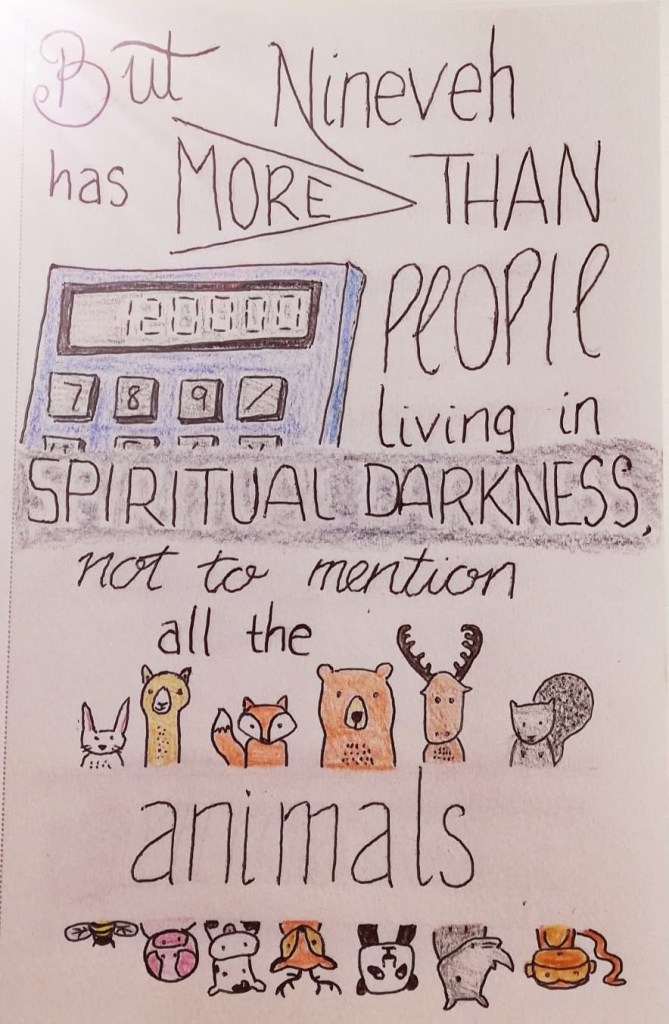
Jonah 4:11 (NLT) But Nineveh has more than 120,000 people living in spiritual darkness, not to mention all the animals. Shouldn’t I feel sorry for such a great city?”
As I write this, I’m overlooking a sort of forest woodland. In the last few minutes I have seen an abundance of nature! I’ve seen ducks, squirrels, deer, rabbits and even what I think was a stoat.
Due to the Coronavirus, the woodland has largely been abandoned at the moment. I suspect that the sudden drop in guests will quite badly affect the wildlife here. Over time I am sure they have become somewhat dependent on the food given to them by visitors. This area will be closed to the public for several weeks leaving the animals to fend for themselves for a while.
While the sudden drop in available food will be a bit of a shock to them, I am not overly worried about them. God cares for people, but He cares for His creation also.
There have been a number of posts on social media about panic buying and stockpiling. As a result, many food banks and charities have seen a dip in food donations. This is not limited to charities offering support for people either, and a number of animal rescue shelters are struggling too. The Coronavirus is affecting the whole world in myriad ways.
The verse above is quoted from the book of Jonah in the Old Testament. In fact, it is the closing verse of that book. Most people recall that Jonah was once swallowed by a big fish, but in case you don’t know the rest of the story, here is a brief summary.
God called Jonah to preach to the non-Jewish (Gentile) city of Nineveh. Instead, Jonah heads in the complete opposite direction and boards a ship to Tarshish. A great storm swamps the ship, and in the end Jonah confesses to the crew that he is the cause of their struggle. Ultimately they have to throw him overboard to still the storm.
It is at this point – more or less – that Jonah is swallowed by the fish. The fish later spews up the reluctant prophet on to the shoreline, and Jonah finally goes to Ninevah as he was instructed.
Jonah did not want to go to Ninevah and preach because he was afraid the people would listen to him… He knew that if they heard his message, they would repent and turn back to God – and God would forgive them. Imagine that?
After he gives his message, he goes and sits outside the city to see what would happen. The sun is burning hot, and he grows weary. God causes a vine to grow up beside him and offer him some shelter. Later however, a worm comes along and eats the root of the vine so it withers and Jonah loses his shade.
It’s something of an odd story right? Indeed it is, but it is really about who is in charge. God is running the show throughout, and He gives Jonah the vine and quickly takes it away to demonstrate to Jonah that he has no control in the situation. God wants Jonah to realise that He cares for the people of Ninevah.
The book of Jonah closes with the verse above. God tells Jonah He is right to care for the 120,000 people living there. We don’t know what happened to Jonah after this, but let’s hope he learned a lesson!
Perhaps 15 years ago, I had a dog who was very poorly. They had a particularly bad night, and we had to contact an emergency vet. The next day I happened to be reading this closing chapter of Jonah. I’ll always remember that because I recall very vividly this final verse. As well as the 120,000 people, God specifically mentions the animals also.
The word animals here is sometimes translated as cattle, so perhaps refers to farm animals or bovine species. Whatever it refers to though, it is clear that God cares for the animals also.
Animals are a part of God’s creation. While they are not as important as people, they are important. We have a responsibility to take care of them, and must certainly not mistreat them.
Spare a thought this week for all those affected by the Coronavirus. We must prioritise helping people with various needs at this time. We, the church, may not be able to gather together in large numbers, but we can and must continue to be Jesus’ hands and feet on the Earth. Call an isolated family member. Check on an elderly neighbour. Let’s do what we can to share God’s love in this difficult time.
As well as those things, and if you’re not overstretched, do consider whether there are ways to take care of God’s creation also. You might consider grabbing a can of dog food to pass on to a struggling pet owner. Perhaps you could walk a friend’s dog. Maybe, like me, there is a nearby animal shelter who could do with a helping hand at this difficult time.
Like many, I’m deeply disappointed to read stories of fighting in supermarkets and immoral seller hiking up prices. There are plenty of positives stories also, and we – the church – should be leading the way in that.
How can you be a blessing to those around you at this time? And remember, God cares about the animals also.





 Andy Brown