A Mighty Message in a Little Letter – 3 John: A Call to Faith, Hospitality, and Truth

Imagine receiving a personal letter from a trusted friend, filled with encouragement, warnings, and a call to live faithfully. The letter of 3 John is just that—a brief but powerful message that resonates with us today. Written by the Apostle John, this short epistle addresses Gaius, a faithful believer, and tackles issues in the early church. In this post,I will unpack the key themes of 3 John, outline its structure, and offer practical applications for our lives.

Though concise, 3 John reveals timeless truths about walking in truth, showing hospitality, and confronting challenges in the church.

A cartoon postman/mailman carrying a tiny letter with a church in the background as if he is delivering this small but important epistle

Context and Background

The letter of 3 John is traditionally attributed to the Apostle John, the same author of 1 and 2 John and the Gospel of John, based on its similar style and theological emphasis. Likely written in the late 1st century, the letter is addressed to Gaius, a beloved member of a Christian community, with references to two other figures: Diotrephes and Demetrius. The setting appears to be a church facing internal conflicts, particularly regarding the support of traveling missionaries and issues of authority.

John’s purpose in writing is multifaceted: to commend Gaius for his faithfulness, to warn against the disruptive behavior of Diotrephes, and to encourage continued support for missionaries spreading the gospel. Despite its brevity—only 14 verses—3 John holds significant value for understanding personal relationships, truth, and hospitality in the early church. It reminds us that even small acts of faithfulness can have a lasting impact.

Outline of Key Topics in 3 John

Greeting and Commendation (Verses 1-4)

The letter opens with John’s warm greeting to Gaius, whom he addresses with affection and describes as beloved. John expresses joy upon hearing that Gaius is “walking in the truth,” a phrase that underscores Gaius’ faithfulness to the gospel. This section highlights the importance of living a life aligned with God’s truth, a central theme of John’s writings. For John, truth is not merely intellectual assent but a way of life that reflects commitment to Christ.

Hospitality and Support for Missionaries (Verses 5-8)

John praises Gaius for his hospitality toward traveling Christian workers, likely itinerant missionaries spreading the gospel. Gaius has provided practical support, such as food and shelter, enabling these workers to continue their ministry. John urges Gaius to persist in this generosity, noting that supporting such workers makes believers “co-workers for the truth.” This section emphasizes the role of hospitality in advancing God’s kingdom and our shared responsibility to support gospel work.

Warning Against Diotrephes (Verses 9-10)

John then addresses a troubling issue: the behavior of Diotrephes, a church member who rejects John’s authority and refuses to welcome traveling missionaries. Diotrephes’ actions are driven by pride, as he seeks preeminence and even expels those who disagree with him. John promises to address this behavior directly if he visits, highlighting the dangers of pride and division in the church. This section serves as a caution against self-centered leadership that undermines the unity and mission of the Christian community.

Commendation of Demetrius (Verses 11-12)

In contrast to Diotrephes, John commends Demetrius, who has a good reputation among the church and is likely a missionary or leader. John encourages Gaius to “imitate what is good” rather than evil, presenting Demetrius as a godly example. This brief section underscores the value of positive role models in the Christian life and the importance of character in leadership.

Closing and Personal Note (Verses 13-14)

John concludes with a personal note, expressing his desire to visit Gaius in person rather than communicate only through letters. He sends greetings from mutual friends and blesses Gaius with peace. This closing reinforces the value of personal connection in the Christian community, reminding us that relationships are central to the life of the church.

Practical Applications for Today

The letter of 3 John, though written to a specific individual in a specific context, offers timeless lessons for us today. Here are five practical applications for living out its teachings:

Walking in Truth

John’s joy over Gaius’ faithfulness encourages us to prioritize studying and applying Scripture in daily life. We ought to live out biblical truth in our actions and decisions, not just understand it intellectually. We should foster accountability by engaging in Bible study groups or mentoring relationships to stay rooted in God’s truth.

Practicing Hospitality

Gaius’ support for missionaries challenges us to open our homes and resources to those in need, particularly those serving in ministry. We should consider hosting a missionary, supporting a local outreach, or providing practical help to church workers. We ought to cultivate a culture of generosity in our churches by organizing initiatives to support global or local missions.

Addressing Division

The example of Diotrephes serves as a warning against prideful or divisive behavior in the church. We should confront such issues with humility and grace, seeking reconciliation and unity. We ought to promote a shared focus on the gospel to prevent self-centeredness from fracturing our communities.

Imitating Godly Examples

Demetrius’ good reputation highlights the importance of seeking and becoming godly role models. We should identify mentors who reflect Christlike character and strive to emulate their faith and integrity. Likewise, we ought to inspire others by living with consistency and humility in our communities.

Building Personal Connections

John’s desire for a face-to-face visit underscores the value of personal relationships in the church. We should invest in meaningful interactions, whether through small groups, one-on-one discipleship, or sending encouraging notes. Building strong connections strengthens our churches’ witness and fosters mutual support.

Conclusion

The letter of 3 John, though only 14 verses long, is a rich and relevant message for us today. It calls us to walk in truth, practice hospitality, confront division, follow godly examples, and build personal connections. These timeless principles challenge us to live faithfully in our churches and communities. We should reflect on how we can apply these lessons—perhaps by supporting a missionary, fostering unity, or mentoring others. Let 3 John inspire us to love generously and strengthen the body of Christ.

If you would be interested in doing a verse by verse study of this letter, do let me know in the comments! Thanks 


Check out Andy‘s brand-new book… From Doubt to Disciples: Unlocking the Great Commission. Now available on Amazon 

From Doubt to Disciples: Unlocking the Great Commission
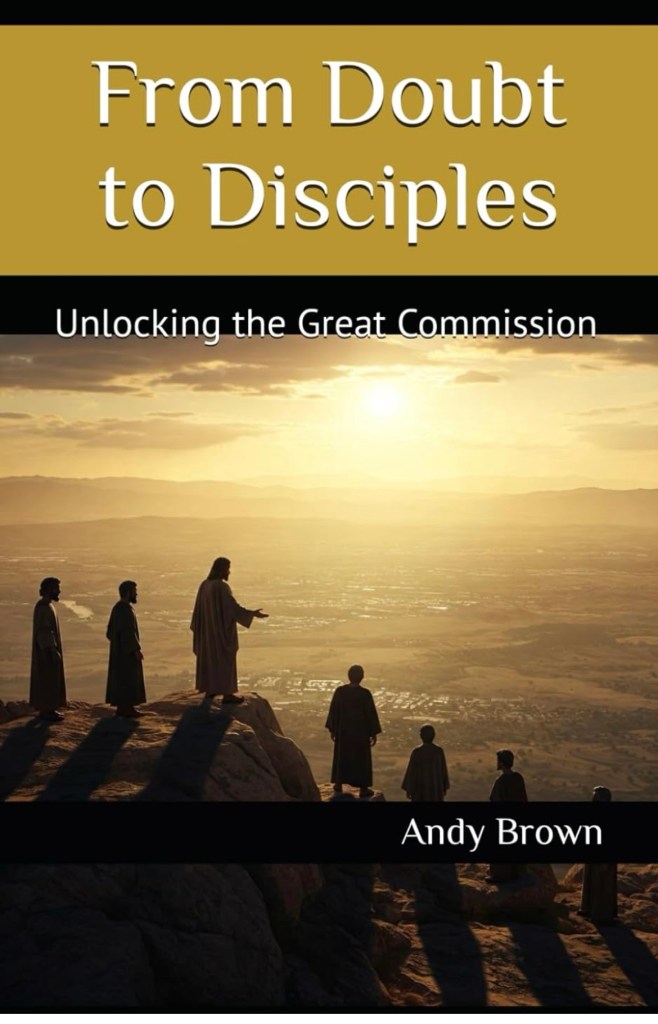
The front cover of Andy‘s new book… From doubt to disciples: unlocking the great commission. 

New Book Announcement! From Doubt to Disciples 

I am very excited to announce the publication of my second book! From Doubt to Disciples: Unlocking the Great Commission is now available on Kindle e-book and paperback from Amazon. 

A photograph of the book cover for From Doubt to Disciples: Unlocking the Great Commission by Andy Brown 

I began writing this little book a number of years ago, based on a series I had written on the blog about the Great commission. While the manuscript was mostly complete, it sat untouched for awhile… I like to think it was maturing! I was very pleased to complete the final edit and get it published this week!

With huge thanks to Andy B of the Berry Bunch and Pure 24/7 Radio, who kindly wrote the foreward for this book.

The book takes a deep dive into the words of the Great Commission which Jesus left us. the commission goes far beyond simply telling others about Jesus, although that is clearly a part of it.

To find out more, I guess you’ll have to read it…


From Doubt to Disciples on Amazon

Here is the blurb from the back cover:

Jesus’ final instructions weren’t just a suggestion – they were a commission. This book delves deep into the Great Commission as revealed in Matthew and Mark, culminating in the vital understanding from Acts: don’t go it alone. Explore the call to make disciples, baptise, and teach, and grasp the essential role of the Holy Spirit in fulfilling this monumental task. Discover how to move forward prayerfully and powerfully, playing your part in God’s enduring mission to the ends of the earth.

If you read and enjoy it, please do recommend to a friend or leave a review.

Finally, a massive thank you to everybody who follows this blog-sporadic as it is-and praise to the Lord Jesus Christ for all that he has done for us. 

Resurrection Sunday 

He is risen! Hallelujah!

This is just a brief post to wish you a very happy Easter, and praying God‘s blessings on you this resurrection Sunday.

I hope you get the opportunity to unite together with other believers or family to celebrate the risen Lord. Jesus‘s death and subsequent resurrection is the only true source of hope, and may you rejoice in that hope today in whatever you are doing.

Early on Sunday morning, while it was still dark, Mary Magdalene came to the tomb and found that the stone had been rolled away from the entrance. She ran and found Simon Peter and the other disciple, the one whom Jesus loved. She said, “They have taken the Lord’s body out of the tomb, and we don’t know where they have put him!”

John 20:1-2, NLT

In the confusion, they do not know what has happened and assume Jesus‘s body has been stolen. Yet later that same morning, Jesus-alive and well-appears to them. Death could not hold him! And if we place our trust in him, it cannot hold us either.

May the joy of this resurrection fill your heart.

And not to detract from the celebrations of this day, but I’m excited to be able to share some important news with you next week… All being well. Stay tuned for the blog for an upcoming announcement…

Have a blessed day! He is risen! 

From Secret Faith to Bold Devotion: John 19:38–42

Following Jesus’ crucifixion, John 19:38–42 describes the burial of His body, a moment of devotion amidst fear and uncertainty. This passage introduces Joseph of Arimathea and Nicodemus, two figures who step forward to honour Jesus in death. This study explores the significance of Jesus’ burial, Jewish customs, the garden tomb’s possible locations, and the disciples’ limbo, encouraging Christians to proclaim their faith boldly. The burial of Jesus reveals both human fear and profound devotion, pointing to the hope of resurrection.

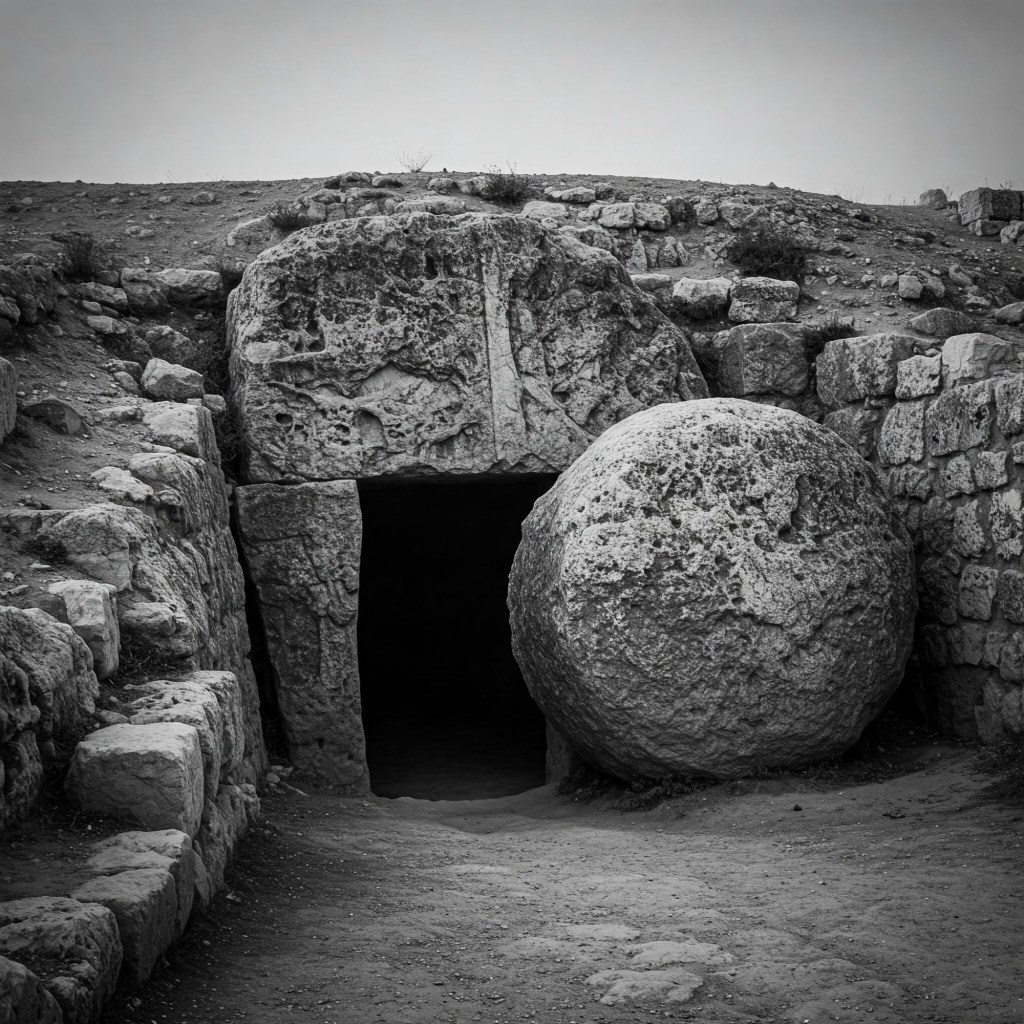
An AI generated image of the garden tomb in black-and-white set against grey sky. The entrance to the tomb is partially open, with a large stone across the right hand side of it. 

Here’s the passage in full : John 19:38–42 (ESV)

“After these things Joseph of Arimathea, who was a disciple of Jesus, but secretly for fear of the Jews, asked Pilate that he might take away the body of Jesus, and Pilate gave him permission. So he came and took away his body. Nicodemus also, who earlier had come to Jesus by night, came bringing a mixture of myrrh and aloes, about seventy-five pounds in weight. So they took the body of Jesus and bound it in linen cloths with the spices, as is the burial custom of the Jews. Now in the place where he was crucified there was a garden, and in the garden a new tomb in which no one had yet been laid. So because of the Jewish day of Preparation, since the tomb was close at hand, they laid Jesus there.”

Secret Disciples: Joseph and Nicodemus

Joseph of Arimathea, a wealthy member of the Sanhedrin, is described as a “secret disciple” of Jesus, concealing his faith due to fear of the Jews. His position in Jewish society made public allegiance to Jesus risky, potentially threatening his status and safety. Yet, in a bold act, Joseph approaches Pilate to request Jesus’ body, an action that could have exposed him to scrutiny. Similarly, Nicodemus, who previously visited Jesus at night (John 3:1–2), likely out of fear, joins Joseph in this act of devotion. He brings approximately seventy-five pounds of myrrh and aloes, an extravagant amount of spices, signaling his commitment. Their actions challenge modern Christians to examine their own faith. Many face pressure to hide their beliefs in hostile or secular environments. Rather than concealing faith, believers are called to proclaim it sensitively but unashamedly, as Jesus instructs in Matthew 5:16: “Let your light shine before others.” How can we move from secrecy to courageous witness in our daily lives?

Jewish Burial Customs in the Passage

In the first century, Jewish burial practices were rooted in respect for the deceased and adherence to purity laws. Deuteronomy 21:23 required prompt burial to avoid defilement, especially before the Sabbath. The body was typically washed, wrapped in linen cloths, and anointed with spices like myrrh and aloes to honor the deceased and mask the odour of decay. In John 19:38–42, Joseph and Nicodemus meticulously follow these customs. They wrap Jesus’ body in linen with the spices Nicodemus provides, a quantity far exceeding typical burials, reflecting deep reverence. Their care fulfills Isaiah 53:9, which prophesies the Messiah’s burial with the rich. This deliberate act underscores Jesus’ dignity, even in death.

The Garden Tomb: Location and Significance

John 19:41 describes the burial site as a new tomb in a garden, unused by anyone else. Joseph’s offering of his own tomb represents a personal sacrifice. Theologically, the tomb is a temporary resting place, foreshadowing the resurrection. Two possible locations in Jerusalem are associated with this site. The Garden Tomb, located north of the Damascus Gate, is favored by some Protestants for its serene, garden-like setting and rock-hewn tomb, fitting John’s description. Alternatively, the Church of the Holy Sepulchre, supported by early Christian tradition and archaeological evidence of first-century tombs, is widely accepted by Catholic and Orthodox traditions. If you would like my opinion, I favour the Garden Tomb location over the Holy Sepulchre .But I am no biblical archaeologist! 

Regardless of the exact site, the garden tomb invites believers to trust God’s redemptive plan, even in moments of apparent defeat.

The Disciples’ Limbo and Our Hope

For the disciples, Jesus’ death was a devastating blow. They believed Him to be the Messiah, yet witnessed His execution, leaving them in fear and confusion. Unaware of the resurrection to come, they faced a limbo of shattered hopes. Their vulnerability reflects the human struggle with uncertainty. In contrast, modern believers have the benefit of hindsight, knowing that Resurrection Sunday follows Good Friday. This perspective transforms despair into hope, as Paul writes in 1 Corinthians 15:20, describing Christ as “the firstfruits of those who have fallen asleep.” The disciples’ experience encourages Christians to hold fast to faith during trials, trusting that God’s plan unfolds according to his will. 

So what do we do? 

Joseph and Nicodemus, once secretive, acted with courage to honour Jesus in His burial. Their example challenges us to proclaim our faith boldly, even in difficult circumstances. We are called to trust in the resurrection hope, knowing that God’s victory overcomes life’s darkest moments.

The darkness of Friday has been and gone, and we find ourselves in the limbo of its aftermath. Fear not though, Sunday is coming…

The Cross and the Crown: Reflecting on John 19:17–24 This Good Friday

As Christians gather on this Good Friday, we pause to reflect on the sacrifice of Jesus Christ, the pivotal moment of our faith. John 19:17–24 captures the raw reality of the crucifixion, where Jesus is declared “King of the Jews” and His clothes are divided by soldiers. This passage reveals Jesus as the sovereign King of all, fulfilling ancient prophecies and completing His mission as the Savior of humanity. On this sacred day, we are called to marvel at His love and respond with heartfelt worship.

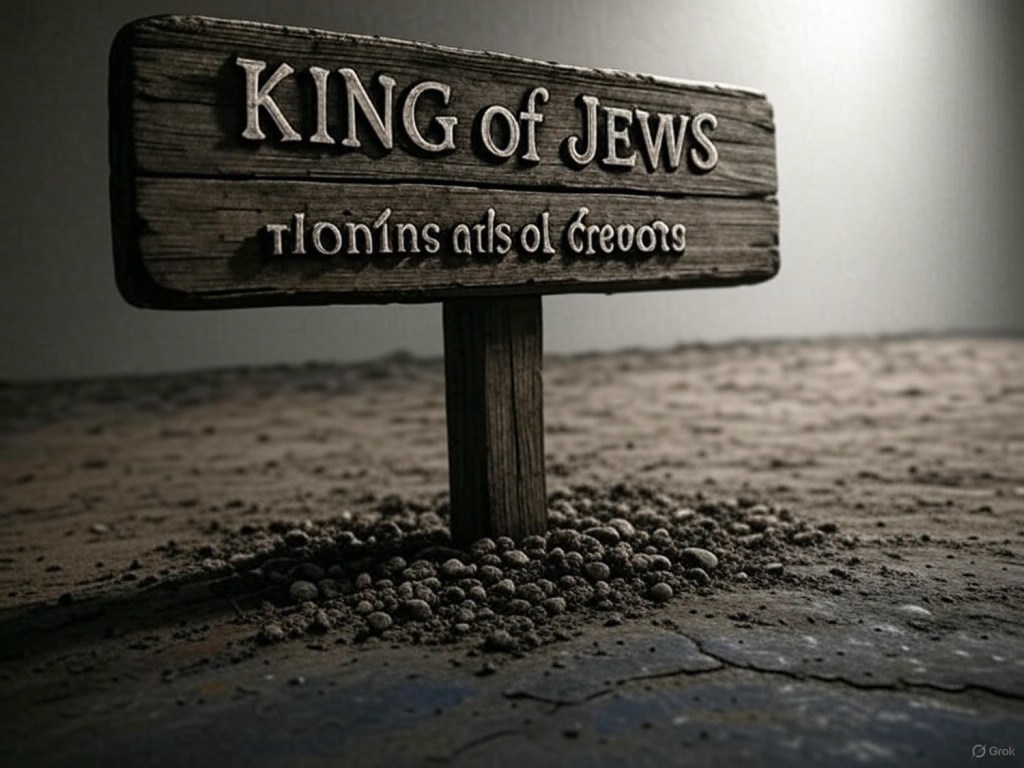
A wooden sign is planted in the ground, surrounded by small pebbles and dirt. The sign has the text “KING of JEWS” prominently displayed in large, bold letters. Below this, there is a line of text in a different script that reads ” πλοκίης αἰς οἱ ςρεοοης” which are random Greek letters for illustration . The background is a plain, slightly textured surface with a gradient of light and shadow.

Jesus: King of the Jews and King of All

John 19:17–19 recounts Jesus’ journey to the cross: “Carrying the cross by himself, he went to the place called Place of the Skull… There they nailed him to the cross… Pilate also had an inscription written and put on the cross. It read, ‘Jesus of Nazareth, the King of the Jews’” (NLT). The title “King of the Jews,” though meant as mockery by Pilate, proclaimed a profound truth. Despite opposition, Pilate refused to change the inscription (John 19:22), unwittingly affirming Jesus’ identity.

Jesus’ kingship transcends earthly boundaries. He is not only the King of the Jews but the “King of kings and Lord of lords” (Revelation 19:16, NLT). On the cross, His reign was established through sacrifice, challenging the powers of this world and offering hope to all who believe. Good Friday reminds us that Jesus’ kingship demands our allegiance. As Christians, we are called to live under His loving authority, trusting His sovereign plan even in the face of suffering.

The Soldiers and the Fulfillment of Prophecy

The scene at the cross continues in John 19:23–24: “When the soldiers had crucified Jesus, they divided his clothes among the four of them. They also took his robe, but it was seamless… So they said, ‘Rather than tearing it apart, let’s throw dice for it.’ This fulfilled the Scripture that says, ‘They divided my garments among themselves and threw dice for my clothing’” (NLT). This moment directly fulfills Psalm 22:18, written centuries earlier, proving Jesus as the promised Messiah.

This single fulfilled prophecy points to a greater truth: Jesus’ entire life and death align with God’s redemptive plan. From His birth in Bethlehem (Micah 5:2) to His suffering (Isaiah 53), Jesus fulfilled every Messianic prophecy, culminating in His sacrificial death. Good Friday marks the climax of His mission to save humanity, as He bore the weight of our sins on the cross. Even the soldiers’ callous actions, dividing His clothes, served God’s purpose, demonstrating His sovereignty over every detail. As we reflect on this, we stand in awe of Jesus’ obedience and God’s faithfulness.

Good Friday: The Weight and Wonder of the Cross

Good Friday is a day of somber reflection and profound gratitude.

Jesus’ death was the ultimate act of love, as He “gave his life to purchase freedom for everyone” (1 Timothy 2:6, NLT). John 19:17–24 anchors us in the reality of the cross—Jesus endured unimaginable pain to atone for our sins, fulfilling the Law and the prophets. His kingship, declared in the inscription, and His fulfillment of prophecy, seen in the soldiers’ actions, assure us of His victory over sin and death.

On this day, we are invited to pause and contemplate the cost of our salvation. The cross reveals both the depth of human sin and the boundless love of God. As we consider Jesus’ sacrifice, we find hope in His reign as King, knowing that His death was not the end but the beginning of eternal life for all who believe. Good Friday calls us to lift our eyes to the cross, where our Savior triumphed.

A Call to Worship

In response to Jesus’ kingship and sacrifice, our hearts turn to worship. Good Friday is a time to gather in worship services, pray, or meditate on Scripture, giving thanks for all Jesus has done. Reflect on His love, which led Him to the cross, and commit to living under His reign daily. Let this day inspire a life of worship, where every action honors Jesus as King and Savior. As Psalm 95:6 urges, “Come, let us worship and bow down. Let us kneel before the Lord our maker” (NLT).

Maundy Thursday and the Last Supper

On Maundy Thursday, we pause during Holy Week to reflect on the Last Supper, a sacred moment when Jesus shared a final meal with His disciples, instituted Holy Communion, and revealed Judas’ betrayal. This day, named from the Latin mandatum meaning “commandment,” centers on Jesus’ call to love one another (John 13:34). As we explore the events leading to this meal, the exposure of Judas’ intentions, and the origin of Communion, we deepen our understanding of Christ’s sacrifice and our calling as His followers. Grounded in Scripture, this reflection reminds us of the love and service at the heart of our faith.

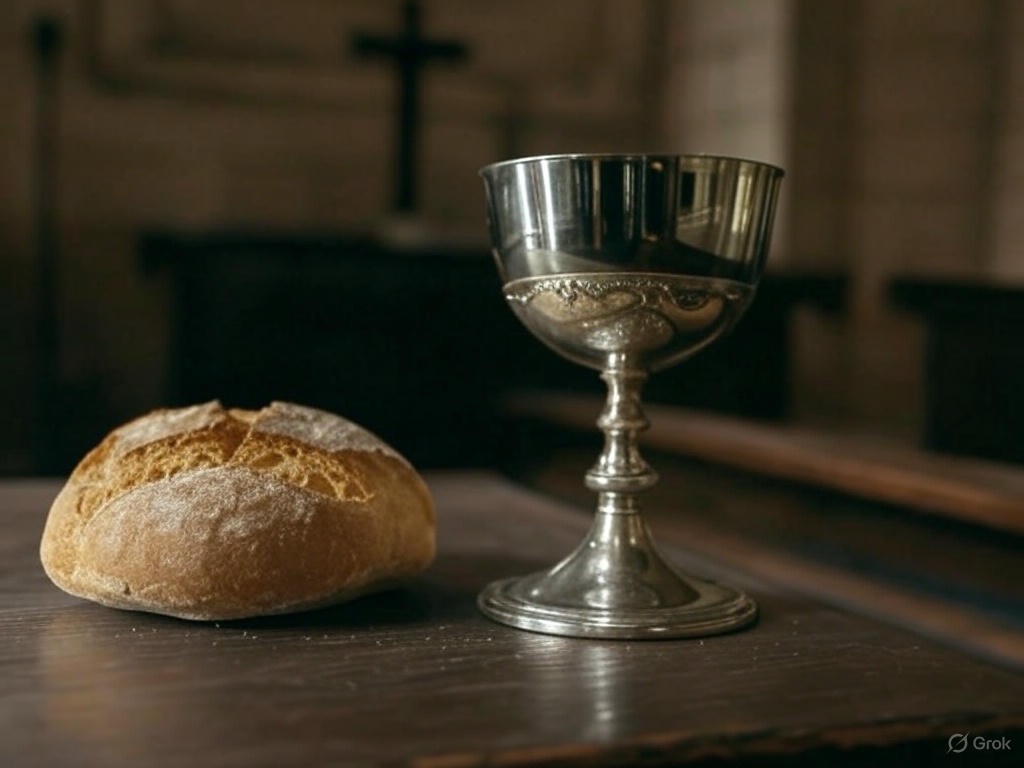
A close-up of a loaf of bread and a silver chalice depicting holy communion 

The Road to the Last Supper

Holy Week unfolds with events that prepare us for the Last Supper. On Palm Sunday, we recall Jesus’ triumphal entry into Jerusalem, greeted by crowds waving palm branches (Matthew 21:1-11). In the days following, He cleanses the temple (Matthew 21:12-13) and teaches parables, confronting religious leaders (Mark 11:27-12:44). These actions intensify opposition, as the chief priests and scribes plot to kill Him (Mark 14:1-2). Amid this tension, Jesus prepares for the Passover, the Jewish feast commemorating God’s deliverance of Israel from Egypt (Exodus 12:1-14).

Jesus instructs His disciples to arrange the meal in an upper room in Jerusalem (Luke 22:7-13). This setting, intimate and solemn, underscores the weight of the moment. Jesus knows His hour is near (John 13:1), and we should sense the gravity as He gathers with those He loves. The Passover meal becomes the backdrop for a new act of redemption, one that we commemorate to this day.

The Last Supper and Judas’ Betrayal

During the Last Supper, Jesus reveals a painful truth: one of His disciples will betray Him. John 13:21-30 captures this moment vividly:

“After he had said this, Jesus was troubled in spirit and testified, ‘Very truly I tell you, one of you is going to betray me.’ … When he had dipped the piece of bread, he gave it to Judas, the son of Simon Iscariot. As soon as Judas took the bread, Satan entered into him. So Jesus told him, ‘What you are about to do, do quickly.’ … As soon as Judas had taken the bread, he went out. And it was night.” (John 13:21, 26-27, 30, NIV)

Matthew’s account adds further clarity:

“And while they were eating, he said, ‘Truly I tell you, one of you will betray me.’ … Judas, the one who would betray him, said, ‘Surely you don’t mean me, Rabbi?’ Jesus answered, ‘You have said so.’” (Matthew 26:21, 25, NIV)

Jesus’ identification of Judas fulfills Old Testament prophecy, such as Psalm 41:9, which speaks of a trusted friend lifting his heel against another. By sharing bread with Judas, a gesture of fellowship, Jesus underscores the depth of the betrayal.

Judas does not leave of his own accord, but is called out in front of them all. It shows that the timing of these events were God ordained, and not planned by sinful humanity. Jesus was in full control. 

The Institution of Holy Communion

At the same meal, Jesus establishes Holy Communion, transforming the Passover elements into symbols of His sacrifice. Luke 22:19-20 records His words:

“And he took bread, gave thanks and broke it, and gave it to them, saying, ‘This is my body given for you; do this in remembrance of me.’ In the same way, after the supper he took the cup, saying, ‘This cup is the new covenant in my blood, which is poured out for you.’” (Luke 22:19-20, NIV)

Paul later affirms this practice, writing in 1 Corinthians 11:23-25:

“For I received from the Lord what I also passed on to you: The Lord Jesus, on the night he was betrayed, took bread, and when he had given thanks, he broke it and said, ‘This is my body, which is for you; do this in remembrance of me.’ In the same way, after supper he took the cup, saying, ‘This cup is the new covenant in my blood; do this, whenever you drink it, in remembrance of me.’”

Here, Jesus reinterprets the bread and wine. The bread represents His body, broken for our salvation; the wine signifies His blood, sealing the new covenant promised in Jeremiah 31:31-34. This act institutes Communion as a sacred rite, one we should observe to remember Christ’s sacrifice, experience His presence, and unite as His body. From the early church (Acts 2:42) to today, Communion remains central to our worship, a tangible reminder of God’s grace.

Moreover, the Last Supper foreshadows the cross. The bread and wine point to Good Friday, when Jesus’ body is broken and His blood is shed. As we participate in Communion, we proclaim His death until He returns (1 Corinthians 11:26). Maundy Thursday thus bridges the joy of Palm Sunday and the sorrow of Good Friday, preparing us for the glory of Easter.

A Time for Reflection

As we observe Maundy Thursday, we are called to reflect on Christ’s love, the cost of our redemption, and the pain of betrayal. The Last Supper invites us to the table, where we encounter Jesus’ sacrifice and receive His grace through Communion. We ought to examine our hearts, asking how we can love and serve as He did. Whether through attending a Maundy Thursday service or quietly meditating on these Scriptures, let us draw near to Jesus, who gave everything for us.

This day reminds us that even in the face of betrayal, Jesus chose love. May we, too, choose love, honoring Him in our worship and our lives.


Hope Beyond Judgement (Micah 4:1-8)

Introduction

Ever relied on a GPS, only to end up completely lost? My father-in-law did—he entered the wrong address in his sat nav and ended up driving around a residential estate looking for a major Metropolitan Hospital! I don’t know what he thought was going to happen – that he’d round the corner and suddenly find this huge hospital right there among the houses! Well, in Micah chapter 4, we round a metaphorical corner from chapters 1, 2, and 3. The stark warnings of sin and judgement vanish, and we find ourselves faced with this passage of hope.

I hesitated to tackle this Old Testament text—it’s challenging, and we often avoid these scriptures, instead favouring a New Testament epistle or a historical narrative or Psalm. In the book of Acts however, the apostles masterfully preached Christ using only the Old Testament, as it was the only Bible they had. This is a skill I fear we’ve largely forgotten.

Let’s explore Micah’s context, unpack this vision of hope, examine its interpretations, and consider what it means for us—sinners redeemed by grace. Here’s the passage:

Micah 4:1–8 (NIV):
“In the last days the mountain of the Lord’s temple will be established as the highest of the mountains; it will be exalted above the hills, and peoples will stream to it. Many nations will come and say, ‘Come, let us go up to the mountain of the Lord, to the temple of the God of Jacob. He will teach us his ways, so that we may walk in his paths.’ The law will go out from Zion, the word of the Lord from Jerusalem. He will judge between many peoples and will settle disputes for strong nations far and wide. They will beat their swords into plowshares and their spears into pruning hooks. Nation will not take up sword against nation, nor will they train for war anymore. Everyone will sit under their own vine and under their own fig tree, and no one will make them afraid, for the Lord Almighty has spoken. All the nations may walk in the name of their gods, but we will walk in the name of the Lord our God for ever and ever. ‘In that day,’ declares the Lord, ‘I will gather the lame; I will assemble the exiles and those I have brought to grief. I will make the lame my remnant, those driven away a strong nation. The Lord will rule over them in Mount Zion from that day and forever. As for you, watchtower of the flock, stronghold of Daughter Zion, the former dominion will be restored to you; kingship will come to Daughter Jerusalem.’”

The Dark Before the Dawn: Micah 1–3 and Historical Context

Picture Judah 2,700 years ago, dwarfed by the menacing Assyrian Empire, ready to strike. Micah, a prophet from rural Moresheth, spoke into this tension. His real alarm, though, was sin. Chapter 1 blasts the people for chasing idols over God—“Their rebellion is their ruin” (Micah 1:5–7). Sin estranges us too—dishonesty, selfishness, neglect. Chapter 2 exposes the wealthy exploiting the poor (2:1–2), while false prophets dismiss guilt (2:11). Chapter 3 condemns corrupt leaders, priests, and prophets, predicting Zion’s ruin (3:12). Sin pervades everything—we’re no exception, deserving judgment. Yet God pivots in chapter 4, offering hope through a Savior.

A Vision of Hope: Summary of Micah 4:1–8

Micah 4:1–8 bursts with promise. Verse 1 begins with “the last days”. To Micah, this is a time in the future and the debate about the “last days” goes on – are we in the last “last days” now? The temple’s mountain rises supreme—an idiom for God’s kingdom or sovereign rule—drawing a parallel to Daniel 2, and the Stone not cut with human hands, which grows to become a great mountain – God’s kingdom and rule.

In verse 2, Gentiles seek God’s ways, and His law flows out from Jerusalem. In verse 3, God resolves conflicts, and the famous picture of turning swords into plowshares is used—this passage a mirror of Isaiah 2:4 and scholars debate which came first. Each person rests “under their own vine and fig tree,” (v4) symbols of peace, secure and unafraid. Verse 5 tells us God’s people stay faithful despite others’ idols. Verses 6–7 depict God gathering the broken—lame, exiles—forming a strong nation under His eternal reign. The section closes with Jerusalem’s dominion returning, a watchtower looking over a flock. This hope, unearned by sinners, comes through a Messiah.

Interpreting the Promise: Major Viewpoints

What does this all mean? Let’s explore the major interpretations.

Jewish View
Jews see this as the Messianic Age—a future when a Davidic king restores Jerusalem’s glory (v. 7). Nations embrace God’s law (v. 2), war ceases (v. 3), and exiled Israel returns (vv. 6–8)—God’s peace through His rule, still awaited.

Christian View 1: Fulfilled in Christ
Some Christians argue Jesus fulfilled this. His cross conquered sin (Romans 3:23–24), making the church the exalted mountain (Acts 15:14–17). Peace begins now (Ephesians 2:14), welcoming the broken (Luke 4:18), with His kingdom launched at the resurrection (v. 8).

Christian View 2: Now and Not Yet
Others see a two-part story. The cross starts it—forgiveness today (1 John 1:8–9)—but Christ’s return completes it, ending war (Revelation 21:4). The church grows (v. 2), His reign maturing from hearts to all (v. 8).

Christian View 3: Millennial Kingdom
A third view expects Jesus to reign 1,000 years (Revelation 20:1–6). Jerusalem rises (v. 1), nations come (v. 2), peace reigns (v. 3), and the broken are restored (vv. 6–7) under His throne (v. 8).

Jews await a Messiah; Christians see Jesus—past, present, or future. Every Christian lens points to Him, our hope against sin through His cross or return.

Living the Vision Today: Practical Application

How do we respond? First, admit our sin. Like Judah—idolatry, greed, lust or whatever—we falter (Romans 3:10). Yet Christ’s cross redeems us (John 3:16). Only our God can transform the wickedness of sin (Micah 1-3) into the saving hope of Christ’s kingdom (Micah 4). We respond by trusting Him. We can’t save ourselves—it’s His gift (Ephesians 2:8–9). Rest in that cross—Jesus paid it all.

This is no mere nod to God – and it should turn our lives upside down. Many people say they believe in God or call themselves Christian, but are their lives surrendered fully to Jesus? The devil believes in God too right?

Conclusion

I have deliberately not pointed to one particular interpretation here, claiming it to be true. I will leave you to study that out for yourselves. However you interpret this prophecy though, I hope we can all agree it points to our hope in Christ. Let’s live like people who believe He will return one day, and perhaps soon.

Come Lord Jesus, come!

Quantum Quill

Over the last couple of weeks I have posted a movie review or two, and have also been writing about technology. I’ve decided to separate these posts out from this current blog for those who are not interested in that side of things.

For my usual Christian content, stay right here… But if you are interested in science-fiction, technology and AI then I encourage you to go here…

http://quantumquill.blog

Thank you for reading! 

Sci-fi Side Step: Transformers – Rise of the Beasts 

Continuing the theme of TV and movie reviews I kicked off last week, I thought I’d turn my hand to writing about Transformers: Rise of the Beasts. As a sci-fi fan with fond memories of watching the Transformers cartoon and animated movie as a boy—probably the peak of Transformers for me—I hoped this one might deliver. It didn’t. (I’ll be digging into plot details about particular characters, so if you don’t want to know what happens, watch the movie first.)

A TV on a wooden stand in front of a white wall 

This installment whisks us back to 1994, where Autobots tangle with a new threat: Scourge, a brutal enforcer for the world-devouring Unicron. Optimus Prime leads the charge, Bumblebee’s along for the ride, and a Transwarp Key holds the key to Earth’s fate. It’s the classic Transformers setup—robots, relics, and relentless stakes—but it left me feeling meh. I’ve caught a few of these films over the years, and this one blurred into the pack: loud, busy, and instantly forgettable. I walked away somewhat indifferent.

The visuals deliver what fans crave. Robots morph with a clang, cities quake under their weight, and the 90s retro vibe adds a nostalgic twist. I perked up for Mirage, the slick Porsche 911 Turbo who struts into the Autobot roster. I’ve always had a thing for Porsche sports cars, so his flashy flair and smooth moves were a rare jolt of joy. Seeing Optimus Prime and Bumblebee again felt like greeting old pals, but even their shine couldn’t shake the sameness of it all.

What dragged it down was its lack of bite. The villain, Scourge, is exactly like every other Transformers villain—a growling hulk with no real edge. He’s mean, he’s metal, but he’s nothing I haven’t seen before. The story chugs along on autopilot, piling on action without building tension or surprise. The one attempt to mix things up comes with the Maximals—animal-like robots led by Optimus Primal, a gorilla, and featuring Airazor, a hawk-type bird. It’s the really only stab at setting this apart from its predecessors, but it doesn’t add anything new—just more robots with a different look, slotted into the same old formula. Even the finale, where human hero Noah fuses with Transformer parts into an Iron Man-like superhero to fight Scourge, feels like a borrowed beat—less inspired than Tony Stark’s sleek ingenuity. I missed a hook to care about, something to lift it beyond the franchise’s usual roar.

One scene did linger: Bumblebee’s death and revival. Scourge takes him down early—a shock that lands hard—but an Energon burst later resurrects him in a blaze of hope. It struck me as a faint echo of Jesus—dying to save others, rising to turn the tide. In Scripture, Christ’s sacrifice and return redefine everything; here, it’s just a plot beat to cheer for. The movie doesn’t dwell on it, racing back to the chaos, but that flicker of meaning gave me pause in an otherwise forgettable blur.

As for content, it’s heavy on robot-on-robot violence—metal limbs clashing, sparks flying—and there’s the occasional profanity tossed in. From memory, it’s not too much to worry about otherwise; it’s standard blockbuster fare that leans hard into action over anything else. I took it in stride, though it’s not winning any awards for subtlety.

Optimus Prime still commands with that deep, noble voice, brought to life by Peter Cullen, who’s been voicing him consistently since that animated movie I loved as a boy—great to hear that continuity after all these years. Bumblebee’s scrappy charm endures, even after his brief exit. Mirage steals scenes with his Porsche swagger, but Scourge? He’s a blank slate of bad—forgettable as the humans scurrying around the edges. The whole thing feels like a rerun with a 90s playlist slapped on top.

So, Rise of the Beasts? It’s a polished shrug—decent if you’re hooked on Transformers, but it won’t sway the unconvinced. I didn’t dislike it; I just didn’t feel it. Mirage was a win, and that Jesus-parallel with Bumblebee stuck with me, but it’s not enough to call it special. It’s the same Transformers flick I’ve seen before, repackaged and fading fast from memory. Have you seen it? Drop a comment with your thoughts—I’d love to hear what you made of this one!

This Sunday at Church: Pray for the children whose parents are going through separation

This Sunday at Church: Pray for the children whose parents are going through separation.

This Sunday at Church: Pray for the children whose parents are going through separation

Sci-fi Side step: Halo, the TV show 

I’m venturing into new waters with this piece, shifting from my usual Bible-centered reflections to try my hand at TV critique. I don’t watch television often—life’s too full for that—so when I do, I’m hoping for something truly standout. Recently, I tuned into the Halo series on Netflix UK, and it left me with thoughts worth sharing. With a lifelong passion for science fiction and fond memories of playing the original Halo game on Xbox (though I never bothered with the sequels), this adaptation gave me plenty to chew on—both as a story and as a spark for bigger questions.

A television on a wooden stand in front of a white wall 

Set in the 26th century, Halo follows Master Chief John-117 as he leads humanity against the Covenant, a zealous alliance of alien races bent on our destruction—a premise that echoes the game’s core of a lone, armored hero standing tall. I’ve always been drawn to that idea, and it tugged at me as I watched. But while the concept hooked me, the show itself landed in a middling spot—not exceptional, yet not entirely skippable either, just hovering at “okay.” As I watched, I kept telling myself I’d give the next episode another try—one more chance to grab me—but it never quite did. I pressed on to the end, though it didn’t leave me itching to dive into more.

Visually, it’s a treat. The sleek ships, alien landscapes, and bursts of action deliver the polish you’d expect from a big-budget sci-fi effort. One standout for me was Cortana, Master Chief’s AI sidekick, whose sharp wit and surprising humanity won me over. In a genre where artificial intelligence often swings between savior or doom, she’s a refreshing take—showing the wonder of human creation without tipping too far. I found myself mulling over what we craft and its limits, even if the show doesn’t chase those threads far.

Where Halo stumbles, though, is in its pacing and depth. It drags at times, bogged down by a subplot that feels tacked on rather than essential, and I kept waiting for the tension to ramp up—only it never quite did. I couldn’t help comparing it to Disney’s The Mandalorian, another tale of a helmeted loner in a rough galaxy; while they share some DNA, Halo’s action lacks the same tight, thrilling pull. I also missed the Flood, those nightmarish parasites from the game, whose absence left the stakes feeling lower than they could’ve been.

Another character who caught my eye was Dr. Catherine Halsey. She’s complex—a woman who’ll use any means to achieve her goals, which might be noble in intent but get murky in practice. That tension between good aims and flawed paths intrigued me, reflecting how often life blurs those lines.

On content, Halo keeps it gritty but not over-the-top. There’s mild swearing and violence—fitting for a war-torn setting, though worth noting if you prefer gentler fare. It didn’t bother me much, but it’s not exactly cozy viewing either.

Master Chief himself offers the richest ground for reflection. Unmasked more than in the game I loved, he’s given a raw edge through Pablo Schreiber’s quiet, steady performance—a soldier hinting at something deeper, shifting from weapon to protector. It’s a thread I wanted more of, though the show stops short of diving in fully, leaving his arc dangling just out of reach.

So where does that leave Halo? It’s a mixed bag—a slick sci-fi romp that flirts with big ideas but doesn’t commit, fine for genre fans if you temper your hopes. For me, it didn’t hit the “really good” mark I crave when I carve out TV time, despite my nostalgia for the original game. Still, it sparked some pondering—about creation, rescue, and the stories we tell—and that’s worth something. I don’t wander into this space often, but maybe I’ll make it a habit, posting on Saturdays about TV or movies in this style. What do you think? Drop a comment—I’d love to hear if this detour resonates with you!

Finding balance and looking ahead-a quick update from me! 

I’m so sorry for not writing much lately. Life has taken a busy turn with a new job and a pretty demanding role. It’s kept me on my toes, and I’ve missed connecting with you all through these posts. The days seem to blur together with meetings, deadlines, and trying to keep up with everything. I’ve always loved sitting down to share thoughts on faith, life, and what God’s been teaching me, so this quieter spell on the blog has felt strange. Thanks for sticking with me through it—I’m hoping to find a better rhythm soon, though it might take a bit of juggling.

A cartoon character with a radio headphones on, a magazine in one hand and a laptop in the other. In the background you can see a busy commuter train and tall buildings 

In a few weeks, I’ve got the privilege of preaching at church on Micah chapter 4, and I’m really looking forward to it. It’s a powerful passage about God’s promise of hope and restoration, packed with vivid imagery and big ideas. Here’s a taste from the early part: “Now it shall come to pass in the latter days That the mountain of the Lord’s house Shall be established on the top of the mountains, And shall be exalted above the hills; And peoples shall flow to it. Many nations shall come and say, ‘Come, and let us go up to the mountain of the Lord, To the house of the God of Jacob; He will teach us His ways, And we shall walk in His paths.'” What a picture of unity and peace—a time when people from all over will come together to seek God and live in His ways. There’s so much in there to unpack, and what’s fascinating is how many different ways folks interpret it. Some see it as a literal future event, with a physical temple and nations streaming to Jerusalem. Others take it more symbolically, pointing to the church or even Christ’s ultimate reign. I’m excited to dig into those perspectives, wrestle with the text, and see where the Spirit leads. It’s a chance to explore what this hope means for us today—how we hold onto it amid our own challenges. Keep praying for God’s kingdom to come as I prepare!

On another note, don’t forget you can catch me every Thursday evening from 6 pm UK time on Pure 24/7 Radio for the 90s show. It’s a blast spinning those tunes—think Oasis, Spice Girls, and maybe a bit of Take That—and chatting about life and faith. There’s something special about music that takes you back, isn’t there? It’s a chance to unwind, reflect, and connect with listeners who share a love for the era. Tune in at pure247radio.org—I’d love to have you along for the ride. The team at Pure 24/7 does an amazing job, and it’s a privilege to be part of their lineup. Whether you’re driving home, cooking dinner, or just chilling out, it’s a great way to spend a couple of hours.

While you’re at it, check out Pure Media’s magazine. It’s a free monthly download packed with inspiring articles that I think you’ll enjoy. Grab it here: puremediafamily.com/magazine. They cover all sorts—faith, family, culture—and it’s a brilliant resource to keep you encouraged. One piece that stood out recently was an article on finding joy in tough seasons. It featured a story about a family navigating loss with faith and resilience, woven with practical tips and Scripture. It hit home for me, especially with the busyness I’ve been feeling, and I reckon it’d resonate with many of you too. The magazine’s got a knack for blending real-life experiences with hope, so it’s well worth a look.

I won’t promise I’ll be back writing loads soon—this job’s keeping me busy, and I’m still figuring out how to carve out time for everything. But I’ll definitely try. These posts are a way to process what’s on my heart and share it with you, and I don’t want that to slip away completely. Thanks for your support—it means a lot to know you’re reading, even when I’ve been quieter. You’re all in my prayers, and I’m grateful for this little community we’ve got here. Keep seeking Him, and maybe I’ll catch you on the radio or in the comments sometime soon!